For general questions, please send us a message and we’ll get right back to you. You can also call us directly to speak with a member of our service team or insurance expert.
If you are searching for an autism test for kids, chances are something has been on your mind lately. Maybe your toddler still isn’t talking much. Maybe your four-year-old lines up toys for hours but never looks at you when you call. Or maybe a teacher mentioned something at the last parent meeting, and you have been lying awake ever since.
First, take a breath. Noticing is not failing. It is actually the most important step. In this guide, we will walk you through what an autism test for kids really looks like, the early signs to watch for, and what to do next. We have also included practical views from our own specialists, Dr. Sugandha Gupta and Dr. Paramjeet Singh.
What Is an Autism Test for Kids?
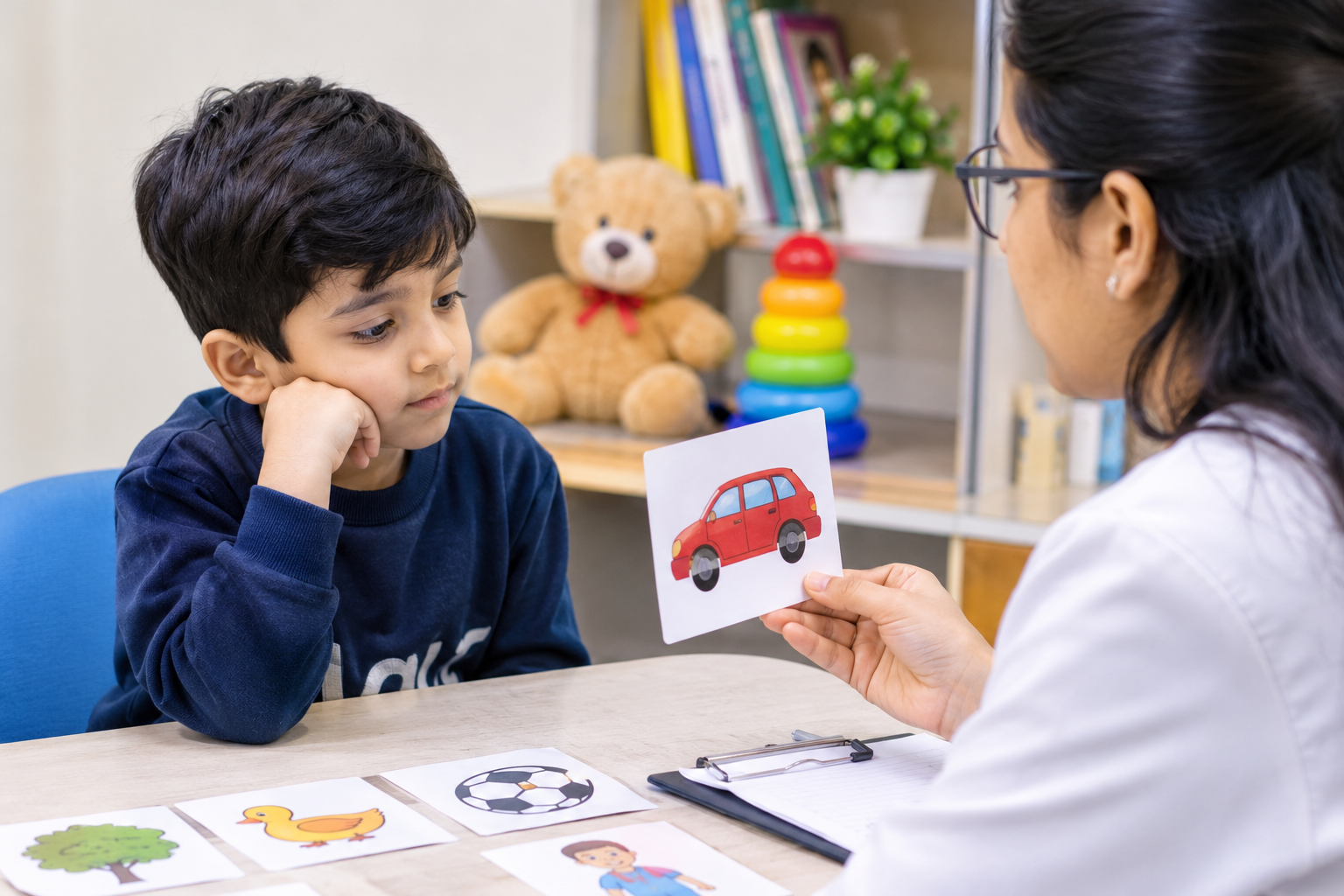
Here is the thing many parents don’t expect: there is no single blood test or scan that confirms autism. An autism test for kids is really a careful assessment. It combines parent interviews, direct observation of the child, play-based activities and standardised screening questionnaires.
Think of it less like an exam and more like a structured conversation, with toys involved.
The goal is simple. A specialist looks at how your child communicates, plays, reacts to people and handles everyday changes. Then they put the full picture together.
Why Early Screening Matters So Much
The brain of a young child learns and adapts at an incredible pace. When support begins early, children often make real gains in speech, social understanding and daily skills.
“Parents often tell us they waited because they were told, ‘He will talk when he is ready.’ Sometimes that is true. But when there are several signs together, waiting can cost valuable time. An early autism test for kids does not label your child. It simply opens the door to the right support.” – Dr. Sugandha Gupta
7 Early Signs That May Call for an Autism Test for Kids
Every child is different, and one sign alone does not mean autism. But if you notice several of these together, it is worth speaking to a specialist.
1. Limited or No Eye Contact
Your baby rarely looks at your face when you talk or smile. Older children may seem to look “through” people.
2. Not Responding to Their Name
By 9 to 12 months, most babies turn when they hear their name. If your child seems to ignore you even though their hearing is fine, mention it to a doctor.
3. Delayed Speech or Loss of Words
No babbling by 12 months, no single words by 16 months, or losing words they once used are all important flags.
4. Repetitive Movements or Play
Hand flapping, spinning, rocking, or lining up objects again and again can be signs, especially when the child gets upset if the pattern is disturbed.
5. Strong Reactions to Sounds, Lights or Textures
Some children cover their ears at the mixer-grinder or refuse certain clothes. Sensory differences are very common in autism.
6. Difficulty Playing with Other Children
Your child may prefer playing alone, or not show interest in pretend play like feeding a doll or talking on a toy phone.
7. Strict Need for Routine
A small change, such as a different route to school or a new cup, may trigger a big meltdown.
How Does an Autism Test for Kids Work? A Step-by-Step Look
Parents are often nervous about what happens inside the clinic. Here is what a typical assessment looks like.
Step 1: Parent Interview
The specialist asks about pregnancy, birth, milestones, sleep, eating, behaviour and family history. Be honest and detailed. There are no wrong answers.
Step 2: Screening Questionnaires
Quick tools such as the M-CHAT-R/F, designed for toddlers between 16 and 30 months, help flag children who need a deeper look. You can read about it on the official M-CHAT website. Remember, a screening is not a diagnosis.
Step 3: Play-Based Observation
The clinician plays with your child and watches how they respond to simple requests, shared attention, pretend play and turn-taking.
Step 4: Developmental and Hearing Checks
Sometimes delayed speech has other causes, such as hearing difficulty or a language delay. Ruling these out is part of a proper evaluation.
Step 5: Discussion and Plan
You receive a clear explanation, not just a report. If autism is identified, the plan may include speech therapy, occupational therapy, behavioural support and parent training.
Can You Do an Autism Test for Kids at Home?
Online checklists can help you organise your thoughts, and many parents find them a useful starting point. But they cannot replace a professional evaluation.
“A home checklist is like a smoke alarm. It tells you something deserves attention, but it cannot tell you what is happening in the room. Please do not self-diagnose, and please do not dismiss concerns because a checklist said ‘low risk’. Trust your instincts and get your child seen.” – Dr. Paramjeet Singh
At What Age Should You Consider an Autism Test for Kids?
Most specialists suggest watching development closely from 12 months. Routine developmental screening is often done around 18 and 24 months. However, an autism test for kids can be done at any age. Many children, especially girls and those with milder signs, are identified only at school age or even later.
So if your child is 6, 9 or 12 and you are still wondering, it is not too late.
What If the Result Says Autism? Common Parent Worries
Hearing the word “autism” can feel heavy. Many parents feel fear, guilt or confusion. Please know that this is a normal reaction.
A few reassuring points from our team:
Autism is not caused by bad parenting.
It is a difference in how the brain develops, and every child has unique strengths.
With the right therapies and a supportive home, many children learn to communicate, make friends and grow in confidence.
“The most powerful part of therapy is the parent. When families understand their child’s way of seeing the world, progress often follows. We always remind families that a diagnosis is a starting point, not a limit.” – Dr. Sugandha Gupta
Tips for Parents Before the Appointment
Note down the specific behaviours you have seen, with examples.
Record short videos of your child at home, playing and speaking.
Bring previous medical, school or therapy reports.
Keep your child fed and rested before the visit.
Come with questions. No question is silly.
When Should You Book an Autism Test for Kids?
Consider booking an evaluation if your child:
Has no words by 16 months or no two-word phrases by 24 months
Has lost skills they previously had
Avoids eye contact or play with others
Shows intense repetitive behaviours or extreme distress with change
Has a sibling with autism, which raises the likelihood
“If you are asking whether you should go, that itself is usually reason enough to have a conversation with a specialist. The worst outcome of an assessment is clarity. The best outcome is early help.” – Dr. Paramjeet Singh
Final Thoughts
An autism test for kids is not about finding something wrong. It is about understanding your child better so you can support them in the way they need. The earlier you start, the more time your child gets to thrive.
The history of autism is a story of curiosity, misunderstanding, and, finally, compassion. For more than a century, doctors, researchers, and families have worked to understand why some people experience the world differently. Today, we know autism as a lifelong neurodevelopmental difference. But that understanding took many decades to build.
At Delhi Mind Clinic, parents often ask us, “Is autism new?” or “Why do we hear about it so much more now?” The answer lies in the history of autism itself. In this guide, we walk through seven major milestones, bust a few myths, and share what our experts, Dr. Sugandha Gupta and Dr. Paramjeet Singh, want every family to know.
Quick Answer: Autism was first named in the early 1900s, described as a distinct condition in the 1940s, and officially recognised as a spectrum in 2013. Our understanding has changed enormously since then.
What Is Autism? A Brief Overview
Before exploring the history of autism, let us define it. Autism spectrum disorder (ASD) is a neurodevelopmental condition. It affects how a person communicates, interacts with others, and processes sensory information.
It is called a “spectrum” because every person is different. Some individuals need significant daily support. Others live independently and have remarkable strengths in areas like memory, pattern recognition, or creativity.
Autism did not suddenly appear in the 20th century. Historians believe that people with autistic traits have always existed. Old records describe individuals who were deeply focused on particular interests, spoke very little, or behaved in ways that communities found unusual.
However, without a medical term, these individuals were often misunderstood. Many were labelled with unrelated conditions. Others were simply described as “odd” or “different.” This lack of language is an important part of the early history of autism.
history of autism
Milestone 1: 1911 – The Word “Autism” Is Born
The word itself comes from the Greek word autos, meaning “self.” In 1911, Swiss psychiatrist Eugen Bleuler used the term “autism” while describing withdrawal from the outside world in adults with schizophrenia.
This early meaning was very different from how we use the word today. Still, it marks the first step in the history of autism as a named concept.
Milestone 2: 1943 – Leo Kanner’s Groundbreaking Study
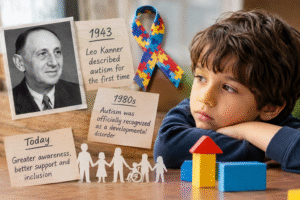
In 1943, American child psychiatrist Leo Kanner published a landmark paper describing eleven children. These children showed strong difficulty connecting with others, a need for sameness, and unusual responses to their surroundings.
Kanner called the condition “early infantile autism.” Most experts agree that this paper is the true starting point of the modern history of autism as a clinical condition.
Milestone 3: 1944 – Hans Asperger’s Parallel Work
At almost the same time, Austrian paediatrician Hans Asperger described a group of children with strong verbal skills but marked social difficulties. His work was written in German and remained unknown to the English-speaking world for decades.
Later research, including historical studies published in 2018, raised serious questions about Asperger’s wartime role. Because of this, many clinicians now prefer the broader term “autism spectrum disorder” over “Asperger syndrome.”
Milestone 4: The 1950s–1960s – A Dark Chapter of Myths
An honest history of autism must include its painful mistakes. For several years, some experts wrongly believed that cold or distant parenting caused autism. This idea, often called the “refrigerator mother” theory, placed enormous blame and guilt on mothers.
This theory was completely incorrect. In 1964, psychologist Bernard Rimland challenged it in his book Infantile Autism, arguing that autism has biological roots. His work, along with growing parent advocacy, helped change the direction of research.
Dr. Paramjeet Singh shares: “Even today, I meet parents who quietly carry guilt, wondering if they did something wrong. The history of autism clearly shows that blaming parents was a scientific error. Autism is not caused by poor parenting. Families need support, not judgement.”
Milestone 5: 1980 – Autism Gets an Official Diagnosis
In 1980, autism was formally included in the American Psychiatric Association’s diagnostic manual (DSM-III) as a separate condition. Before this, many children were wrongly grouped under childhood schizophrenia.
This change was a turning point in the history of autism. It gave clinicians a common language, helped researchers study autism properly, and opened the door to services in schools and clinics.
Milestone 6: 1981 and the 1990s – The Spectrum Idea Grows
In 1981, British psychiatrist Lorna Wing introduced the idea that autistic traits exist across a wide range. She helped popularise the term “Asperger syndrome” in English and shaped the modern “spectrum” concept.
During the 1990s, diagnostic criteria widened, and awareness grew rapidly. More children, including girls and those with milder presentations, began to be identified. This is one reason why diagnosis numbers have increased over time.
Milestone 7: 2013 – One Spectrum, One Diagnosis
In 2013, the DSM-5 merged several separate labels into a single diagnosis: autism spectrum disorder. Doctors now describe each person’s support needs in areas such as social communication and repetitive behaviours.
Many parents worry that autism is “increasing.” Looking at the history of autism helps explain this. Several factors play a role:
Better awareness: Parents and teachers now recognise early signs.
Wider criteria: The spectrum approach includes more people.
Improved screening: Paediatric check-ups now include developmental questions.
Reduced stigma: Families are more willing to seek help.
Dr. Sugandha Gupta explains: “When we study the history of autism, we see that these children were always there. What has changed is our ability to notice, understand, and support them. Early identification gives a child the best chance to build communication and confidence.”
How Autism Care Has Changed Over Time
The history of autism also shows a major shift in how we support people. Decades ago, many individuals were placed in institutions. Today, care focuses on understanding the whole person.
Modern support commonly includes:
Early developmental assessment by a qualified specialist.
Speech and communication support tailored to the child.
Occupational and sensory-based activities to help with daily skills.
Behavioural and social skills guidance for children and families.
Inclusive education plans that respect the child’s learning style.
Parent counselling so families feel confident and supported.
Every plan should be personalised. There is no single approach that fits all.
The Neurodiversity Movement: A New Chapter
One of the most hopeful chapters in the history of autism began in the 1990s. Autistic self-advocates, including author and speaker Temple Grandin, began sharing their own voices. The neurodiversity movement encouraged society to see autism as a natural variation of the human brain, not simply something to be “fixed.”
Dr. Paramjeet Singh adds: “Today, our goal is not to make a child ‘normal.’ Our goal is to help each child communicate, learn, and enjoy life in their own way. Respecting strengths is just as important as addressing challenges.”
Common Myths the History of Autism Has Corrected
Myth: Bad parenting causes autism. Fact: It does not.
Myth: Autistic people have no feelings. Fact: Many feel deeply but express emotions differently.
Myth: Autism only affects boys. Fact: Girls are often diagnosed later because their signs can be subtle.
Myth: Autism can be “outgrown.” Fact: Autism is lifelong, but support can make a real difference.
When Should You Seek an Evaluation?
Knowing the history of autism is helpful, but acting early is even better. Consider speaking with a specialist if your child:
Does not respond to their name by 12 months
Has limited eye contact or shared smiles
Shows delayed speech or loses previously gained skills
Strongly resists changes in routine
Is very sensitive to sounds, textures, or lights
These signs do not always mean autism, but a professional assessment can bring clarity and peace of mind.
Final Thoughts: Learning From the History of Autism
The history of autism reminds us how far we have come, from confusion and blame to science, empathy, and inclusion. There is still more to learn, but one lesson is clear: understanding leads to better support.
If you have concerns about your child’s development or want guidance as a family, our team is here to help. Book a consultation with Dr. Sugandha Gupta or Dr. Paramjeet Singh at Delhi Mind Clinic and take the first step with confidence.
Frequently Asked Questions
Who first discovered autism? Eugen Bleuler first used the word in 1911, while Leo Kanner described autism as a distinct condition in children in 1943.
Is the history of autism the same as the history of Asperger syndrome? No. Asperger syndrome was described separately in 1944 and is now included within autism spectrum disorder.
Can autism be detected early? Yes. Many signs can be noticed in the first two years of life, and early assessment is encouraged.
Autism has been all over the news lately, and a lot of what’s circulating on WhatsApp and Instagram is plain wrong. One viral claim says the Supreme Court has “banned autism diagnosis.” It hasn’t.
We’ve had worried parents calling the clinic about this for weeks, so let’s clear it up.
What Did the Supreme Court Actually Say About Autism?
On January 30, 2026, the Supreme Court of India decided a case called Yash Charitable Trust & Ors. v. Union of India. The case was about clinics offering stem cell “therapy” for autism.
The court said this treatment can’t be offered as a regular clinical service. It is allowed only inside approved clinical trials. The reason is simple: there isn’t enough scientific proof that it is safe or that it works.
The judges also pointed out that unproven treatments had spread for years because nobody stepped in. Families paid a lot of money and got very little in return.
autism and the supreme court ruling
Is Autism Diagnosis Banned? No.
This is truth number one, and it matters most.
Nothing in the ruling stops a child, teenager or adult from being assessed. Nothing stops speech therapy, occupational therapy, special education or counselling either. The judgment is aimed at one thing: unproven stem cell procedures sold as treatment.
Since then, the Health Ministry has asked States and Union Territories to make sure the directions reach every clinic involved. The Supreme Court has also asked the Centre for a report on how well they’re being followed.
Why Stem Cell Therapy for Autism Was Restricted
Here are the other truths in short:
There is no cure for autism. It isn’t an illness in the usual sense. It’s a different way the brain develops.
Expert reviews found weak evidence. National scientific bodies looked at the research and weren’t convinced.
Costs can be enormous. Many families spend lakhs, sometimes on loans.
Delay is the hidden cost. Months spent chasing a “miracle” are months without proven support.
That last one worries us the most.
What Our Doctors Say About the Ruling
We asked two of our team members for their thoughts.
“Parents come to me exhausted and hopeful, and I never want to take that hope away. But I also won’t pretend a shortcut exists. The strongest results I see in autism come from starting early, staying consistent, and involving the whole family. This ruling pushes people toward honest care, and I think that’s a good thing.”
“When a child is diagnosed, the first question is almost always ‘Can this be fixed?’ I tell families that the goal is helping the child communicate, learn and feel secure. Any treatment should come with evidence and ethical oversight. If someone promises guaranteed results, please pause and get a second opinion.”
Early Signs of Autism Parents Shouldn’t Ignore
You know your child best. Some things worth noticing:
Not responding when called by name
Little or no eye contact
Delayed speech, or losing words they once had
Lining up toys instead of playing with them
Strong distress over small changes in routine
Unusual reactions to noise, lights or textures
One sign alone doesn’t mean anything. A few together are a reason to book an assessment.
What Real Autism Support Looks Like
Good support is usually unglamorous. It looks like:
Speech and language therapy
Occupational therapy for sensory and daily-living skills
Behavioural and developmental programmes matched to the child
Parent coaching, so progress continues at home
School support and inclusion planning
Help with sleep, anxiety or attention, guided by a qualified doctor
Plans change as children grow. That’s normal.
Questions to Ask Before Starting Any Autism Treatment
Before you pay for anything, ask:
Do recognised medical bodies recommend it?
Is it part of an approved trial?
Does the provider promise a cure or guaranteed results?
Search for a famous person with autism and you’ll find far more than trivia — you’ll find proof that autism doesn’t limit what a person can achieve. Autism Spectrum Disorder (ASD) affects how a person communicates, processes information, and experiences the world, but it says nothing about a person’s potential, creativity, or capacity to succeed.
Every well-known famous person with autism featured in this list has, at some point, shared their journey publicly — helping break stigma, spread awareness, and remind us that neurodiversity is simply another way of thinking, not a limitation.
In this blog, we explore the inspiring stories of a famous person with autism from different fields — science, film, music, and activism — and what their achievements teach us about acceptance, strength, and human potential.
What Does It Mean to Be a Famous Person With Autism?
Being a famous person with autism means living publicly with a developmental condition that affects social communication, behavior, and sensory processing — while still reaching the very top of your field. Autism is called a “spectrum” because it looks different in every individual. Some people need significant daily support, while others live fully independent lives, pursue careers, and become household names.
Understanding this spectrum matters before we look at these famous names, because it shows just how diverse and multi-dimensional autism truly is.
5 Examples of a Famous Person With Autism
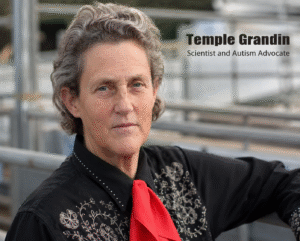
1. Temple Grandin — Scientist and Autism Advocate
Dr. Temple Grandin is perhaps the most recognized famous person with autism in the world. Diagnosed with autism as a child, she went on to become a professor of animal science and a global speaker on autism awareness. Her ability to “think in pictures” helped her revolutionize humane livestock handling systems used worldwide. Temple often says autism gave her a unique way of understanding the world — not a barrier to succeeding in it.
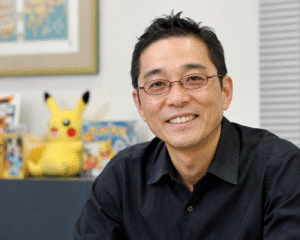
2. Satoshi Tajiri — Creator of Pokémon
The mind behind one of the most beloved franchises in gaming history, Satoshi Tajiri, has spoken about childhood traits associated with autism, including his intense, singular focus on collecting insects — a passion that later inspired the concept of “catching” and collecting creatures in Pokémon.
3. Daryl Hannah — Actress
Known for her roles in Splash and Blade Runner, Daryl Hannah is a famous person with autism who has spoken publicly about being diagnosed as a child. She has described how it once made red carpets and interviews overwhelming, yet it never stopped her from building a successful career in Hollywood.
4. Anthony Hopkins — Academy Award-Winning Actor
Sir Anthony Hopkins revealed later in life that he has Asperger’s syndrome, a term historically used to describe autism without significant language delay. Despite early struggles in school, Hopkins became one of the most celebrated actors of his generation, known for his intense focus and dedication to his craft.
5. Everyday Heroes You Won’t Find in the Headlines
For every well-known famous person with autism, there are countless individuals who quietly excel in their own lives — as engineers, artists, teachers, entrepreneurs, and parents. Fame is not a requirement for success. Every person on the spectrum has the potential to lead a fulfilling, meaningful life with the right understanding and support.
What a Famous Person With Autism Teaches Us
Autism is a spectrum, not a single story. Every individual experiences it differently.
Strengths often accompany challenges. Many people with autism display remarkable focus, memory, pattern recognition, and creativity.
Early support matters. Timely evaluation and the right guidance can help individuals build on their strengths from a young age.
Representation reduces stigma. When a famous person with autism speaks openly, it helps families and individuals feel less alone in their journey.
Supporting a Loved One Who May Be on the Spectrum
If you suspect that your child, or someone close to you, may be showing early signs of autism, it’s natural to feel uncertain about the next steps. Seeking a professional evaluation early can make a significant difference in how a person learns to navigate the world, build social connections, and use their natural strengths — the same strengths that helped every famous person with autism on this list thrive.
AtDelhi Mind Clinic, our team of experienced mental health professionals offers compassionate, evidence-based evaluation and support for children and adults on the autism spectrum. We believe every individual deserves an environment where their unique way of thinking is understood — not judged.
The story of every famous person with autism on this list proves one thing clearly: a diagnosis does not define a person’s ceiling. With acceptance, the right support system, and an environment that values neurodiversity, individuals with autism can — and do — achieve extraordinary things.
If you have questions about autism or want to understand more about evaluation and support options, reach out to Delhi Mind Clinic — because every mind, famous or not, deserves to be understood.
Autism Spectrum Disorder (ASD) is a complex neurodevelopmental condition that affects communication, behavior, and social interactions. As research in genetics has advanced, many wonder: is autism a genetic disorder? In this article, we’ll explore the connection between autism and genetic factors, as well as the roles that environmental influences play in ASD. By understanding these influences, we can better support individuals with autism and their families.
What is Autism Spectrum Disorder?
Autism Spectrum Disorder is a lifelong condition that varies significantly among individuals. Those with ASD may face challenges in communication, social interactions, and behavior. But is autism a genetic disorder solely, or do other factors contribute? Examining genetic and environmental factors helps us understand autism more comprehensively, improving diagnosis and intervention options.
For those seeking the best Autism treatment, consider visiting:
Genetics plays a substantial role in autism, although it is not the sole cause. Research indicates that autism is linked to genetic and environmental factors combined. Studies show that autism can run in families, suggesting a hereditary component. This genetic influence has led many to ask, is autism a genetic disorder, or do other factors play an equally important role? For further information on autism, you can visit Autism Research Institute (ARI)
2. Insights from Twin and Family Studies
Twin and family studies provide strong evidence that autism has genetic components. Identical twins, for example, have a significantly higher chance of both being diagnosed with autism compared to fraternal twins. This trend suggests that genes contribute notably to ASD. Similarly, siblings of individuals with autism are more likely to receive an ASD diagnosis than those in the general population, which further supports a familial link.
3. Genes Associated with Autism
Twin and family studies provide compelling evidence for a genetic link to autism. For example, identical twins have a significantly higher probability of both having autism compared to fraternal twins. This fact suggests that genes play a critical role in ASD. Additionally, siblings of individuals with autism are more likely to receive an ASD diagnosis than those in the general population, further pointing to a familial, genetic connection.
4. Environmental Factors and Autism
While genetics plays a key role, environmental factors also contribute to autism risk. Prenatal factors, such as the mother’s health, exposure to certain toxins, and even infections during pregnancy, may increase the likelihood of ASD. These environmental factors interact with genetic predispositions, suggesting that both genes and the environment are important in understanding autism. For further information on autism, you can visit National Institute of Mental Health (NIMH)
5. The Role of Genetic Testing in Autism
As more genes associated with autism are identified, genetic testing has become a valuable tool for understanding ASD risk. Although genetic tests cannot confirm autism, they may reveal certain genetic markers linked to ASD. Such insights can assist families in accessing early interventions and tailoring support based on risk factors, ultimately enhancing the quality of care and life for individuals with autism.
Conclusion
Is autism a genetic disorder? The answer is complex: genetics certainly play a major role, but they are not the only factor. Autism arises from a mix of genetic predispositions and environmental influences. As we continue to learn more, our understanding of autism’s causes will improve, potentially leading to better support systems and interventions for those with ASD.
So, is autism a genetic disorder? The answer is complex. Genetics certainly play a major role, but they are not the only factor. Autism arises from a combination of genetic predispositions and environmental influences. As research continues to unfold, our understanding of autism’s causes will improve, potentially leading to enhanced support systems and more effective interventions. For further information on autism, you can visit Centers for Disease Control and Prevention (CDC) .
Hand flapping in autism is a common behavior observed in individuals with autism spectrum disorder (ASD) and is often one of the early signs that parents or caregivers notice. While it may seem unusual to those unfamiliar with autism, hand flapping serves different purposes for individuals with autism, often as a way of expressing feelings or regulating sensory experiences. In this guide, we’ll explore what hand flapping in autism means, its potential causes, and effective strategies to support individuals who display this behavior.
What is Hand Flapping Autism?
Hand flapping in autism, often categorized as a “stimming” or self-stimulatory behavior, involves quick, repetitive hand movements. This behavior can be a natural way for individuals with autism to express excitement, cope with stress, or regulate sensory input. Although it may draw attention in public settings, understanding the comfort hand flapping brings to those with autism is essential.
For those seeking the best Autism treatment, consider visiting:
Why Do Individuals with Autism Engage in Hand Flapping?
The reasons behind hand flapping autism can vary greatly, but several factors often contribute to this behavior:
1. Sensory Regulation
Individuals with autism frequently experience heightened sensory sensitivities, meaning they perceive sounds, lights, and textures more intensely than others. Hand flapping autism can be a way to manage these sensory experiences, providing a form of sensory regulation, like how a deep breath can calm an anxious mind.
2. Emotional Expression
Hand flapping autism often acts as an emotional outlet, helping individuals convey feelings such as excitement, anxiety, or frustration. The repetitive motion can provide relief, like shaking a soda can before popping it open—without the release, it can feel overwhelming.
3. Communication Aid
For non-verbal individuals or those with limited communication abilities, hand flapping autism may serve as a form of self-expression. It’s one way to convey feelings or needs when verbal communication presents challenges, akin to using gestures when words fail.
When is Hand Flapping in Autism Considered a Red Flag?
Hand flapping autism alone does not necessarily signal autism. However, if it occurs alongside other symptoms, it may indicate autism spectrum disorder. Some potential red flags to watch for include:
Limited eye contact
Delayed language development
Preference for routines and resistance to change
Recognizing these signs can encourage parents and caregivers to seek early intervention, which can significantly improve support and developmental outcomes. For more details on autism screening and diagnosis, refer to resources from the Centers for Disease Control and Prevention (CDC).
How Can Caregivers Support Children with Hand Flapping in Autism?
1. Encourage Alternative Stimming Options
Offering tools such as sensory toys or stress balls can help manage hand flapping autism while still allowing individuals to self-regulate. By providing alternatives, caregivers can meet sensory needs in various ways, like replacing a fidget spinner for someone who flaps their hands.
2. Positive Reinforcement
Encouraging alternative behaviors or forms of expression can reduce the frequency of hand flapping autism if it causes social or personal difficulties. Positive reinforcement, such as praise or small rewards, can gently guide the behavior without suppressing natural instincts.
3. Occupational Therapy
Occupational therapists specialize in helping individuals develop skills and coping strategies to manage stimming behaviors. For individuals with autism, therapies can be particularly helpful in adapting to new environments and addressing sensory needs constructively. For more information, visit the National Institute of Mental Health (NIMH).
4. Provide a Safe and Supportive Environment
Creating an understanding and accepting space where hand flapping autism is acknowledged as part of the individual’s experience is crucial. Educating family members, peers, and teachers about this behavior can foster greater inclusion and reduce judgment.
Is Hand Flapping in Autism a Behavior That Needs to Be Stopped?
Many parents wonder if they should work to eliminate hand flapping autism in their child. Generally, it’s not necessary to stop this behavior unless it interferes with daily activities or poses a risk. Hand flapping in autism often helps individuals feel at ease, much like how a comforting blanket can soothe a restless child. Rather than suppressing this behavior, finding a balance that includes sensory regulation tools and therapeutic support can be more effective.
Conclusion
Hand flapping autism is a natural and often beneficial behavior that aids in sensory management and emotional expression. While it may attract attention in public, it’s essential to approach it with understanding and support rather than judgment. By recognizing the reasons behind hand flapping autism and providing alternative support options, caregivers can create a positive environment that fosters growth and self-regulation.
For additional resources on autism spectrum disorder and related behaviors, consider consulting the Autism Society, which offers information on autism signs, therapies, and support for families.