For general questions, please send us a message and we’ll get right back to you. You can also call us directly to speak with a member of our service team or insurance expert.
The history of autism is a story of curiosity, misunderstanding, and, finally, compassion. For more than a century, doctors, researchers, and families have worked to understand why some people experience the world differently. Today, we know autism as a lifelong neurodevelopmental difference. But that understanding took many decades to build.
At Delhi Mind Clinic, parents often ask us, “Is autism new?” or “Why do we hear about it so much more now?” The answer lies in the history of autism itself. In this guide, we walk through seven major milestones, bust a few myths, and share what our experts, Dr. Sugandha Gupta and Dr. Paramjeet Singh, want every family to know.
Quick Answer: Autism was first named in the early 1900s, described as a distinct condition in the 1940s, and officially recognised as a spectrum in 2013. Our understanding has changed enormously since then.
What Is Autism? A Brief Overview
Before exploring the history of autism, let us define it. Autism spectrum disorder (ASD) is a neurodevelopmental condition. It affects how a person communicates, interacts with others, and processes sensory information.
It is called a “spectrum” because every person is different. Some individuals need significant daily support. Others live independently and have remarkable strengths in areas like memory, pattern recognition, or creativity.
Autism did not suddenly appear in the 20th century. Historians believe that people with autistic traits have always existed. Old records describe individuals who were deeply focused on particular interests, spoke very little, or behaved in ways that communities found unusual.
However, without a medical term, these individuals were often misunderstood. Many were labelled with unrelated conditions. Others were simply described as “odd” or “different.” This lack of language is an important part of the early history of autism.
history of autism
Milestone 1: 1911 – The Word “Autism” Is Born
The word itself comes from the Greek word autos, meaning “self.” In 1911, Swiss psychiatrist Eugen Bleuler used the term “autism” while describing withdrawal from the outside world in adults with schizophrenia.
This early meaning was very different from how we use the word today. Still, it marks the first step in the history of autism as a named concept.
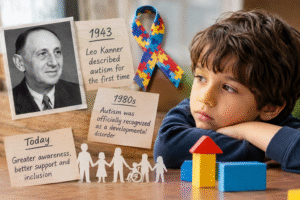
Milestone 2: 1943 – Leo Kanner’s Groundbreaking Study
In 1943, American child psychiatrist Leo Kanner published a landmark paper describing eleven children. These children showed strong difficulty connecting with others, a need for sameness, and unusual responses to their surroundings.
Kanner called the condition “early infantile autism.” Most experts agree that this paper is the true starting point of the modern history of autism as a clinical condition.
Milestone 3: 1944 – Hans Asperger’s Parallel Work
At almost the same time, Austrian paediatrician Hans Asperger described a group of children with strong verbal skills but marked social difficulties. His work was written in German and remained unknown to the English-speaking world for decades.
Later research, including historical studies published in 2018, raised serious questions about Asperger’s wartime role. Because of this, many clinicians now prefer the broader term “autism spectrum disorder” over “Asperger syndrome.”
Milestone 4: The 1950s–1960s – A Dark Chapter of Myths
An honest history of autism must include its painful mistakes. For several years, some experts wrongly believed that cold or distant parenting caused autism. This idea, often called the “refrigerator mother” theory, placed enormous blame and guilt on mothers.
This theory was completely incorrect. In 1964, psychologist Bernard Rimland challenged it in his book Infantile Autism, arguing that autism has biological roots. His work, along with growing parent advocacy, helped change the direction of research.
Dr. Paramjeet Singh shares: “Even today, I meet parents who quietly carry guilt, wondering if they did something wrong. The history of autism clearly shows that blaming parents was a scientific error. Autism is not caused by poor parenting. Families need support, not judgement.”
Milestone 5: 1980 – Autism Gets an Official Diagnosis
In 1980, autism was formally included in the American Psychiatric Association’s diagnostic manual (DSM-III) as a separate condition. Before this, many children were wrongly grouped under childhood schizophrenia.
This change was a turning point in the history of autism. It gave clinicians a common language, helped researchers study autism properly, and opened the door to services in schools and clinics.
Milestone 6: 1981 and the 1990s – The Spectrum Idea Grows
In 1981, British psychiatrist Lorna Wing introduced the idea that autistic traits exist across a wide range. She helped popularise the term “Asperger syndrome” in English and shaped the modern “spectrum” concept.
During the 1990s, diagnostic criteria widened, and awareness grew rapidly. More children, including girls and those with milder presentations, began to be identified. This is one reason why diagnosis numbers have increased over time.
Milestone 7: 2013 – One Spectrum, One Diagnosis
In 2013, the DSM-5 merged several separate labels into a single diagnosis: autism spectrum disorder. Doctors now describe each person’s support needs in areas such as social communication and repetitive behaviours.
Many parents worry that autism is “increasing.” Looking at the history of autism helps explain this. Several factors play a role:
Better awareness: Parents and teachers now recognise early signs.
Wider criteria: The spectrum approach includes more people.
Improved screening: Paediatric check-ups now include developmental questions.
Reduced stigma: Families are more willing to seek help.
Dr. Sugandha Gupta explains: “When we study the history of autism, we see that these children were always there. What has changed is our ability to notice, understand, and support them. Early identification gives a child the best chance to build communication and confidence.”
How Autism Care Has Changed Over Time
The history of autism also shows a major shift in how we support people. Decades ago, many individuals were placed in institutions. Today, care focuses on understanding the whole person.
Modern support commonly includes:
Early developmental assessment by a qualified specialist.
Speech and communication support tailored to the child.
Occupational and sensory-based activities to help with daily skills.
Behavioural and social skills guidance for children and families.
Inclusive education plans that respect the child’s learning style.
Parent counselling so families feel confident and supported.
Every plan should be personalised. There is no single approach that fits all.
The Neurodiversity Movement: A New Chapter
One of the most hopeful chapters in the history of autism began in the 1990s. Autistic self-advocates, including author and speaker Temple Grandin, began sharing their own voices. The neurodiversity movement encouraged society to see autism as a natural variation of the human brain, not simply something to be “fixed.”
Dr. Paramjeet Singh adds: “Today, our goal is not to make a child ‘normal.’ Our goal is to help each child communicate, learn, and enjoy life in their own way. Respecting strengths is just as important as addressing challenges.”
Common Myths the History of Autism Has Corrected
Myth: Bad parenting causes autism. Fact: It does not.
Myth: Autistic people have no feelings. Fact: Many feel deeply but express emotions differently.
Myth: Autism only affects boys. Fact: Girls are often diagnosed later because their signs can be subtle.
Myth: Autism can be “outgrown.” Fact: Autism is lifelong, but support can make a real difference.
When Should You Seek an Evaluation?
Knowing the history of autism is helpful, but acting early is even better. Consider speaking with a specialist if your child:
Does not respond to their name by 12 months
Has limited eye contact or shared smiles
Shows delayed speech or loses previously gained skills
Strongly resists changes in routine
Is very sensitive to sounds, textures, or lights
These signs do not always mean autism, but a professional assessment can bring clarity and peace of mind.
Final Thoughts: Learning From the History of Autism
The history of autism reminds us how far we have come, from confusion and blame to science, empathy, and inclusion. There is still more to learn, but one lesson is clear: understanding leads to better support.
If you have concerns about your child’s development or want guidance as a family, our team is here to help. Book a consultation with Dr. Sugandha Gupta or Dr. Paramjeet Singh at Delhi Mind Clinic and take the first step with confidence.
Frequently Asked Questions
Who first discovered autism? Eugen Bleuler first used the word in 1911, while Leo Kanner described autism as a distinct condition in children in 1943.
Is the history of autism the same as the history of Asperger syndrome? No. Asperger syndrome was described separately in 1944 and is now included within autism spectrum disorder.
Can autism be detected early? Yes. Many signs can be noticed in the first two years of life, and early assessment is encouraged.
Autism has been all over the news lately, and a lot of what’s circulating on WhatsApp and Instagram is plain wrong. One viral claim says the Supreme Court has “banned autism diagnosis.” It hasn’t.
We’ve had worried parents calling the clinic about this for weeks, so let’s clear it up.
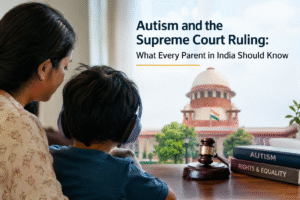
What Did the Supreme Court Actually Say About Autism?
On January 30, 2026, the Supreme Court of India decided a case called Yash Charitable Trust & Ors. v. Union of India. The case was about clinics offering stem cell “therapy” for autism.
The court said this treatment can’t be offered as a regular clinical service. It is allowed only inside approved clinical trials. The reason is simple: there isn’t enough scientific proof that it is safe or that it works.
The judges also pointed out that unproven treatments had spread for years because nobody stepped in. Families paid a lot of money and got very little in return.
autism and the supreme court ruling
Is Autism Diagnosis Banned? No.
This is truth number one, and it matters most.
Nothing in the ruling stops a child, teenager or adult from being assessed. Nothing stops speech therapy, occupational therapy, special education or counselling either. The judgment is aimed at one thing: unproven stem cell procedures sold as treatment.
Since then, the Health Ministry has asked States and Union Territories to make sure the directions reach every clinic involved. The Supreme Court has also asked the Centre for a report on how well they’re being followed.
Why Stem Cell Therapy for Autism Was Restricted
Here are the other truths in short:
There is no cure for autism. It isn’t an illness in the usual sense. It’s a different way the brain develops.
Expert reviews found weak evidence. National scientific bodies looked at the research and weren’t convinced.
Costs can be enormous. Many families spend lakhs, sometimes on loans.
Delay is the hidden cost. Months spent chasing a “miracle” are months without proven support.
That last one worries us the most.
What Our Doctors Say About the Ruling
We asked two of our team members for their thoughts.
“Parents come to me exhausted and hopeful, and I never want to take that hope away. But I also won’t pretend a shortcut exists. The strongest results I see in autism come from starting early, staying consistent, and involving the whole family. This ruling pushes people toward honest care, and I think that’s a good thing.”
“When a child is diagnosed, the first question is almost always ‘Can this be fixed?’ I tell families that the goal is helping the child communicate, learn and feel secure. Any treatment should come with evidence and ethical oversight. If someone promises guaranteed results, please pause and get a second opinion.”
Early Signs of Autism Parents Shouldn’t Ignore
You know your child best. Some things worth noticing:
Not responding when called by name
Little or no eye contact
Delayed speech, or losing words they once had
Lining up toys instead of playing with them
Strong distress over small changes in routine
Unusual reactions to noise, lights or textures
One sign alone doesn’t mean anything. A few together are a reason to book an assessment.
What Real Autism Support Looks Like
Good support is usually unglamorous. It looks like:
Speech and language therapy
Occupational therapy for sensory and daily-living skills
Behavioural and developmental programmes matched to the child
Parent coaching, so progress continues at home
School support and inclusion planning
Help with sleep, anxiety or attention, guided by a qualified doctor
Plans change as children grow. That’s normal.
Questions to Ask Before Starting Any Autism Treatment
Before you pay for anything, ask:
Do recognised medical bodies recommend it?
Is it part of an approved trial?
Does the provider promise a cure or guaranteed results?
The Ultimate Guide to Autism Cure: 7 Proven Facts You Must Know
Autism Cure: Exploring the Myths and Realities
Autism Spectrum Disorder (ASD) is a complex neurodevelopmental condition characterized by challenges in social interaction, communication, and repetitive behaviors. According to the Centers for Disease Control and Prevention (CDC), about 1 in 36 children in the United States is diagnosed with ASD, making it a significant public health issue. With such prevalence, many are left wondering: Is there an Autism Cure? The answer is far from straightforward, and it’s often surrounded by myths, misunderstandings, and ongoing debates.
Understanding Autism and the Search for an Autism Cure
Autism is known as a “spectrum” disorder because it manifests in a wide range of symptoms and severity. Some individuals with autism may require significant support in their daily lives, while others can live independently and excel in various fields. This diversity within the spectrum is part of what makes autism so challenging to define, understand, and, as some might hope, “cure.”
It’s crucial to recognize that autism is not a disease in the traditional sense. Rather, it is a neurodevelopmental condition that shapes how a person perceives and interacts with the world. The idea of an Autism Cure, therefore, is not as simple as curing an infection or a broken bone. Autism is intricately linked to the brain’s wiring and development, which makes the concept of a cure much more complex.
The Myth of an Autism Cure: Debunking Misconceptions
The notion of an Autism Cure has been a controversial topic for years. Various organizations, researchers, and even parents have explored or promoted different “cures” for autism, ranging from dietary changes and detoxification therapies to stem cell treatments and alternative medicines. However, none of these approaches have been scientifically proven to cure autism.
One of the most pervasive myths is that certain diets or supplements can cure autism. While some children with autism may have food sensitivities or gastrointestinal issues that benefit from dietary adjustments, there is no evidence to support the idea that diet alone can cure autism. Similarly, detoxification therapies that claim to remove toxins from the body have not been shown to have any impact on autism symptoms and can sometimes be harmful. For more on this topic, visit Delhi Mind Clinic.
Why There Is No Autism Cure: Understanding the Science
The search for an Autism Cure has also led to the rise of pseudoscientific treatments, many of which prey on the hopes and fears of families affected by autism. It’s essential for parents and caregivers to approach these treatments with skepticism and rely on evidence-based practices. The focus should be on therapies and interventions that improve quality of life, rather than chasing after a non-existent cure.
Evidence-Based Interventions Over an Autism Cure
While there is no Autism Cure, there are numerous evidence-based interventions that can significantly improve the lives of individuals with autism. Early intervention, in particular, has been shown to be highly effective in helping children with autism develop critical skills. You can learn more about effective interventions on our Early Intervention Programs page.
Applied Behavior Analysis (ABA) is one of the most well-known and widely used interventions for autism. ABA focuses on teaching positive behaviors and reducing negative ones through reinforcement techniques. It can be tailored to each individual’s needs and has been proven to improve communication, social skills, and academic performance. Explore our detailed guide on Applied Behavior Analysis (ABA) Therapy for more insights.
Speech therapy, occupational therapy, and social skills training are other valuable interventions that can help individuals with autism navigate the challenges they face. These therapies aim to enhance communication, sensory processing, and daily living skills, allowing individuals with autism to lead more independent and fulfilling lives.
Medications can also play a role in managing certain symptoms associated with autism, such as anxiety, attention deficits, or aggressive behavior. However, it’s important to note that these medications do not cure autism; they simply help manage specific symptoms.
Acceptance Over Autism Cure: Embracing Neurodiversity
Rather than focusing on an Autism Cure, many experts and advocates emphasize the importance of acceptance and support for individuals with autism. The neurodiversity movement, which advocates for the recognition and respect of neurological differences, including autism, has gained momentum in recent years. This perspective argues that autism is not something to be cured but rather a different way of experiencing the world that should be embraced.
Supporting individuals with autism involves creating environments that accommodate their unique needs and strengths. This includes inclusive education, workplace accommodations, and community support systems that promote independence and social inclusion.
Families and caregivers also play a crucial role in providing support. Parenting a child with autism can be challenging, but with the right resources, education, and community, parents can help their children thrive. Support groups, counseling, and respite care are valuable resources for families navigating the complexities of autism. For further guidance, check out our article on Parenting a Child with Autism.
Conclusion: The Reality Behind the Autism Cure Debate
The idea of an Autism Cure is more of a myth than a reality. Autism is a lifelong condition that shapes an individual’s experiences and interactions with the world. Rather than seeking a cure, the focus should be on providing evidence-based interventions that improve quality of life and promote independence. Acceptance, understanding, and support are key to helping individuals with autism lead fulfilling lives.
As research continues, our understanding of autism will evolve, and new therapies and interventions may emerge. However, the goal should always be to support and empower individuals with autism, recognizing their unique strengths and contributions to society. Instead of seeking an Autism Cure, we should aim to cure the misunderstandings and misconceptions surrounding it, fostering a world that embraces neurodiversity.
Is Autism a Disease? Autism has been a subject of intense debate and speculation, often clouded by misconceptions and misinformation. One of the prevailing questions surrounding autism is whether it is a disease. This article aims to shed light on the topic, unraveling the complexities of autism spectrum disorder (ASD) and challenging the notion that it should be classified as a disease.
Understanding Autism Spectrum Disorder:
First and foremost, it is crucial to comprehend what autism spectrum disorder is. ASD is a neurodevelopmental disorder characterized by a range of challenges in social interaction, communication, and repetitive behaviors. The term “spectrum” emphasizes the wide variation in challenges and strengths possessed by individuals with autism.
Is Autism a Disease?
The classification of autism as a disease is a controversial topic, with differing perspectives from various quarters. To arrive at a comprehensive understanding, it is essential to differentiate between diseases and disorders.
Diseases are typically characterized by specific pathological changes in the body’s structure or function, often leading to identifiable symptoms and a predictable course. In contrast, disorders encompass a broader category, including conditions that affect mental health, behavior, and development without necessarily having a clear-cut pathological basis.
Autism, being a neurodevelopmental disorder, falls under the latter category. It is not caused by a specific pathogen, malfunctioning organ, or genetic anomaly that fits the conventional definition of a disease. Instead, it involves atypical development of the brain and neural systems.
The Medical Model vs. the Neurodiversity Paradigm:
The debate over whether autism is a disease is closely tied to two contrasting perspectives: the medical model and the neurodiversity paradigm.
1. **Medical Model:**
The medical model views autism as a set of deficits or abnormalities that require treatment or intervention. From this perspective, autism is often approached as a condition to be diagnosed, managed, and, if possible, cured. This model emphasizes the challenges individuals with autism face and seeks to address those challenges through therapeutic interventions.
2. **Neurodiversity Paradigm:**
On the other hand, the neurodiversity paradigm embraces the idea that neurological differences, including those associated with autism, are simply natural variations of the human brain. Advocates of the neurodiversity paradigm argue against pathologizing autism, suggesting that it is a valid and valuable aspect of human diversity. This perspective encourages acceptance and accommodation rather than focusing solely on interventions aimed at normalization.
The Role of Stigma:
Labeling autism as a disease can contribute to the stigma surrounding the condition. The term “disease” carries connotations of illness and abnormality, potentially reinforcing negative stereotypes and misconceptions. The stigma associated with diseases can lead to discrimination and exclusion, hindering the social integration of individuals with autism.
Embracing a Holistic Approach:
Rather than getting entangled in the semantics of whether autism is a disease or not, a more constructive approach is to adopt a holistic understanding of neurodiversity. Recognizing and celebrating the diverse ways in which individuals’ brains function can foster a more inclusive and supportive society.
It is important to acknowledge that individuals with autism can lead fulfilling lives and make valuable contributions to their communities. Instead of focusing solely on addressing deficits, society should strive to create an environment that accommodates and appreciates neurodiversity.
Conclusion:
In conclusion, the question of whether autism is a disease is complex and multifaceted. The medical model and the neurodiversity paradigm represent two contrasting viewpoints, each with its own set of implications. By embracing a more inclusive and holistic perspective, we can move away from divisive debates and work towards creating a society that values and accommodates neurodiversity. Ultimately, the focus should be on understanding, acceptance, and support, allowing individuals with autism to thrive and contribute to the rich tapestry of human experience.
Autism Spectrum Disorder (ASD) is a complex neurodevelopmental condition that affects individuals in various ways, impacting their social interaction, communication, and behavior. Early identification and intervention are crucial for providing the necessary support to individuals with autism. In this blog post, we will explore the key signs of autism, emphasizing the importance of recognizing these signs for early intervention.
1. Social Challenges:
One of the primary indicators of autism is difficulty in social interactions. Children with autism may exhibit challenges in understanding and interpreting social cues. They may struggle with making eye contact, initiating or responding to social gestures, and understanding emotions in others. Difficulty in forming friendships and engaging in reciprocal conversations are common social challenges observed in individuals with autism.
2. Communication Difficulties:
Language development is often delayed in children with autism. Some individuals may have limited speech, while others might experience challenges in understanding and using non-verbal communication, such as gestures and facial expressions. Repetitive or unusual speech patterns, echolalia (repeating words or phrases), and a lack of interest in initiating or sustaining conversations are common communication difficulties seen in those with autism.
3. Repetitive Behaviors and Interests:
Individuals with autism often engage in repetitive behaviors, such as hand-flapping, rocking, or repeating specific movements. They may also develop intense interests in particular topics, objects, or activities, often focusing on them to the exclusion of other interests. Resistance to changes in routines and rituals is another characteristic feature, with disruptions causing distress.
4. Sensory Sensitivities:
Heightened or diminished sensitivities to sensory stimuli are common in individuals with autism. They may be hypersensitive to certain sounds, lights, textures, or smells, leading to strong reactions or discomfort. Conversely, some individuals may show reduced sensitivity, seemingly oblivious to pain or temperature changes.
5. Delayed Developmental Milestones:
Children with autism may experience delays in reaching developmental milestones, such as crawling, walking, or talking. These delays can be noticed during early childhood and may indicate the need for further assessment. It’s essential to differentiate between natural variations in development and persistent delays that could be indicative of autism.
6. Difficulty in Play and Imagination:
Play skills and imaginative activities may be limited in individuals with autism. They may struggle with pretend play, have difficulty understanding social rules during play, or exhibit a strong preference for solitary activities. An apparent lack of interest in age-appropriate toys or games may also be observed.
Conclusion:
Recognizing the early signs of autism is pivotal for timely intervention and support. Early diagnosis allows for the implementation of targeted therapies and strategies that can significantly improve outcomes for individuals with autism. If you notice any of these signs in yourself or someone you know, seeking professional guidance for a comprehensive evaluation is crucial. Remember, every individual with autism is unique, and early identification opens doors to tailored interventions that can make a substantial difference in their lives.