For general questions, please send us a message and we’ll get right back to you. You can also call us directly to speak with a member of our service team or insurance expert.
Honey trapping psychological warfare is a growing concern that Dr. Paramjeet Singh recently discussed with News Nation, describing how this manipulation tactic has moved far beyond espionage and intelligence circles into everyday life. What was once a tool used against soldiers, diplomats, and officials is now increasingly deployed against ordinary individuals, professionals, and even organisations — making honey trapping psychological warfare a threat almost anyone can encounter.
This blog breaks down what honey trapping psychological warfare really means, how it unfolds on social media, who is most at risk, and — most importantly — how you can protect yourself and the people around you.
What Is Honey Trapping Psychological Warfare?
At its core, honey trapping psychological warfare involves using emotional or romantic attraction to manipulate a person into giving up something valuable — information, money, access, or influence. The manipulation rarely feels like manipulation while it’s happening. It often begins as a seemingly genuine connection: someone who appears interested, attentive, and emotionally available.
honey-trapping-psychological-warfare
What makes this form of manipulation so effective is that it doesn’t target weaknesses in technology or security systems. It targets trust, loneliness, and the basic human need to feel valued — making honey trapping psychological warfare a psychological strategy long before it becomes a financial or security one.
How Social Media Fuels Honey Trapping Psychological Warfare
Social media has made honey trapping psychological warfare easier to execute and harder to detect. A few common patterns include:
Fake or curated profiles designed to appear attractive, credible, and relatable
Flattering photographs used to quickly capture attention and build initial interest
Emotionally engaging conversations that escalate quickly, creating a false sense of intimacy
Gradual trust-building, followed by requests for private photos, sensitive information, financial help, or access to confidential data
Because these interactions often move fast and feel personal, victims may not recognise the pattern until sensitive information has already been shared.
The Psychological and Personal Impact
The consequences of honey trapping psychological warfare go far beyond financial loss. People targeted often experience:
Anxiety and persistent worry
Shame or self-blame, even though they were deliberately deceived
Fear related to blackmail or threats of exposure
Damage to personal reputation and relationships
Professional setbacks, especially if sensitive workplace information was involved
These emotional effects can linger long after the incident itself, often affecting a person’s ability to trust others or feel safe online.
Why Honey Trapping Psychological Warfare Is a Bigger Issue Than It Seems
While it may appear to be a personal or individual problem, honey trapping psychological warfare has much wider implications, touching on:
Personal safety — emotional and sometimes physical risk
Cybersecurity — leaked passwords, private data, or financial details
Workplace confidentiality — sensitive business or government information at risk
Mental health — long-term anxiety, trust issues, and emotional distress
National security — in cases involving defence, law enforcement, or government personnel
This is precisely why Dr. Paramjeet Singh emphasised, in his discussion with News Nation, that honey trapping psychological warfare should be treated as a serious form of manipulation — not dismissed as a personal lapse in judgment.
Understanding the Model of Vulnerability
Honey trapping psychological warfare doesn’t succeed because people are careless. It succeeds because it targets very human, very normal emotional states, including:
Loneliness or a desire for connection
Unmet emotional needs
Curiosity about a new or exciting interaction
A natural inclination to trust
A desire for recognition, validation, or admiration
Limited awareness of digital safety practices
Recognising these vulnerabilities isn’t about self-criticism — it’s about understanding the psychological entry points manipulators rely on, so they can be identified and interrupted early.
7 Ways to Prevent Honey Trapping Psychological Warfare
Awareness is the first and most powerful line of defence. Practical habits that reduce risk include:
Verify identities before trusting someone met online — reverse image searches and cross-checking profiles can help.
Limit personal sharing, especially details related to your workplace, finances, or location, in early conversations.
Be cautious with unknown links or requests, particularly ones that ask for money, private photos, or sensitive documents.
Enable two-factor authentication on all important accounts to reduce the damage even if credentials are compromised.
Report suspicious behaviour to the relevant platform or authorities rather than trying to handle it alone.
Slow down emotionally charged interactions — manipulators often rely on urgency and intensity to bypass careful thinking.
Talk to someone you trust before acting on requests involving money, private images, or confidential information.
Final Thoughts
Honey trapping psychological warfare is not simply a cybersecurity issue — it is a psychological one. As Dr. Paramjeet Singh highlighted in his discussion with News Nation, understanding the emotional mechanics behind these tactics is essential to preventing them. By recognising the warning signs, staying mindful of emotional vulnerabilities, and practising basic digital caution, individuals can protect not only their information but also their mental and emotional wellbeing.
If you or someone you know is struggling with anxiety, shame, or emotional distress after an experience like this, seeking professional support can make a meaningful difference in processing and moving forward from it.
When we talk about health, the mind is often the last thing that comes to mind — and that’s exactly the gap Dr. Paramjeet Singh has spent his career trying to close. As a Consultant Psychiatrist at PSRI Hospital, Co-Founder & Senior Consultant at Delhi Mind Clinic, and General Secretary of the Delhi Psychiatric Society, Dr. Paramjeet Singh has become one of Delhi’s most trusted voices in mental health — someone who believes that emotional well-being deserves the same attention, respect, and care as physical health.
Taking Mental Health Beyond the Clinic
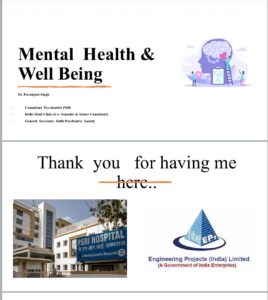
While consulting rooms remain at the heart of his practice, Dr. Paramjeet Singh strongly believes that real change happens when mental health conversations move beyond hospital walls — into workplaces, communities, and everyday life. That belief was on full display during his recent session on “Mental Health & Well-Being”, delivered to employees at Engineering Projects (India) Limited (EPI), a Government of India Enterprise.
The session focused on a topic that touches almost every working professional today: corporate and employee mental health.
Why Work-Life Balance Isn’t Just a Buzzword
Standing before a room full of employees, Dr. Paramjeet Singh opened with a simple but powerful reminder:
“Work-life balance is an integral part of management.”
It’s a line many people hear often — but rarely reflect on deeply. In the session, Dr. Singh unpacked why this idea matters more than ever in modern corporate culture:
Unmanaged stress quietly erodes productivity. What starts as a few tense days at work can, over time, affect focus, decision-making, and overall performance.
Silence is often the biggest barrier. Many employees privately wonder whether they should open up about what they’re going through, but hold back — unsure how colleagues or managers will react.
Not all stress is “bad” stress. One of the more thought-provoking points from the session was the idea that a certain kind of pressure, when understood and managed well, can actually fuel growth rather than hinder it.
By addressing these questions directly, Dr. Paramjeet Singh helped create a space where mental health wasn’t treated as a taboo subject, but as a normal, necessary part of workplace conversations.
Why Corporate Mental Health Deserves More Attention
India’s corporate landscape has changed dramatically in the last decade — longer hours, higher targets, and constant connectivity have blurred the line between professional and personal life. Yet, mental well-being at the workplace is still often overlooked until it becomes a crisis.
Dr. Paramjeet Singh’s work — through sessions like the one at EPI, his clinical practice, and his role with the Delhi Psychiatric Society — consistently pushes back against this neglect. His approach is not about offering quick fixes, but about building awareness, empathy, and open dialogue within organizations, so that employees feel safe acknowledging stress before it turns into burnout.
This is a philosophy that also shapes the work at Delhi Mind Clinic, where Dr. Singh and his team focus on creating a supportive, non-judgmental environment for anyone navigating emotional or psychological challenges — whether they’re a student, a working professional, a parent, or a senior citizen.
A Voice That Bridges Clinical Expertise and Public Awareness
What makes Dr. Paramjeet Singh’s contribution unique is the range of his engagement with mental health:
As a Consultant Psychiatrist at PSRI Hospital, he brings deep clinical expertise to complex cases.
As Co-Founder & Senior Consultant at Delhi Mind Clinic, he helps shape a practice built on accessibility and compassionate care.
As General Secretary of the Delhi Psychiatric Society, he plays an active role in advancing mental health awareness and professional standards across the city.
And through corporate sessions like the one at EPI, he takes psychiatric insight out of the clinic and into everyday spaces where people spend most of their waking hours — their workplaces.
This blend of clinical depth and public engagement is exactly what mental health advocacy in India needs today: experts who are willing to step outside traditional settings and meet people where they are.
The Bigger Picture: Normalizing Mental Health Conversations
Sessions like the one Dr. Paramjeet Singh conducted at EPI are more than one-off events — they’re part of a larger, necessary shift. As organizations across India begin to recognize that employee well-being directly impacts performance, retention, and culture, the demand for credible, compassionate mental health guidance will only grow.
Dr. Paramjeet Singh’s continued work — in hospitals, in clinics, in professional associations, and now in corporate boardrooms — reflects a simple but important message: mental health is not a side conversation. It’s central to how we live, work, and grow.
Mental illness rarely announces itself with a single dramatic moment. More often, it builds quietly — mood changes, withdrawal, disrupted sleep — until, for some families, it reaches a point where a loved one becomes acutely disturbed, aggressive, or unable to recognise that they need help at all. When that happens, families are often left asking the same painful question: what do we do now?
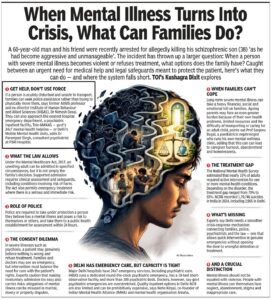
This question was at the heart of a recent feature in The Times of India (Times City, September 5, 2026), titled “When Mental Illness Turns Into Crisis, What Can Families Do?” The article was prompted by a deeply troubling case — a father and his friend allegedly killed his 38-year-old son, who was living with schizophrenia, after describing him as having become “aggressive and unmanageable.” It’s an extreme and tragic outcome, but it highlights something many families quietly struggle with: the gap between recognising a mental health emergency and knowing how to respond to it safely and lawfully.
Get Help, Don’t Use Force
Among the experts consulted for the piece was Dr. Paramjeet Singh, Consultant Psychiatrist, who offered a piece of guidance that deserves to be repeated often: when a person is acutely disturbed and unsafe to move, families should never attempt to physically restrain or transport them on their own.
Instead, Dr. Singh pointed families toward the support systems that already exist and are built for exactly this kind of moment:
The emergency department of the nearest hospital
A psychiatric inpatient facility
Tele-MANAS, the government’s round-the-clock mental health helpline
Delhi’s Mobile Mental Health Units, which can respond directly where the person is
This advice matters because in a crisis, panic often pushes families toward action that feels urgent but is actually unsafe — for the patient and for themselves. Knowing which door to knock on first can change the entire outcome of that day.
Why Families Feel Stuck: The Legal and Emotional Reality
The Times of India feature also unpacked why this issue is so complicated in the first place. Under the Mental Healthcare Act, 2017, an unwilling adult can be admitted for treatment only under specific, safeguarded circumstances — it isn’t simply a decision the family gets to make. This exists to protect patients from misuse, since allegations of mental illness have, unfortunately, been weaponised in disputes over marriage, dowry, or property in the past.
At the same time, severe conditions like psychosis can make it genuinely impossible for a patient to recognise that anything is wrong. Families and doctors may clearly see an emergency unfolding, while the patient sees no reason to seek care at all. Balancing a patient’s rights with a family’s need to act quickly is one of the hardest parts of mental healthcare — and one of the least talked about.
The article also cited sobering figures: an estimated treatment gap of 70–92% for various mental health conditions in India, and over 1.7 lakh reported suicides nationally in 2024, including thousands in Delhi alone. These numbers point to a system that is still catching up to the scale of the need — even as good emergency infrastructure, like round-the-clock psychiatric care at hospitals such as IHBAS, does exist.
What This Means for Families in Delhi
If there’s one message worth taking away from this feature, it’s this: a mental health crisis is a medical emergency, not a private failure to manage on your own. Families don’t need to have all the answers, and they certainly don’t need to face it alone or by force. What they need is to know where to turn — and to turn there early, before a situation escalates.
A few practical takeaways for families supporting a loved one with severe mental illness:
Recognise early warning signs of increasing agitation, disorientation, or risk — before a full crisis develops.
Keep helpline and hospital information handy in advance, not just when a crisis is already underway.
Don’t attempt physical intervention with someone who is acutely disturbed; seek professional or police assistance instead.
Understand that mental illness does not equal violence. As the article rightly notes, people living with mental illness are far more likely to face neglect, stigma, and inappropriate care than to pose a danger to others.
Look after the caregivers too. Long-term illness takes a real emotional and financial toll on families, particularly ageing parents.
Compassionate, Professional Care Starts with the Right Conversation
Being featured in a national publication for this kind of expert commentary reflects the broader work Dr. Paramjeet Singh and the team continue to do — helping families navigate not just crisis moments, but the everyday realities of living with and supporting someone through mental illness.
AtDelhi Mind Clinic, we believe families deserve clear guidance long before things reach a breaking point. Whether you’re noticing early changes in a loved one’s behaviour or facing a situation that already feels overwhelming, professional support can make the difference between a manageable moment and a full-blown crisis.
If you or someone you love needs guidance, don’t wait for things to escalate. Reach out to Delhi Mind Clinic to speak with an experienced mental health professional and find the right path forward — for your loved one, and for your whole family.
Psychological trauma after sexual assault is far more complex, and far more lasting, than most people realize. A recent case out of Delhi — where a young girl endured a harrowing 47-kilometre ordeal aboard a moving bus — has once again forced the country to confront uncomfortable questions. Why do such crimes keep happening? Why does the fear never seem to leave? And why, despite decades of reform since the Nirbhaya case, does a woman still not feel fully safe travelling alone at night?
In a recent televised discussion, Dr. Sugandha Gupta, a leading psychologist at Delhi Mind Clinic, was invited to unpack the psychological trauma after sexual assault cases like this one — not just what happened, but why it happened, and what it does to the mind of a survivor, a family, and a society. Below are five key insights from her conversation.
psychological trauma after sexual assault
1. “Mental Illness” Is Not the Same as “Mindset” — And the Difference Matters
One of the most important clarifications Dr. Gupta made was around a common misconception: that people who commit such crimes must be “mentally ill,” and that psychological trauma after sexual assault can somehow be prevented simply by treating an underlying illness in offenders.
She was clear: this is not accurate.
What we are often looking at is not a mental illness, but a mindset — a set of learned beliefs and attitudes, absorbed from one’s surroundings over years. When boys grow up watching women being dominated, dismissed, or treated as objects rather than individuals, that observation quietly becomes internalised belief. Aggression gets rewarded with the label “masculine.” Boundary-crossing gets excused as “boys being boys.” Over time, this mindset hardens into a dangerous sense of entitlement — the belief that one has the right to take what they want, without consequence or guilt.
Alongside this, Dr. Gupta pointed to something else: a profound lack of empathy in individuals who commit such acts — an inability to register another person’s pain as real. This absence of empathy is what allows such crimes to be repeated without remorse, sometimes even years later, as seen in documented interviews of past offenders who showed no accountability even facing the harshest consequences.
2. Psychological Trauma After Sexual Assault Can Last a Lifetime
Perhaps the most sobering part of Dr. Gupta’s commentary was on the lasting nature of psychological trauma after sexual assault.
She noted that survivors — many of whom experience this trauma as teenagers — often carry it for the rest of their lives. It’s not something that fades neatly with time. Even women well into their middle age, she observed, continue to be affected by something that happened to them decades earlier, at 15 or 16 years old. That trauma doesn’t just shape how they see the world — it often shapes how they raise their own daughters, colouring their fears and their sense of safety passed on to the next generation.
This is a critical point for families and communities to internalise: healing from psychological trauma after sexual assault is not a linear or quick process, and survivors deserve patience, support, and access to spaces where they can process what they’ve experienced without judgment.
3. Victim Blaming Deepens Psychological Trauma After Sexual Assault
Dr. Gupta also addressed a pattern that surfaces after nearly every such case — the tendency of society to question the survivor rather than the perpetrator. Why was she out at night? Why did she board an empty bus?
These questions, however well-intentioned some may seem, add a second wound on top of psychological trauma after sexual assault. They compound the original experience with shame, self-doubt, and isolation — feelings that can be just as damaging as the incident itself, and that often prevent survivors from seeking help or speaking up at all.
Dr. Gupta was unambiguous: this pattern of victim-blaming stems from a deep-rooted patriarchal mindset in society — one that seeks to control and dominate, and that reduces women to objects rather than recognising them as individuals with full agency.
4. Systemic Delays Make the Trauma Worse
The conversation didn’t stop at diagnosis — it moved toward responsibility and accountability. Dr. Gupta emphasised a few key points that directly affect how psychological trauma after sexual assault is experienced and processed:
Accountability is collective. No single institution — police, government, or society — can address this alone.
Sensitisation is missing at every level — from how FIRs are registered, to how survivors are treated by law enforcement, to how cases are handled in courts.
Delayed justice deepens psychological harm. When consequences take seven or eight years to materialise, survivors are left carrying unresolved trauma for far longer, with little sense of closure or safety.
5. Healing Requires More Than Conversation — It Requires Support
Conversations like this one matter — but as Dr. Gupta pointed out, discussion alone cannot heal a survivor’s wounds. Addressing psychological trauma after sexual assault requires access to compassionate, professional psychological support: a space to process trauma, rebuild a sense of safety, and work through fear, grief, or anxiety at one’s own pace.
At Delhi Mind Clinic, our approach centers on providing exactly this — a safe, non-judgmental environment where individuals affected by trauma, whether recent or from years past, can find support tailored to their experience. Whether it’s a survivor, a parent, or anyone carrying the weight of fear after such news, professional guidance can make a meaningful difference in the healing journey.
If you or someone you know is struggling with psychological trauma after sexual assault, reaching out for support is not a sign of weakness — it’s often the first step toward reclaiming a sense of safety and control.
We live in a world where connecting with someone is easier than ever.
A message can reach someone instantly. A video call can bring two people together across thousands of kilometres. Social media can give us hundreds or even thousands of contacts, followers and online communities.
Yet, despite all this connectivity, many people still experience a deep sense of loneliness.
This raises an important question:
Social-Media-Loneliness
Has social media actually brought us closer, or has it sometimes made us feel more disconnected from the people around us?
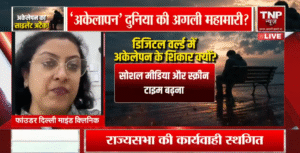
This issue was recently discussed in a television news programme featuring Dr. Sugandha Gupta, Senior Psychiatrist and Founder & Director of Delhi Mind Clinic, along with other speakers. The discussion explored why people can feel lonely despite being constantly connected online, how excessive digital engagement can affect relationships, and what families and communities can do to rebuild meaningful connections.
What Is Social Media Loneliness?
Social media loneliness refers to the feeling of emotional disconnection that can exist despite having frequent online interactions.
A person may receive messages throughout the day, have hundreds of followers and regularly interact with people online, yet still feel that there is nobody with whom they can genuinely share their worries, fears or difficult experiences.
This is an important distinction.
Being digitally connected is not always the same as feeling emotionally connected.
A like, comment, emoji or short message can provide momentary interaction. However, meaningful relationships usually require time, trust, understanding and genuine presence.
The World Health Organization has identified loneliness and social isolation as important public health concerns. Its 2025 Commission on Social Connection reported that approximately one in six people worldwide experience loneliness, with younger people among the groups experiencing particularly high levels.
Why Are People Feeling Lonely Despite Having So Many Online Connections?
There is no single reason behind loneliness. Social media may be one factor among several, including changes in family life, work patterns, urban lifestyles, relationship difficulties and reduced face-to-face interaction.
The television discussion highlighted several possible contributors.
1. Online interaction can replace real-world interaction
When much of our free time is spent scrolling, messaging or watching content, there may be less time available for conversations with family members, friends and neighbours.
A person can spend hours interacting with people online without having a meaningful face-to-face conversation during the entire day.
Over time, this can create an unusual situation:
More communication, but less emotional connection.
2. The pressure to appear happy online
Social media often presents carefully selected versions of people’s lives.
People usually share achievements, celebrations, holidays, attractive photographs and positive experiences. Difficult moments may remain private.
As a result, someone scrolling through social media may begin comparing their ordinary life with other people’s carefully presented highlights.
This can create thoughts such as:
“Everyone else is happier than me.”
“Everyone has more friends than I do.”
“Why am I not living like this?”
“Something must be wrong with my life.”
Such comparisons can make existing feelings of loneliness more noticeable.
3. The need for constant validation
Likes, comments, followers and messages can sometimes become a source of validation.
The problem begins when a person’s sense of self-worth becomes strongly dependent on online reactions.
If a post receives less attention than expected, the person may feel rejected or ignored. If it receives attention, the positive feeling may be temporary, creating a desire for more validation.
This can turn social media into a cycle of checking, comparing and seeking approval.
4. Fear of rejection in real life
The discussion also touched upon an important psychological issue: people may sometimes find online interaction easier than real-world relationships because face-to-face relationships involve vulnerability and the possibility of rejection.
Online platforms can provide a controlled environment where people can choose what to share, whom to follow and how they want to present themselves.
But real relationships require us to deal with disagreement, disappointment, misunderstanding and vulnerability.
Avoiding these experiences completely may make genuine relationships harder to build.
Dr. Sugandha Gupta on the Growing Digital Disconnect
Social-Media-Awareness
During the discussion, Dr. Sugandha Gupta highlighted that technology has gradually become an ordinary part of modern life. From radio and television to mobile phones and social media, every technological development has changed how people communicate.
The challenge, she explained, is not simply the existence of technology but how much and how intensely we use it.
She also pointed to the changes that occurred during the COVID-19 period, when social restrictions made digital communication one of the primary ways people stayed connected. For many people, those digital habits continued even after normal social interaction returned.
Her comments highlight an important principle:
The goal should not necessarily be to eliminate technology. The goal is to learn where to draw the line.
This is particularly important for young people, who have grown up surrounded by smartphones, online entertainment and social platforms.
Is Social Media Always Bad for Mental Health?
No.
Social media can provide genuine benefits.
It can help people:
Stay connected with relatives living far away
Maintain friendships
Find communities with similar interests
Access educational information
Discover opportunities
Express creativity
Receive social support
Communicate during difficult circumstances
For someone living away from family, a video call can be extremely meaningful.
The concern is therefore not simply social media use, but unhealthy or excessive patterns of use that begin interfering with sleep, relationships, responsibilities, physical activity or emotional well-being.
WHO similarly emphasizes that digital tools should be used wisely to enhance rather than replace human relationships.
Young People May Be Particularly Vulnerable
Young people are among the groups that deserve particular attention.
Adolescence and early adulthood are periods when identity, friendships, confidence and social skills are developing.
If much of a young person’s social experience takes place through screens, opportunities for face-to-face interaction may decrease.
The discussion highlighted concerns around children receiving smartphones at very young ages, increasing screen exposure and parents sometimes using phones as an easy way to keep children occupied.
This does not mean that parents should completely isolate children from technology.
Instead, families can create healthier boundaries around its use.
What Can Families Do?
Parents often tell children to reduce their screen time while spending much of their own time on their phones.
This can create resistance.
A healthier approach is to make digital boundaries a family habit rather than a punishment for children.
For example:
Create a phone-free family meal
Choose one meal each day when everyone keeps their phones away.
The objective is simple: eat together, talk and listen.
Create a technology-free hour
Families can experiment with one hour without unnecessary screen use.
That hour can be used for conversation, walking, games, hobbies, music or simply spending time together.
The discussion specifically emphasized the importance of families sitting together and creating periods without technology.
Parents should lead by example
Children notice what adults do.
If parents constantly check notifications while asking children to put their phones away, the message becomes confusing.
Healthy digital habits should therefore begin with adults as well.
Encourage offline activities
Sports, hobbies, music, community events, festivals, exercise and social activities can create opportunities for genuine interaction.
The television discussion also highlighted schools, colleges and residential communities as places where more in-person activities can help people reconnect.
How Can You Reduce Social Media Loneliness?
You don’t necessarily have to delete every social media application.
Instead, start by examining your relationship with technology.
Ask yourself:
Do I use social media because I genuinely want to connect, or because I feel uncomfortable being alone?
Do I feel better after using it, or more anxious and dissatisfied?
Am I spending more time online than I spend talking to people around me?
Do I check my phone automatically whenever I have nothing to do?
Have I stopped participating in activities that I previously enjoyed?
Your answers can help you identify whether your digital habits are supporting your well-being or interfering with it.
Self-care rituals don’t have to be elaborate to work. Scroll through social media and self-care can start to look like a full-time job — elaborate skincare shelves, hour-long yoga sessions, expensive retreats, and colour-coded journals. For most people juggling work, family, and everyday responsibilities, that picture doesn’t feel like relaxation. It feels like one more thing to keep up with.
self-care-rituals
The good news? Real self-care doesn’t need to be elaborate, expensive, or time-consuming. According to mental health experts, some of the most effective self-care habits take less than five minutes — and the ones that stick are usually the simplest.
In this post, we break down why small, consistent habits matter more than grand wellness gestures, and share five easy self-care rituals you can build into your day starting today.
Why “Waiting Until You’re Burnt Out” Doesn’t Work
One of the most common mistakes people make with self-care is treating it as damage control — something you turn to only after you’re exhausted, overwhelmed, or running on empty.
Mental health professionals often compare this to servicing a car only after it breaks down, instead of maintaining it regularly. Self-care works best as prevention, not recovery. The World Health Organization defines self-care as the ability of individuals to promote and maintain their own health and well-being — not just a response to illness or burnout. When self-care rituals are woven into your daily routine in small ways, they help you stay balanced before stress builds up — rather than trying to undo weeks of neglect in one go.
The rituals that actually last aren’t the ones that require a special mood, a free weekend, or a shopping list. They’re the ones that feel easy enough to become a natural part of your day. In fact, the American Psychological Association notes that even brief, consistent self-care practices can meaningfully reduce stress and improve emotional resilience over time.
5 Simple, Low-Effort Self-Care Rituals to Try Today
These self-care rituals are designed to take five minutes or less, so they’re easy to stick with even on your busiest days.
1. The Two-Minute Body Check-In
Pause for a moment. Relax your shoulders, unclench your jaw, and notice how your body actually feels — are you hungry, thirsty, tired, or emotionally overwhelmed? This quick scan helps you catch needs that often go unnoticed during a busy day, before they turn into bigger stress or fatigue.
2. A Five-Minute Movement Break
You don’t need a full workout to reset your energy. Gentle neck rolls, shoulder stretches, a short walk around the room, or a couple of flights of stairs can ease stiffness and improve alertness. If you have a desk job, try setting a reminder every hour or two to simply stand up and move — your body and focus will thank you.
“People who work at desks often don’t realise how much prolonged sitting affects both their body and their mind. A short movement break every hour isn’t just good for posture — it genuinely helps reset focus and reduce the mental fatigue that builds up over a long workday,” says Dr. Paramjeet Singh, Psychiatrist at Delhi Mind Clinic.
3. A No-Phone Buffer After Work
The moment work ends, many of us go straight from one screen to another. Instead, try keeping your phone away for 10–15 minutes after you finish work — put it on silent or leave it in another room. This small buffer gives your mind a chance to shift out of “work mode” before you dive back into notifications and distractions.
4. Writing Down a Single Thought
Journaling doesn’t have to mean pages of reflection. Just jot down one thought — how you’re feeling, something that made you smile, or one thing you want to focus on tomorrow. This tiny habit can help clear mental clutter and improve emotional awareness over time. If you’d like a more structured approach, check out our guide to journaling for mental health for simple prompts to get started.
5. Making a Beverage — For Yourself, Not on Autopilot
Whether it’s a cup of tea, coffee, or a glass of infused water, the act of preparing a drink slowly and mindfully can be a moment of pause in itself. Instead of rushing through it while multitasking, let it be a small, intentional break that helps you be present before moving to the next task.
The Bigger Picture: Consistency Over Intensity
None of these self-care rituals require special equipment, a big time commitment, or a complete lifestyle overhaul. That’s the point. Self-care isn’t about how much effort you put in — it’s about how consistently you show up for yourself, even in small ways.
If you find that stress, low mood, or anxiety are affecting your daily life despite these efforts, that’s a sign it may help to talk to a mental health professional. Small rituals are powerful for everyday balance, but ongoing distress deserves proper support and guidance — you can learn more about when to seek professional help for stress and anxiety in our related guide.
Final Thoughts
Self-care doesn’t have to look like a curated aesthetic or a luxury experience. Often, it’s the two-minute pause, the short walk, the single honest sentence written down, or the quiet cup of tea made just for you. Start with just one or two self-care rituals, stay consistent, and let them become a natural part of your everyday rhythm — not another task on your to-do list.
If you’re finding it difficult to manage stress, anxiety, or emotional overwhelm on your own, our team at Delhi Mind Clinic is here to help. Explore our therapy and counselling services or book a consultation to speak with a mental health professional and find support that works for you.