For general questions, please send us a message and we’ll get right back to you. You can also call us directly to speak with a member of our service team or insurance expert.
Every year, as temperatures drop and Diwali smoke settles over the city, Delhi’s air turns from bad to hazardous. Most of the conversation focuses on coughs, sore throats, and burning eyes.
But there’s a quieter crisis happening at the same time. The link between pollution and mental health is real, and it’s affecting how Delhiites feel, not just how they breathe.
At Delhi Mind Clinic, we’re seeing this pattern every winter — patients whose anxiety, low mood, and fatigue spike right alongside the AQI. Here’s what’s actually going on with pollution and mental health, and what you can do about it.
Why Winter Makes Pollution and Mental Health Symptoms Worse
Pollution in Delhi is a year-round issue, but winter makes it far more dangerous. Cold, still air traps particulate matter closer to the ground instead of letting it disperse.
So pollution lingers in the air for much longer during the colder months. Combined with crop-burning smoke and Diwali firecrackers, this creates the thick winter smog Delhi has become known for — and it’s exactly this seasonal spike that makes the connection between pollution and mental health so noticeable each year.
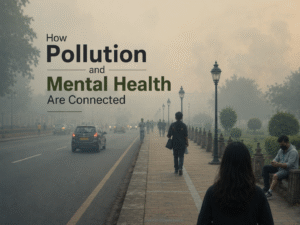
how-pollution-and-mental-health
The Science: How Pollution Affects Mental Health and the Brain
This isn’t just “in your head” — there’s a real biological pathway connecting pollution and mental health:
Inflammation reaches the brain. Fine particulate matter (PM2.5) triggers inflammation throughout the body. Research shows this inflammatory response can disrupt neurotransmitters like serotonin and dopamine — the same chemicals responsible for regulating mood, motivation, and emotional balance.
Oxidative stress damages brain cells. Long-term pollution exposure has been linked to oxidative stress that affects cognitive function, memory, and focus.
A growing body of research backs this up. An Oxford University review of multiple research papers found evidence that both indoor and outdoor air pollution can contribute to serious mental illnesses.
Local data confirms it. A Delhi-NCR based study specifically examined the connection between AQI levels and depression, anxiety, and general well-being in city residents, given how far local pollution levels exceed WHO safety guidelines.
7 Proven Effects Linking Pollution and Mental Health
People living in high-pollution cities often report psychological changes that are easy to dismiss as “just a bad mood” or ordinary stress. Research increasingly shows these changes are connected to air quality. Here are seven of the most well-documented effects.
1. Increased Anxiety
Long-term exposure to poor air quality has been associated with heightened anxiety symptoms, including restlessness, racing thoughts, and a persistent sense of unease. If anxiety feels like it’s becoming harder to manage, our [INTERNAL LINK: Anxiety Treatment] page outlines the support options available at Delhi Mind Clinic.
2. Low Mood and Depressive Symptoms
Several studies have found a correlation between elevated pollution levels and higher rates of depressive symptoms, particularly in urban populations exposed to chronic smog. The American Psychiatric Association notes that people who breathe polluted air show changes in brain regions that regulate emotion, which may raise the likelihood of developing anxiety and depression over time.
3. Irritability and Mood Swings
Many people notice they feel more short-tempered or emotionally reactive on high-pollution days — a pattern that lines up with pollution’s effect on the body’s stress response.
4. Brain Fog and Poor Concentration
Reduced oxygen efficiency and inflammation can make it harder to focus, retain information, or think clearly, especially during prolonged smog episodes.
5. Fatigue and Low Motivation
Poor air quality is linked to disrupted sleep and lower energy levels, both of which can leave people feeling mentally drained and unmotivated.
6. Heightened Stress Response
Chronic exposure to pollution keeps the body’s stress systems mildly activated, which over time can make people more vulnerable to stress-related mental health difficulties. A recent umbrella review of global evidence, published in a peer-reviewed database, reinforces that this is an active and growing area of research.
7. Greater Risk for Existing Mental Health Conditions
For people already managing anxiety, depression, or another mental health condition, high-pollution periods can intensify symptoms and make day-to-day coping more difficult.
Why the Link Between Pollution and Mental Health Matters More in Delhi
Delhi consistently ranks among the most polluted cities in the world, particularly during the winter months when smog, stubble burning, vehicular emissions, and construction dust combine to push air quality into “severe” and “hazardous” categories.
This matters for mental health because:
Duration of exposure is longer. Unlike a single smoggy day, Delhi residents may face weeks of poor air quality every year, giving pollution more time to affect mood-regulating systems in the brain.
Indoor air isn’t always safer. Pollutants can seep indoors, meaning exposure often continues even when people stay inside.
Compounding stressors. Traffic, noise, and visibly poor air quality can add a layer of everyday psychological stress on top of the biological effects of pollution.
Vulnerable groups face greater risk. Children, older adults, and individuals already managing a mental health condition may experience more pronounced emotional effects.
How to Protect Your Mental Health During High-Pollution Days
While we can’t control outdoor air quality, there are meaningful steps that can help protect emotional wellbeing:
Track the Air Quality Index (AQI) and plan outdoor activities for times when pollution levels are comparatively lower.
Create a clean-air space at home using air purifiers and by keeping windows closed during peak pollution hours.
Prioritize sleep hygiene, since good sleep helps buffer against pollution-related mood disturbances.
Stay physically active indoors — gentle movement, stretching, or yoga can support mood even when outdoor exercise isn’t advisable.
Practice stress-reduction techniques such as mindfulness, deep breathing, or journaling to help regulate the nervous system. Our [INTERNAL LINK: Stress Management / Therapy Services] page has more on building these skills with professional guidance.
Stay connected with others. Social support is a strong protective factor against pollution-related stress and low mood.
Limit prolonged outdoor exposure, especially during early mornings when pollution levels tend to peak.
Seek professional support if you notice persistent changes in mood, anxiety, sleep, or concentration — especially during high-pollution seasons.
When to Reach Out for Support
If pollution season consistently affects your mood, sleep, energy, or ability to function — year after year — that’s not something to just push through. At Delhi Mind Clinic, we help patients recognize these seasonal patterns and build a plan that addresses both the environmental trigger and the underlying mental health impact. Our team, led by Dr. Sugandha Gupta (Founder & Director, with over a decade of experience treating anxiety and depression) and Dr. Paramjeet Singh (Senior Consultant Neuropsychiatrist and Joint Secretary of the Delhi Psychiatric Society), offers a combined medical and therapeutic approach to help you manage seasonal mental health dips.
Struggling with anxiety, low mood, or brain fog this pollution season? and let’s talk about it.