For general questions, please send us a message and we’ll get right back to you. You can also call us directly to speak with a member of our service team or insurance expert.
Elderly mental health & dementia awareness is becoming one of the most urgent conversations in Indian households today. As our loved ones grow older, we naturally focus on their physical health — checking blood pressure, managing joint pain, or scheduling regular check-ups. But there’s an equally important part of ageing that often goes unnoticed until it becomes serious: mental wellbeing.
With India’s elderly population growing rapidly, elderly mental health & dementia awareness have become urgent public health priorities. Conditions like depression, anxiety, and dementia are far more common in older adults than most families realise — yet they remain surrounded by silence, stigma, and misdiagnosis.
In this blog, we break down why elderly mental health & dementia awareness matters, the early warning signs of dementia, and how families in Delhi and beyond can support their ageing loved ones with compassion and confidence.
Elderly-Mental-Health-&-Dementia-Awareness
Why Elderly Mental Health & Dementia Awareness Deserves More Attention
Ageing brings major life transitions — retirement, loss of loved ones, reduced mobility, and increasing dependence on others. These changes can significantly affect emotional wellbeing. Common mental health challenges among the elderly include:
Depression — often mistaken for “just being old” or “grumpiness”
Anxiety — worry about health, finances, or being a burden on family
Loneliness and social isolation — especially in nuclear family setups common in urban India
Sleep disturbances — which can worsen both mood and cognitive function
Cognitive decline — ranging from mild forgetfulness to dementia
Unfortunately, many families dismiss these signs as “normal ageing.” This delay in recognition often means elderly individuals suffer silently for years before receiving proper support.
Understanding Dementia: More Than Just Forgetfulness
Dementia is not a single disease — it’s a broad term describing a decline in memory, thinking, language, and reasoning skills severe enough to interfere with daily life. It’s important to understand that occasional forgetfulness is a normal part of ageing, but dementia is not.
Early Warning Signs of Dementia to Watch For
Families are often the first to notice changes. Here are some early red flags:
Memory loss that disrupts daily life — forgetting recently learned information, important dates, or asking the same question repeatedly
Difficulty with familiar tasks — struggling to follow a recipe, manage household bills, or operate a phone they’ve used for years
Confusion with time or place — losing track of dates, seasons, or getting lost in familiar neighbourhoods
Trouble with words — struggling to follow or join a conversation, repeating themselves, or calling things by the wrong name
Poor judgment — falling for scams, neglecting hygiene, or making unusual financial decisions
Withdrawal from social activities — avoiding hobbies, family gatherings, or social commitments they once enjoyed
Mood and personality changes — becoming confused, suspicious, anxious, or fearful without clear reason
If you notice several of these signs persisting over weeks or months, it’s time to consult a mental health professional — early evaluation makes a significant difference in care planning and quality of life.
Elderly Mental Health & Dementia Awareness: Breaking the Stigma in India
In many Indian households, mental health struggles among the elderly are often brushed aside with phrases like “yeh toh budhape mein hota hai” (this happens with old age) or “unhe kuch nahi hua, bas mood off hai” (nothing’s wrong, just a mood swing).
This stigma prevents timely diagnosis and treatment. A few uncomfortable truths worth acknowledging:
Depression in the elderly is not a personality flaw or weakness — it’s a genuine health condition.
Dementia is not something a person can simply “snap out of” or improve through willpower.
Seeking help from a psychiatrist or psychologist doesn’t mean the family has failed — it means they care enough to act.
Awareness is the first step toward reducing this stigma, both within families and society at large.
How Families Can Support Elderly Loved Ones
Supporting an ageing parent or relative’s mental wellbeing doesn’t always require complex intervention. Small, consistent actions can make a meaningful difference:
1. Encourage Social Connection
Isolation is one of the biggest risk factors for both depression and cognitive decline. Encourage regular interaction with friends, family, or community groups — even short daily conversations matter.
2. Promote Mental Stimulation
Activities like reading, puzzles, simple games, or learning a new skill can help keep the mind active and may slow cognitive decline.
3. Maintain a Routine
Predictable daily schedules for meals, sleep, and activities provide comfort and reduce confusion, particularly for those experiencing early cognitive changes.
4. Watch for Physical Health Links
Poor sleep, uncontrolled health conditions, and lack of physical activity often worsen mental health symptoms. A holistic approach to health supports the mind as much as the body.
5. Listen Without Judgment
Sometimes elderly individuals simply need to feel heard. Avoid dismissing their fears or frustrations, even if they seem irrational — validation goes a long way.
6. Seek Professional Guidance Early
If you notice persistent sadness, withdrawal, confusion, or memory issues, consult a qualified mental health professional. Early assessment allows for better planning, support strategies, and quality of life — for both the individual and the family.
The Role of Professional Mental Health Support
A proper evaluation by a psychiatrist or clinical psychologist can help distinguish between normal ageing, depression, anxiety, and dementia — each of which requires a different approach to care. Professional support can include:
Comprehensive cognitive and psychological assessments
Emotional counselling for both the elderly individual and their caregivers
Structured care plans tailored to the individual’s needs
Guidance for family members on how to communicate and provide support effectively
At DelhiMindClinic.com, we understand how overwhelming it can feel to watch a loved one struggle silently. Our approach focuses on compassionate, judgment-free care that respects the dignity of every individual while supporting families through the journey.
Caring for the Caregiver
It’s worth remembering: supporting an elderly loved one with mental health challenges or dementia can be emotionally and physically demanding. Caregiver burnout is real and common. Families should:
Take breaks and seek support from other family members
Join caregiver support groups where experiences can be shared
Consider professional respite care when needed
Prioritise their own mental health too — you cannot pour from an empty cup
Final Thoughts on Elderly Mental Health & Dementia Awareness
Elderly mental health & dementia awareness isn’t just a medical concern — it’s a family and societal responsibility. By recognising early signs, breaking the silence around stigma, and seeking timely professional guidance, we can help our elders age with dignity, connection, and emotional wellbeing.
If you’re noticing changes in a loved one’s memory, mood, or behaviour, don’t wait for things to worsen. A conversation with a mental health professional today could make all the difference tomorrow.
Have questions about elderly mental health or want to schedule a consultation? Reach out to our team at DelhiMindClinic.com — we’re here to help your family navigate this journey with care and expertise.
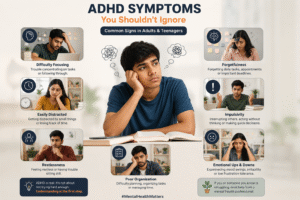
Attention-Deficit/Hyperactivity Disorder (ADHD) is one of the most common neurodevelopmental conditions, yet it’s also one of the most misunderstood. Many people picture ADHD as simply “a child who can’t sit still,” but the reality is far more nuanced. ADHD symptoms can look very different depending on a person’s age, gender, and the type of ADHD they have.
If you’ve been searching for clarity on ADHD symptoms — whether for yourself, your child, or a loved one — here are 10 essential signs to watch for, along with guidance on when it might be time to seek professional support.
What Is ADHD?
ADHD is a neurodevelopmental condition that affects how the brain regulates attention, impulse control, and activity levels. It’s not caused by poor parenting, laziness, or a lack of discipline — it stems from differences in brain development and functioning. ADHD typically begins in childhood, but for many people, it goes unrecognised until adolescence or adulthood, especially in those who don’t fit the “hyperactive” stereotype.
Below are the 10 most common ADHD symptoms seen in both children and adults.
ADHD-SYMPTOMS.
1. Difficulty Sustaining Attention
Trouble staying focused on tasks, conversations, lessons, or reading — especially when the activity isn’t inherently stimulating. This can look like zoning out mid-conversation or losing track of what’s being read.
2. Frequent Forgetfulness
Regularly misplacing items like keys, phones, or documents, and forgetting appointments, deadlines, or daily responsibilities, even when they matter.
3. Trouble Following Through on Tasks
Starting projects with enthusiasm but struggling to finish them. Instructions may be forgotten partway through, or attention shifts before a task is complete.
4. Easily Distracted by Surroundings or Thoughts
Unrelated noises, thoughts, or stimuli frequently pull focus away from the task at hand, making sustained concentration difficult.
5. Difficulty with Organisation and Time Management
Struggling to plan ahead, prioritise tasks, or estimate how long something will take. This often results in last-minute scrambling or missed deadlines.
6. Restlessness or Fidgeting
In children, this often looks like an inability to stay seated, excessive running, or climbing in inappropriate settings. In adults, it’s more often an inner restlessness — a constant urge to move, tap, or stay busy.
7. Excessive Talking or Interrupting
Talking more than the situation calls for, blurting out answers before a question is finished, or interrupting others mid-conversation.
8. Impulsivity in Decisions or Actions
Acting without fully thinking through consequences — this can show up as impulsive spending, rash decisions, or risky behaviour.
9. Difficulty Waiting or Taking Turns
Struggling with patience in queues, conversations, or group settings, often accompanied by a sense of urgency or frustration while waiting.
10. Emotional Sensitivity and Low Frustration Tolerance
Difficulty regulating emotional responses — quick frustration, irritability, or feeling overwhelmed more easily than others in similar situations.
Expert Insight: “A large number of adults who visit us for anxiety, low mood, or relationship stress are actually dealing with undiagnosed ADHD underneath it all. Once we look closely at their history — chronic procrastination, restlessness, difficulty organising their day — the pattern becomes clear. It’s never too late to understand your mind better and build strategies that genuinely work for you.” —Dr. Sugandha Gupta
How These Symptoms Differ Between Children and Adults
In children, ADHD symptoms tend to be more visible — difficulty sitting still, trouble following classroom instructions, frequent daydreaming, and struggles with peer relationships due to impulsivity. Teachers are often the first to notice these patterns, since classroom settings demand sustained attention and self-regulation.
In adults, symptoms often look less like hyperactivity and more like chronic disorganisation, procrastination, missed deadlines, and difficulty managing emotions. Many adults describe feeling like they’re “trying harder than everyone else just to keep up,” which can quietly affect self-esteem, careers, and relationships over time.
ADHD Symptoms Can Look Different in Women
Research shows that ADHD often presents differently in women and girls, who are more likely to show inattentive symptoms rather than visible hyperactivity. This can include internalised restlessness, difficulty with emotional regulation, and perfectionism paired with disorganisation. Because of this, many women are diagnosed later in life — sometimes only after a family member, often a child, receives a diagnosis first.
Why Recognising These Symptoms Matters
Unrecognised ADHD can affect nearly every area of life — academic performance, career growth, relationships, and emotional well-being. Many individuals with undiagnosed ADHD experience chronic feelings of underachievement, anxiety linked to ongoing struggles, strained relationships, and low self-confidence from repeated setbacks.
The encouraging news is that with the right support, understanding, and strategies, people with ADHD can build effective systems to manage symptoms and thrive in their personal and professional lives.
When Should You Seek Professional Guidance?
While occasional forgetfulness or restlessness is completely normal, it may be worth speaking to a mental health professional if these patterns:
Persist over a long period of time (six months or more)
Appear across multiple settings — home, school, or work
Significantly interfere with daily functioning
Cause distress to you or those around you
A qualified psychiatrist or psychologist can conduct a thorough evaluation, which usually involves a detailed history, standardised questionnaires, and sometimes input from family members or teachers, to understand whether ADHD or another condition might be contributing to these symptoms.
Expert Insight: “Parents often ask us how to tell the difference between normal childhood energy and something that needs attention. The key is looking at consistency and impact — if the restlessness or inattention shows up across home, school, and social settings, and it’s genuinely affecting the child’s confidence or learning, that’s when a proper evaluation is worthwhile. Early recognition makes a real difference in how a child experiences school and friendships.” — Dr. Paramjeet Singh
ADHD is a highly individual condition — no two people experience it in exactly the same way. Recognising these 10 essential symptoms early, whether in a child or an adult, is the first step toward better understanding, self-compassion, and effective management strategies.
If you or someone you love is showing signs of ADHD, know that support is available. A proper evaluation can offer clarity and open the door to strategies that make daily life more manageable.
At Delhi Mind Clinic, our specialists — including Dr. Sugandha Gupta and Dr. Paramjeet Singh — offer comprehensive ADHD evaluations for both children and adults. If you have questions or would like to schedule a consultation, feel free to reach out to us — understanding your mind is the first step toward supporting it better.
Pick up your phone right now — how many times have you already checked it today? For most people, the honest answer is somewhere between 60 and 100 times. Phones have quietly become the first thing we touch in the morning and the last thing we see at night. For many, this has crossed from convenience into excessive phone use — a pattern that affects sleep, focus, relationships, and mental well-being.
At Delhi Mind Clinic, we increasingly see patients — students, working professionals, and parents alike — who describe feeling “controlled” by their phones rather than in control of them. The good news: this is a well-understood pattern, and it is absolutely possible to change it.
What Counts as “Excessive” Phone Use?
There’s no single screen-time number that applies to everyone. What matters more is the impact your phone use is having on your daily life. Excessive phone use is generally characterised by:
Reaching for your phone automatically, without a clear reason
Feeling anxious, restless, or “incomplete” when it’s not nearby
Losing track of time while scrolling, often for far longer than intended
Using the phone late into the night, cutting into sleep
Neglecting work, studies, chores, or face-to-face conversations because of phone use
Feeling a small jolt of relief or distraction every time a notification appears
If several of these sound familiar, you’re not alone — and it’s worth understanding why this happens.
excessive-phone-use
Why Phones Are So Hard to Put Down
This isn’t simply a matter of “willpower.” Phones — and the apps on them — are deliberately designed to hold attention.
1. The dopamine loop Every like, message, or notification triggers a small release of dopamine, the brain’s “reward” chemical. Because these rewards arrive unpredictably, the brain stays hooked, checking again and again in anticipation of the next one — the same mechanism that makes slot machines addictive.
2. Fear of missing out (FOMO) Social feeds create a constant, low-level worry that something important is happening elsewhere, making it hard to disengage.
3. Escape from difficult emotions For many people, scrolling becomes an automatic way to avoid boredom, stress, loneliness, or uncomfortable feelings — offering short-term relief but reinforcing the habit over time.
4. Habit and environment cues A buzzing notification, a lull in conversation, even a quiet room can become an automatic trigger to check the phone, often before we’ve consciously decided to.
The Real-World Impact
Excessive phone use rarely stays contained to “just the phone.” Over time, it can quietly affect several areas of life:
Sleep — Late-night scrolling delays sleep onset and reduces sleep quality, leaving you tired and irritable the next day.
Focus and productivity — Frequent checking fragments attention, making deep, sustained concentration harder to sustain.
Mood — Constant comparison with curated, highlight-reel lives on social media can lower self-esteem and increase feelings of anxiety or low mood.
Relationships — “Phubbing” (phone snubbing) — glancing at your phone while someone is talking to you — can quietly erode connection with family, friends, and partners.
Posture and physical health — Prolonged phone use is linked to neck strain, eye fatigue, and reduced physical activity.
Recognising these effects is not about guilt — it’s the first, most useful step toward change.
Practical Steps to Reduce Excessive Phone Use
Small, consistent changes tend to work far better than dramatic, short-lived resolutions. Here are strategies our team often recommends:
1. Create Phone-Free Zones and Times
Keep the phone out of the bedroom and away from the dining table. Even simple boundaries — like no phones for the first hour after waking, or the last hour before sleep — can significantly reduce automatic checking.
2. Turn Off Non-Essential Notifications
Most notifications aren’t urgent. Turning off alerts for social media and games removes the constant “pull” and lets you check apps on your own schedule instead of the app’s.
3. Use Screen-Time Tools Intentionally
Built-in screen-time trackers and app limits can make invisible habits visible. Simply seeing your daily average often motivates a natural reduction.
4. Replace, Don’t Just Remove
Cutting phone use without filling that time with something else often backfires. Keep an easy, satisfying alternative on hand — a short walk, a book, a hobby, or a quick chat with someone nearby.
5. Practice the “Pause Before You Pick Up” Habit
Before reaching for your phone, pause for three seconds and ask: Am I checking this for a reason, or out of habit? This small pause interrupts the automatic loop.
6. Be Mindful of Emotional Triggers
Notice if you reach for your phone specifically when bored, anxious, or lonely. Naming the feeling — “I’m scrolling because I feel anxious” — helps you address the actual emotion instead of masking it.
7. Set Tech-Free Time With Loved Ones
Designate meals, family time, or outings as phone-free. This strengthens real-world connection and gives the brain a genuine break from constant stimulation.
When to Seek Professional Support
For most people, awareness and small habit changes are enough to bring phone use back into balance. However, it may be worth speaking with a mental health professional if:
Your phone use feels genuinely out of your control, despite repeated attempts to cut back
It’s significantly affecting your sleep, work, studies, or relationships
You notice it’s linked to underlying anxiety, low mood, or difficulty coping with stress
Attempts to reduce use lead to noticeable irritability, restlessness, or distress
Excessive phone use is often a symptom of something deeper — stress, anxiety, loneliness, or difficulty regulating emotions — rather than the root problem itself. A mental health professional can help identify and address these underlying factors in a supportive, non-judgmental way.
Your phone is a tool — a powerful one — but it works best when it serves you, not the other way around. Rebuilding a healthier relationship with your phone doesn’t require giving it up entirely; it requires awareness, small structural changes, and patience with yourself along the way.
If you feel like excessive phone use is affecting your mental well-being, the team at Delhi Mind Clinic is here to help. Reach out to speak with a mental health professional in a confidential, supportive space.
Self-care rituals don’t have to be elaborate to work. Scroll through social media and self-care can start to look like a full-time job — elaborate skincare shelves, hour-long yoga sessions, expensive retreats, and colour-coded journals. For most people juggling work, family, and everyday responsibilities, that picture doesn’t feel like relaxation. It feels like one more thing to keep up with.
self-care-rituals
The good news? Real self-care doesn’t need to be elaborate, expensive, or time-consuming. According to mental health experts, some of the most effective self-care habits take less than five minutes — and the ones that stick are usually the simplest.
In this post, we break down why small, consistent habits matter more than grand wellness gestures, and share five easy self-care rituals you can build into your day starting today.
Why “Waiting Until You’re Burnt Out” Doesn’t Work
One of the most common mistakes people make with self-care is treating it as damage control — something you turn to only after you’re exhausted, overwhelmed, or running on empty.
Mental health professionals often compare this to servicing a car only after it breaks down, instead of maintaining it regularly. Self-care works best as prevention, not recovery. The World Health Organization defines self-care as the ability of individuals to promote and maintain their own health and well-being — not just a response to illness or burnout. When self-care rituals are woven into your daily routine in small ways, they help you stay balanced before stress builds up — rather than trying to undo weeks of neglect in one go.
The rituals that actually last aren’t the ones that require a special mood, a free weekend, or a shopping list. They’re the ones that feel easy enough to become a natural part of your day. In fact, the American Psychological Association notes that even brief, consistent self-care practices can meaningfully reduce stress and improve emotional resilience over time.
5 Simple, Low-Effort Self-Care Rituals to Try Today
These self-care rituals are designed to take five minutes or less, so they’re easy to stick with even on your busiest days.
1. The Two-Minute Body Check-In
Pause for a moment. Relax your shoulders, unclench your jaw, and notice how your body actually feels — are you hungry, thirsty, tired, or emotionally overwhelmed? This quick scan helps you catch needs that often go unnoticed during a busy day, before they turn into bigger stress or fatigue.
2. A Five-Minute Movement Break
You don’t need a full workout to reset your energy. Gentle neck rolls, shoulder stretches, a short walk around the room, or a couple of flights of stairs can ease stiffness and improve alertness. If you have a desk job, try setting a reminder every hour or two to simply stand up and move — your body and focus will thank you.
“People who work at desks often don’t realise how much prolonged sitting affects both their body and their mind. A short movement break every hour isn’t just good for posture — it genuinely helps reset focus and reduce the mental fatigue that builds up over a long workday,” says Dr. Paramjeet Singh, Psychiatrist at Delhi Mind Clinic.
3. A No-Phone Buffer After Work
The moment work ends, many of us go straight from one screen to another. Instead, try keeping your phone away for 10–15 minutes after you finish work — put it on silent or leave it in another room. This small buffer gives your mind a chance to shift out of “work mode” before you dive back into notifications and distractions.
4. Writing Down a Single Thought
Journaling doesn’t have to mean pages of reflection. Just jot down one thought — how you’re feeling, something that made you smile, or one thing you want to focus on tomorrow. This tiny habit can help clear mental clutter and improve emotional awareness over time. If you’d like a more structured approach, check out our guide to journaling for mental health for simple prompts to get started.
5. Making a Beverage — For Yourself, Not on Autopilot
Whether it’s a cup of tea, coffee, or a glass of infused water, the act of preparing a drink slowly and mindfully can be a moment of pause in itself. Instead of rushing through it while multitasking, let it be a small, intentional break that helps you be present before moving to the next task.
The Bigger Picture: Consistency Over Intensity
None of these self-care rituals require special equipment, a big time commitment, or a complete lifestyle overhaul. That’s the point. Self-care isn’t about how much effort you put in — it’s about how consistently you show up for yourself, even in small ways.
If you find that stress, low mood, or anxiety are affecting your daily life despite these efforts, that’s a sign it may help to talk to a mental health professional. Small rituals are powerful for everyday balance, but ongoing distress deserves proper support and guidance — you can learn more about when to seek professional help for stress and anxiety in our related guide.
Final Thoughts
Self-care doesn’t have to look like a curated aesthetic or a luxury experience. Often, it’s the two-minute pause, the short walk, the single honest sentence written down, or the quiet cup of tea made just for you. Start with just one or two self-care rituals, stay consistent, and let them become a natural part of your everyday rhythm — not another task on your to-do list.
If you’re finding it difficult to manage stress, anxiety, or emotional overwhelm on your own, our team at Delhi Mind Clinic is here to help. Explore our therapy and counselling services or book a consultation to speak with a mental health professional and find support that works for you.
This list of phobias a to z is designed to help you understand just how wide-ranging human fears can be. Fear is a natural human emotion — but for some people, a specific fear becomes so intense and persistent that it starts to interfere with daily life. This is known as a phobia: an overwhelming, often irrational fear of a specific object, situation, or activity.
Phobias are more common than most people realize, and they can range from the well-known (fear of heights or spiders) to the surprisingly specific (fear of buttons or the number 13). At DelhiMindClinic, we believe that understanding phobias — what they are, how they present, and when they need attention — is an important step toward reducing stigma and helping people seek support.
In this article, we’ve compiled a comprehensive list of phobias a to z, along with an explanation of what causes phobias, common symptoms, and guidance on when professional help may be beneficial.
What Is a Phobia?
Before diving into our full list of phobias a to z, it helps to understand what a phobia actually is. A phobia is more than just disliking something or feeling a bit nervous. It is an intense, persistent fear that is often out of proportion to the actual danger posed by the object or situation. People with phobias may go out of their way to avoid the source of their fear, and simply thinking about it can trigger significant anxiety.
Common signs that a fear may have become a phobia include:
Rapid heartbeat, sweating, or shortness of breath when exposed to the trigger
Overwhelming urge to escape or avoid the situation entirely
Anxiety that begins well before actually encountering the trigger
Awareness that the fear is excessive, but feeling unable to control it
Fear that noticeably disrupts work, relationships, or daily routines
Common signs that a fear may have become a phobia include:
Rapid heartbeat, sweating, or shortness of breath when exposed to the trigger
Overwhelming urge to escape or avoid the situation entirely
Anxiety that begins well before actually encountering the trigger
Awareness that the fear is excessive, but feeling unable to control it
Fear that noticeably disrupts work, relationships, or daily routines
Complete List of Phobias A to Z
list-of-phobias-a-to-z
Below is an extensive list of phobias a to z, covering recognized phobias along with what each one refers to.
A
Acrophobia – Fear of heights
Agoraphobia – Fear of open or crowded spaces, or situations where escape feels difficult
Aerophobia – Fear of flying
Aichmophobia – Fear of sharp or pointed objects
Ailurophobia – Fear of cats
Amaxophobia – Fear of riding in or driving vehicles
Arachnophobia – Fear of spiders
Astraphobia – Fear of thunder and lightning
Automatonophobia – Fear of humanoid figures (dolls, wax figures, robots)
B
Bacteriophobia – Fear of bacteria and germs
Bathophobia – Fear of depths
Belonephobia – Fear of needles or pins
Brontophobia – Fear of thunderstorms
C
Claustrophobia – Fear of confined or enclosed spaces
Coulrophobia – Fear of clowns
Cynophobia – Fear of dogs
Chronophobia – Fear of time or the passing of time
Cibophobia – Fear of food
D
Dentophobia – Fear of dentists
Domatophobia – Fear of houses or being in a house
Dystychiphobia – Fear of accidents
E
Emetophobia – Fear of vomiting
Entomophobia – Fear of insects
Equinophobia – Fear of horses
Erythrophobia – Fear of blushing or the color red
F
Felinophobia – Fear of cats
Frigophobia – Fear of the cold
Friggatriskaidekaphobia – Fear of Friday the 13th
G
Gamophobia – Fear of marriage or commitment
Genophobia – Fear of sexual intimacy
Gephyrophobia – Fear of bridges
Glossophobia – Fear of public speaking
H
Hemophobia – Fear of blood
Herpetophobia – Fear of reptiles
Hydrophobia – Fear of water
Hypochondria – Persistent fear of having a serious illness
I
Iatrophobia – Fear of doctors
Ichthyophobia – Fear of fish
Insectophobia – Fear of insects
K
Kenophobia – Fear of empty or open spaces
Koinoniphobia – Fear of rooms full of people
L
Leukophobia – Fear of the color white
Lilapsophobia – Fear of tornadoes and hurricanes
M
Mysophobia – Fear of germs and dirt
Melissophobia – Fear of bees
Musophobia – Fear of mice
N
Necrophobia – Fear of death or dead things
Nyctophobia – Fear of the dark
Nosocomephobia – Fear of hospitals
O
Ochlophobia – Fear of crowds
Odontophobia – Fear of teeth or dental procedures
Ombrophobia – Fear of rain
Ophidiophobia – Fear of snakes
Ornithophobia – Fear of birds
P
Panphobia – Fear of everything
Pediophobia – Fear of dolls
Phasmophobia – Fear of ghosts
Photophobia – Fear or sensitivity to light
Pyrophobia – Fear of fire
R
Radiophobia – Fear of radiation
Rhytiphobia – Fear of getting wrinkles
S
Scolionophobia – Fear of school
Selachophobia – Fear of sharks
Social Phobia (Social Anxiety Disorder) – Fear of social situations and being judged by others
Somniphobia – Fear of sleep
T
Tachophobia – Fear of speed
Taphophobia – Fear of being buried alive or of graves
Technophobia – Fear of technology
Thanatophobia – Fear of death
Trypanophobia – Fear of injections or needles
Trypophobia – Fear of clustered patterns of holes
V
Vehophobia – Fear of driving
Verminophobia – Fear of germs
X
Xenophobia – Fear of strangers or foreigners
Z
Zoophobia – Fear of animals
Note: There are hundreds of documented phobias, and new terms continue to be coined for very specific fears. This list of phobias a to z highlights some of the most recognized and commonly discussed phobias.
Why Do Phobias Develop?
Looking through our list of phobias a to z, you may notice that the specific triggers vary widely — but the underlying reasons they develop tend to follow similar patterns. Phobias can develop for a variety of reasons, including:
Past experiences – A frightening or traumatic event involving the object or situation
Learned behavior – Observing a family member’s fear during childhood
Genetics and temperament – Some individuals may be naturally more prone to anxiety
Evolutionary factors – Certain fears (like snakes or heights) may have roots in survival instincts
Understanding the root cause of a phobia can be a helpful part of addressing it, though it isn’t always necessary for recovery.
Expert Insights: What Our Specialists Say
Dr. Sugandha Gupta, Consultant Psychiatrist, shares: “In my clinical experience, many people live with a specific phobia for years before seeking help, often because they assume it’s just a personal quirk rather than something that can be addressed. What I tell my patients is that a phobia isn’t a sign of weakness — it’s simply the mind’s alarm system misfiring in response to a particular trigger. With the right, structured support, most people see meaningful improvement.”
Dr. Paramjeet Singh, Consultant Psychiatrist, adds: “One pattern I often see is that families underestimate how much a phobia can affect daily functioning — from career choices to relationships to something as simple as travel. Awareness is the first step. Once someone understands what they’re experiencing has a name, a cause, and a path forward, it becomes much easier for them to reach out and get support.”
(Note: These insights are provided by our specialists at DelhiMindClinic and are intended for general educational purposes.)
When a Fear Becomes a Phobia
Everyone experiences fear from time to time — but a phobia is distinct because of its intensity and impact. If a fear is:
Disproportionate to the actual risk involved
Consistently avoided, even at a personal or professional cost
Accompanied by physical symptoms like a racing heart, dizziness, or panic
Present for six months or more
…it may be time to consider speaking with a mental health professional.
How Phobias Are Typically Addressed
Mental health professionals often use structured, evidence-based approaches to help individuals manage and reduce phobic responses, such as:
Gradual exposure techniques – Slowly and safely facing the feared object or situation in a controlled way
Cognitive approaches – Identifying and reshaping the thought patterns that fuel the fear
Relaxation and breathing techniques – Managing the physical symptoms of anxiety in the moment
Psychoeducation – Understanding the phobia itself often reduces the fear of the fear
A qualified professional can help determine the most appropriate approach for each individual’s specific phobia and situation.
Phobias are far more common — and far more varied — than most people realize. From widely recognized fears like heights and spiders to highly specific ones, phobias can affect anyone, at any stage of life. The good news is that phobias are among the most treatable mental health concerns, and with the right support, people can regain a sense of control and freedom in their daily lives.
If a specific fear is affecting your daily life, relationships, or wellbeing, reaching out to a mental health professional is a strong and worthwhile first step. We hope this list of phobias a to z helps you better understand your own experience or that of someone you care about.
Every family has its own rhythm — its own way of laughing, arguing, comforting, and coming back together after a hard day. But behind these everyday moments lies something deeper and often overlooked: family mental health. Understanding and nurturing your family’s mental health can transform the way your household copes, connects, and grows together.
When we talk about mental wellbeing, we usually think of it as an individual issue. Yet mental health rarely exists in isolation. It is shaped — and often healed — within the family unit. A supportive home can be one of the strongest protective factors against stress, anxiety, and emotional burnout, while a strained or disconnected one can quietly affect every member’s emotional world.
At DelhiMindClinic.com, we believe that understanding and prioritizing family mental health isn’t just helpful — it’s essential for building homes where every member, from the youngest to the oldest, feels safe, heard, and valued. Below, we walk through 7 essential secrets to strengthening family mental health, so your household can thrive together.
What Does “Family Mental Health” Really Mean?
Family mental health refers to the emotional, psychological, and social wellbeing of a family as a collective system — not just the individuals within it. It includes:
How family members communicate and resolve conflict
The emotional safety each person feels at home
How stress, grief, or major life changes are processed together
The patterns of support (or silence) that get passed down through generations
How connected — or disconnected — members feel from one another
Think of a family as an emotional ecosystem. When one member struggles, it naturally affects the others. Similarly, when the family environment is warm, communicative, and emotionally responsive, it becomes a source of resilience for everyone in it.
Why Family Mental Health Deserves More Attention
1. It Shapes How Children Understand Emotions
Children learn emotional regulation primarily by observing the adults around them. A home where feelings are acknowledged rather than dismissed teaches children that emotions are normal, manageable, and safe to express.
2. It Influences How Adults Cope With Stress
Work pressure, financial worries, and daily responsibilities can weigh heavily on parents and caregivers. A supportive family environment acts as a buffer, helping adults process stress in healthier ways instead of internalizing or suppressing it.
3. It Affects Relationship Patterns for Life
The communication styles, conflict-resolution habits, and emotional openness (or avoidance) modeled at home often become the blueprint people carry into their own future relationships and families.
4. It Strengthens Family Bonds During Difficult Times
Illness, loss, financial setbacks, or major transitions test every family. Families with strong emotional foundations tend to navigate these challenges with more unity and less long-term strain.
Common Signs a Family May Need to Focus on Mental Wellbeing
It’s not always obvious when family mental health needs attention. Some subtle signs include:
Frequent misunderstandings or unresolved arguments
Family members withdrawing or spending less time together
A general sense of tension, even without an obvious cause
Children or teens becoming unusually quiet, irritable, or withdrawn
Difficulty discussing feelings openly without judgment or defensiveness
One or more members feeling emotionally “unseen” within the family
Recognizing these patterns early — rather than dismissing them as “just a phase” — can make a significant difference in preventing deeper emotional strain.
7 Essential Secrets to Strengthening Family Mental Health
family-mental-health
These 7 secrets to family mental health are simple to start, but powerful when practiced consistently.
1. Create Space for Open Conversations
Set aside regular, low-pressure time — even 10–15 minutes a day — where family members can share how they’re feeling without fear of criticism or being rushed to “fix” the problem. This habit alone can significantly improve family mental health over time.
2. Practice Active Listening
Listening to understand, rather than to respond, helps family members feel genuinely heard. This means putting away distractions, maintaining eye contact, and resisting the urge to immediately offer solutions.
3. Normalize Talking About Emotions
Avoid treating sadness, anger, or anxiety as things to hide. When emotions are discussed openly and without shame, family members are more likely to seek support early rather than suppressing difficulties until they escalate — a key pillar of good family mental health.
4. Build Predictable Rituals of Connection
Shared meals, weekend walks, or a simple bedtime check-in create consistency and emotional security — especially for children, who thrive on predictability.
5. Respect Individual Coping Styles
Not everyone processes stress the same way. Some family members may need quiet time alone, while others seek comfort through conversation. Respecting these differences, rather than forcing one “right” way to cope, strengthens trust.
6. Model Healthy Conflict Resolution
Disagreements are natural in every family. What matters is how they’re handled — with respect, patience, and a willingness to repair the relationship afterward, rather than avoidance or blame.
7. Recognize When Professional Support Can Help
Just as families seek medical guidance for physical health, reaching out to a mental health professional is a proactive, healthy step — not a sign of failure. Family counseling or therapy can offer tools and perspective that are difficult to access on your own, especially during prolonged stress, major transitions, or recurring conflict. Investing in professional support is one of the most effective ways to protect long-term family mental health.
The Ripple Effect of Strong Family Mental Health
When families prioritize family mental health, the benefits extend far beyond the home. Children grow into emotionally resilient adults. Parents experience less chronic stress. Relationships across generations become more compassionate. And the family, as a whole, becomes a source of strength rather than strain during life’s inevitable challenges.
Family mental health isn’t about achieving a “perfect” home — it’s about creating an environment where imperfection, growth, and honest emotion are welcomed rather than hidden.
Strong families aren’t the ones without struggles — they’re the ones that learn to face struggles together. By prioritizing communication, empathy, and emotional safety, every family can build a foundation that supports each member’s mental wellbeing, today and for generations to come.
If your family is going through a difficult phase or simply wants to strengthen your emotional connection, reaching out for professional guidance can be a meaningful first step toward better family mental health. At DelhiMindClinic.com, we’re here to support families in building healthier, happier, and more emotionally connected homes.