For general questions, please send us a message and we’ll get right back to you. You can also call us directly to speak with a member of our service team or insurance expert.
Conversations about mental health are everywhere today. Families, workplaces, schools and social media are talking about emotional well-being more openly than ever before.
Dr. Paramjeet Singh, Psychiatrist at Delhi Mind Clinic, New Delhi, shares his perspective on this shift. Here are five powerful insights from his thoughts on why this topic matters now and how each of us can contribute.
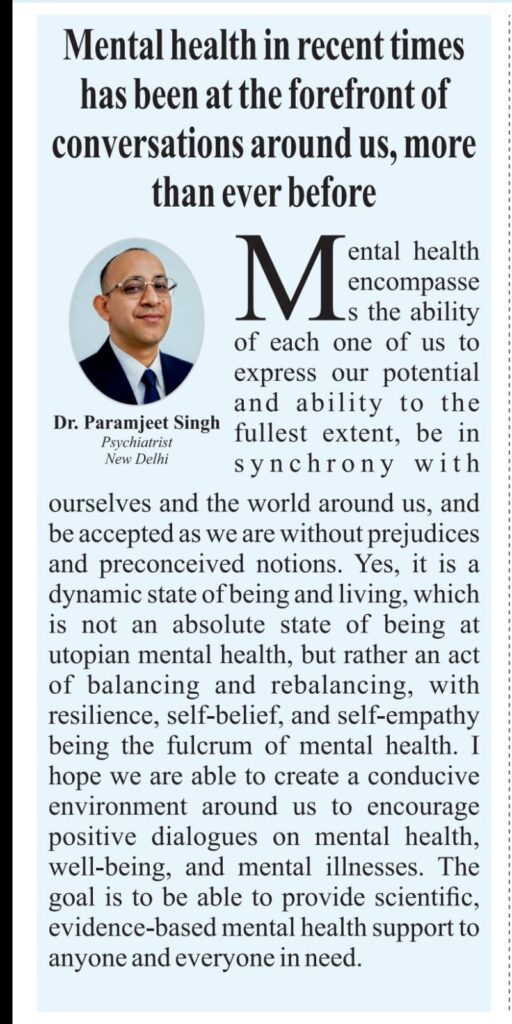
Insight 1: Well-Being Means Expressing Your Full Potential
According to Dr. Singh, mental health is the ability of each one of us to:
Express our potential and abilities to the fullest extent
Stay in synchrony with ourselves and the world around us
Be accepted as we are, without prejudice or preconceived notions
It is far more than the absence of illness. It is about how we think, feel, relate to others and handle the demands of daily life.
Insight 2: Well-Being Is a Dynamic State, Not a Destination
Dr. Singh describes emotional wellness as a dynamic state of being and living. It is not a perfect, utopian condition that we reach once and keep forever.
Instead, it is an act of balancing and rebalancing. Life brings stress, change, loss and uncertainty, and healing means finding our footing again each time. A difficult season does not mean you have failed. It means you are human.
Insight 3: Resilience, Self-Belief and Self-Empathy Are the Fulcrum
Dr. Singh calls these three qualities the fulcrum of mental health, the point on which everything else balances:
Resilience: the capacity to recover and adapt after setbacks.
Self-belief: trust in your own worth and ability to grow.
Self-empathy: treating yourself with the kindness you would offer a friend.
Small habits strengthen all three: regular routines, quality sleep, physical activity, supportive relationships and kind self-talk.
Dr. paramjeet singh on mental health
Insight 4: Why Everyone Is Talking About It More Than Ever
Emotional well-being has moved to the forefront of public conversation for several reasons:
Greater awareness: people recognize distress in themselves and others.
Fast-paced lifestyles: work pressure and constant connectivity take a toll.
Less silence: shared stories help break stigma.
Mind-body connection: emotional balance affects sleep, relationships and productivity.
Dr. Singh hopes we can create a conducive environment that encourages positive dialogue. You can help by listening without judging, avoiding stereotypes, checking in on loved ones and relying on credible information rather than myths.
Insight 5: Evidence-Based Support for Anyone in Need
Dr. Singh’s goal is to provide scientific, evidence-based mental health support to anyone and everyone in need. Asking for help is a sign of strength and self-care, not weakness.
When to Consider Professional Help
Consider consulting a psychiatrist or mental health professional if you or someone close to you experiences:
Persistent sadness, worry or irritability
Changes in sleep, appetite or energy
Difficulty concentrating or functioning at work, school or home
Withdrawal from people or activities once enjoyed
If you or someone you know is in crisis or having thoughts of self-harm, reach out immediately to a trusted person, a nearby doctor or hospital, or the national helpline Tele-MANAS (14416) in India.
Frequently Asked Questions
1. What is mental health?
Mental health is our emotional, psychological and social well-being. It shapes how we think, feel, act and relate to others, and how we handle stress and make choices.
2. Is mental health the same as mental illness?
No. Everyone has mental health, just as everyone has physical health. Mental illness refers to conditions that affect thinking, mood or behavior and may need professional care.
3. Can mental health change over time?
Yes. It is dynamic and can shift with life events, stress, relationships and support. Balancing and rebalancing is a normal part of life.
4. How can I improve my mental health?
Build resilience, self-belief and self-empathy. Maintain healthy routines, stay connected with loved ones, and seek professional guidance when needed.
5. When should I see a psychiatrist?
When emotional or behavioral difficulties persist, interfere with daily life, or feel too heavy to manage alone, it is a good time to consult a specialist.
Conclusion
Mental health is not a luxury or a trend. It is a vital part of living well. As Dr. Paramjeet Singh reminds us, it is a continuous act of balance, supported by resilience, self-belief and self-empathy, and by a society that listens without prejudice.
Need support? Book a consultation with Dr. Paramjeet Singh at Delhi Mind Clinic, New Delhi, and take the first step toward better mental health.
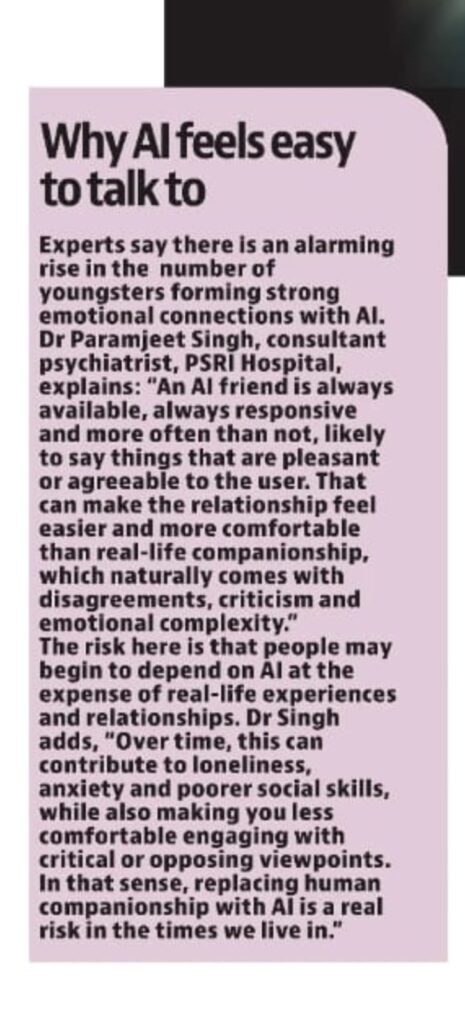
This World Mental Health Day (10 October), Dr Paramjeet Singh explains why more young people are forming emotional bonds with AI, and where the risks begin.
It’s 3 a.m. Sleep won’t come, your mind is racing, and nobody is awake to talk to. So you open a chatbot. It replies instantly, it doesn’t judge, and it never gets tired of you.
For many people, this is now a nightly habit. As AI and mental health increasingly overlap, a bigger question follows: when does a helpful conversation become emotional dependence?
Dr Paramjeet Singh Insights
On World Mental Health Day, Dr Paramjeet Singh, Consultant Psychiatrist at PSRI Hospital, shared his insights in a Hindustan Times feature. Here is what every parent, student and young professional should know about AI and emotional wellbeing.
Why Chatbots Are on the Agenda This World Mental Health Day
World Mental Health Day (October 10) aims to raise awareness of mental health worldwide. This year’s theme, “Lived experiences heard: real voices, real change,” is a timely reminder that real voices matter, and that no chatbot can fully replace the human ones around us.
An “Alarming Rise” in Youngsters Bonding With AI
Experts are seeing a worrying trend: more and more young people are forming strong emotional connections with AI. What began as a tool for answers is becoming a companion for feelings.
Why AI Feels So Easy to Talk To
According to Dr Singh, a chatbot companion has three qualities that make it so comfortable:
Always available. There are no appointments, no waiting and no “I’m busy right now.”
Always responsive. It replies instantly, every time.
Usually agreeable. More often than not, it says things the user finds pleasant.
Real relationships work differently. Friendships, family and partnerships naturally involve disagreements, criticism and emotional complexity. Next to a chatbot that always accommodates you, human connection can start to feel like too much effort. That contrast is the heart of the problem.
The Real Risk: Choosing AI Over Real Life
The concern is not that people use these tools. It is that they may begin to depend on them at the expense of real-life experiences and relationships.
Dr Singh warns that over time this can contribute to:
Loneliness, because a screen cannot fully replace human presence.
Anxiety, especially around real-world interactions.
Poorer social skills, because less practice makes conversation harder.
Discomfort with opposing views, since constant agreement makes disagreement feel threatening.
In his view, replacing human companionship with AI is a real risk in the times we live in.
5 Warning Signs of Unhealthy Chatbot Reliance
Watch for these patterns in yourself, your child or a family member:
Withdrawing from family, friends and everyday activities
Spending far more time with a chatbot than with people
Feeling anxious, low or upset when unable to access it
Skipping school, work, sleep, hobbies or social plans to keep chatting
Preferring chatbot conversations because real ones feel “too difficult”
One or two of these signs doesn’t mean there is a disorder, but a persistent pattern deserves attention.
AI Is Not a Substitute for Mental Health Care
A chatbot can help someone put their thoughts into words, and that has value. But it cannot replace the clinical judgement, empathy and human connection that matter most when someone is in serious distress. A screen can respond to words. A trained professional can recognise the pain behind them, ask the difficult questions and stay present when it matters most.
If you or someone you know is experiencing severe low mood, hopelessness or thoughts of self-harm, please reach out to a mental health professional or a trusted person immediately. In India you can also call the Tele-MANAS helpline at 14416.
How to Use AI Healthily: Practical Tips
Set time limits, especially at night.
Treat chatbots as a tool, not a confidant for your deepest struggles.
Reach out to one real person each day, even briefly.
Practise disagreement. Healthy relationships include difficult conversations.
Parents: stay engaged. Talk openly with your children instead of leaving hard conversations to technology.
Seek help early if screen time is affecting sleep, studies, work or relationships.
When to Consult a Psychiatrist for Mental Health Concerns
Consider professional support if you notice persistent anxiety, loneliness, mood changes, sleep problems or increasing withdrawal from people. Early support makes a real difference, and talking to a real person is a strong first step.
This World Mental Health Day, take that step. At Delhi Mind Clinic, our team provides confidential, compassionate care for anxiety, depression, stress, sleep problems and emotional wellbeing.
When we talk about health, the mind is often the last thing that comes to mind — and that’s exactly the gap Dr. Paramjeet Singh has spent his career trying to close. As a Consultant Psychiatrist at PSRI Hospital, Co-Founder & Senior Consultant at Delhi Mind Clinic, and General Secretary of the Delhi Psychiatric Society, Dr. Paramjeet Singh has become one of Delhi’s most trusted voices in mental health — someone who believes that emotional well-being deserves the same attention, respect, and care as physical health.
Taking Mental Health Beyond the Clinic
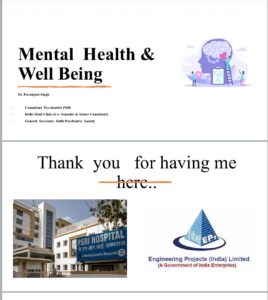
While consulting rooms remain at the heart of his practice, Dr. Paramjeet Singh strongly believes that real change happens when mental health conversations move beyond hospital walls — into workplaces, communities, and everyday life. That belief was on full display during his recent session on “Mental Health & Well-Being”, delivered to employees at Engineering Projects (India) Limited (EPI), a Government of India Enterprise.
The session focused on a topic that touches almost every working professional today: corporate and employee mental health.
Why Work-Life Balance Isn’t Just a Buzzword
Standing before a room full of employees, Dr. Paramjeet Singh opened with a simple but powerful reminder:
“Work-life balance is an integral part of management.”
It’s a line many people hear often — but rarely reflect on deeply. In the session, Dr. Singh unpacked why this idea matters more than ever in modern corporate culture:
Unmanaged stress quietly erodes productivity. What starts as a few tense days at work can, over time, affect focus, decision-making, and overall performance.
Silence is often the biggest barrier. Many employees privately wonder whether they should open up about what they’re going through, but hold back — unsure how colleagues or managers will react.
Not all stress is “bad” stress. One of the more thought-provoking points from the session was the idea that a certain kind of pressure, when understood and managed well, can actually fuel growth rather than hinder it.
By addressing these questions directly, Dr. Paramjeet Singh helped create a space where mental health wasn’t treated as a taboo subject, but as a normal, necessary part of workplace conversations.
Why Corporate Mental Health Deserves More Attention
India’s corporate landscape has changed dramatically in the last decade — longer hours, higher targets, and constant connectivity have blurred the line between professional and personal life. Yet, mental well-being at the workplace is still often overlooked until it becomes a crisis.
Dr. Paramjeet Singh’s work — through sessions like the one at EPI, his clinical practice, and his role with the Delhi Psychiatric Society — consistently pushes back against this neglect. His approach is not about offering quick fixes, but about building awareness, empathy, and open dialogue within organizations, so that employees feel safe acknowledging stress before it turns into burnout.
This is a philosophy that also shapes the work at Delhi Mind Clinic, where Dr. Singh and his team focus on creating a supportive, non-judgmental environment for anyone navigating emotional or psychological challenges — whether they’re a student, a working professional, a parent, or a senior citizen.
A Voice That Bridges Clinical Expertise and Public Awareness
What makes Dr. Paramjeet Singh’s contribution unique is the range of his engagement with mental health:
As a Consultant Psychiatrist at PSRI Hospital, he brings deep clinical expertise to complex cases.
As Co-Founder & Senior Consultant at Delhi Mind Clinic, he helps shape a practice built on accessibility and compassionate care.
As General Secretary of the Delhi Psychiatric Society, he plays an active role in advancing mental health awareness and professional standards across the city.
And through corporate sessions like the one at EPI, he takes psychiatric insight out of the clinic and into everyday spaces where people spend most of their waking hours — their workplaces.
This blend of clinical depth and public engagement is exactly what mental health advocacy in India needs today: experts who are willing to step outside traditional settings and meet people where they are.
The Bigger Picture: Normalizing Mental Health Conversations
Sessions like the one Dr. Paramjeet Singh conducted at EPI are more than one-off events — they’re part of a larger, necessary shift. As organizations across India begin to recognize that employee well-being directly impacts performance, retention, and culture, the demand for credible, compassionate mental health guidance will only grow.
Dr. Paramjeet Singh’s continued work — in hospitals, in clinics, in professional associations, and now in corporate boardrooms — reflects a simple but important message: mental health is not a side conversation. It’s central to how we live, work, and grow.
Open your phone right now, and there’s a good chance you’ll find at least one app promising to “boost your mood,” “reduce your stress,” or “talk you through anxiety.” Over the past few years, AI chatbots and mental health apps have quietly become part of daily life for millions of people — especially younger users who find it easier to type out their feelings to a bot at 2 a.m. than to book an appointment.
At Delhi Mind Clinic, we get asked about this often: “Can an app really help my anxiety?” “Is talking to an AI chatbot the same as therapy?” “Should I trust these apps with my mental health?”
This blog post breaks down what AI chatbots and mental health apps actually do, where they genuinely help, where they fall short, and how to use them wisely — without replacing the human support that real healing often needs.
What Are AI Chatbots and Mental Health Apps, Exactly?
AI chatbots and mental health apps are digital tools designed to support emotional wellbeing. They generally fall into a few categories:
Conversational chatbots that simulate supportive conversation, using natural language processing to respond to how you’re feeling.
Mood and habit trackers that help you log emotions, sleep, and daily patterns over time.
Guided self-help tools offering structured exercises based on approaches like cognitive behavioural techniques, mindfulness, and journaling.
Meditation and relaxation apps that use guided audio, breathing exercises, and calming visuals to reduce stress in the moment.
Some of these tools are built by mental health professionals and grounded in evidence-based frameworks. Others are more casual wellness products with far less clinical rigour behind them — and knowing the difference matters.
Ai-chatbots-and-mental-health-apps
Why Are So Many People Turning to AI Chatbots for Mental Health Support?
The rise of AI chatbots and mental health apps isn’t happening in a vacuum. A few real factors are driving it:
1. Availability, Anytime
Mental health struggles don’t stick to office hours. A chatbot is available at midnight, during a panic moment, or on a quiet Sunday when no clinic is open.
2. Lower Barrier to Starting
For many people, the idea of walking into a clinic feels intimidating. Typing a message to an app feels safer as a first step — especially for those who aren’t ready to speak to a person yet.
3. Anonymity and Reduced Stigma
In a culture where mental health is still surrounded by stigma, an app can feel like a judgment-free space to admit “I’m not okay” for the first time.
4. Affordability
Many mental health apps are free or low-cost, which makes them accessible to people who may not yet be able to afford regular professional sessions.
5. Consistency
Apps don’t get tired, distracted, or busy. They can offer the same calm, structured check-in every single day, which builds a helpful routine for some users.
Where AI Chatbots and Mental Health Apps Genuinely Help
It’s easy to dismiss these tools as “just an app,” but used correctly, they do offer real value:
Building a daily self-awareness habit — logging moods and thoughts helps people notice patterns they’d otherwise miss.
Practising coping skills — breathing exercises, grounding techniques, and journaling prompts are simple but effective tools for everyday stress.
A bridge to professional help — for many people, using an app is the first step that eventually leads them to seek real therapy or counselling.
Support between sessions — for those already working with a therapist, apps can reinforce techniques discussed in session.
Reducing isolation in small moments — sometimes, just having something respond when you’re overwhelmed can feel steadying.
The Real Limitations of AI Chatbots and Mental Health Apps
This is where it’s important to be honest — because your mental health deserves more than good marketing copy.
They Cannot Diagnose You
An AI chatbot cannot understand the full context of your history, your relationships, your body, and your life the way a trained mental health professional can. Patterns that look “mild” in a chat window can sometimes be far more serious in person.
They Cannot Replace Human Connection
Healing often happens through relationship — being truly seen, heard, and understood by another person. No algorithm can fully replicate the safety of a real therapeutic relationship.
Risk in Crisis Situations
If someone is going through a serious mental health crisis, a chatbot is not equipped to provide the urgent, human intervention that’s needed. Relying on an app during a crisis can dangerously delay real help.
Data Privacy Concerns
Not every app is transparent about how your emotional data is stored, used, or shared. Given how sensitive mental health information is, this deserves real scrutiny before you share your innermost thoughts with any platform.
One-Size-Fits-All Responses
Even the most advanced chatbot responds based on patterns in data — not lived clinical judgment. Two people with “the same” symptoms can need completely different approaches, something only a professional assessment can determine.
How to Use AI Chatbots and Mental Health Apps Wisely
If you’re already using — or considering — one of these apps, here’s how to get the most out of it safely:
Treat it as a supplement, not a substitute. Use it alongside professional support, not instead of it.
Choose apps built with clinical input. Look for tools developed with psychologists, psychiatrists, or licensed mental health experts involved in their design.
Check the privacy policy. Understand exactly how your data is stored and whether it’s shared with third parties.
Notice if you’re relying on it to avoid real help. If you find yourself using an app to sidestep talking to a professional about something serious, that’s worth paying attention to.
Know when to escalate. If you’re experiencing persistent low mood, overwhelming anxiety, or thoughts of self-harm, reach out to a mental health professional or a trusted person immediately — don’t rely on an app alone.
What Our Doctors Say
We asked our senior clinicians at Delhi Mind Clinic to share their perspective on this growing trend.
Dr. Paramjeet Singh, Senior Neuropsychiatrist
“In my practice, I’ve seen a growing number of patients — especially young adults — who mention using an AI chatbot before they ever consider seeing a psychiatrist. I don’t see this as a bad thing in itself. For someone hesitant to seek help, an app can lower that first barrier. My concern is when it becomes a substitute rather than a starting point. Conditions like anxiety, depression, or bipolar disorder often present with overlapping symptoms that require a trained clinical eye to differentiate — something no chatbot is equipped to do. I always tell my patients: use these tools if they help you build awareness, but don’t let them delay a proper diagnosis.”
— Dr. Paramjeet Singh, Senior Consultant Neuropsychiatrist, Delhi Mind Clinic
Dr. Sugandha Gupta, Founder & Director, Delhi Mind Clinic
“AI chatbots can’t read body language, tone, or family history — the subtle cues we rely on in a real consultation. Still, they have a place, especially in India where stigma keeps many people from seeking help. If a mood-tracking app helps someone open up for the first time, that’s valuable. Our job as clinicians is to make sure that conversation continues safely, beyond the app.”
We believe technology has a real, growing role to play in mental wellness — especially in making the first step feel less overwhelming. AI chatbots and mental health apps can be a gentle entry point, a daily companion, or a helpful add-on to therapy.
But they are not, and should not be treated as, a replacement for professional care. Mental health is deeply personal, shaped by your history, your body, your relationships, and your circumstances — and that calls for a trained human who can truly listen, assess, and guide you.
If you’ve been using an app to manage stress, anxiety, or low mood and feel like you need more support, that’s not a failure — it’s simply the next right step. Our team at Delhi Mind Clinic is here to offer that human connection, with a safe, non-judgmental space to be heard.
Are AI chatbots and mental health apps safe to use? Many are safe for everyday stress management and self-awareness, but they aren’t equipped to handle serious mental health conditions or crisis situations. Always check an app’s credibility and privacy practices.
Can an AI chatbot replace a therapist? No. Chatbots can support daily coping and self-reflection, but they cannot replace the depth of understanding, diagnosis, and personalised guidance a trained mental health professional provides.
When should I stop relying on an app and see a professional instead? If your symptoms are persistent, intensifying, affecting your daily life, or involve any thoughts of self-harm, it’s time to speak with a mental health professional right away.
Are these apps useful for mild everyday stress? Yes — for general stress, mindfulness, and building healthy routines, many apps offer genuinely helpful, low-pressure support.
Young adulthood — roughly the ages between 18 and 25 — is one of the most transformative periods of life. It’s a time of new independence, career choices, relationships, and self-discovery. But it’s also the age range when most mental health conditions first begin to appear. Research consistently shows that nearly 75% of lifetime mental illnesses start before the age of 24.
Despite this, the early signs of mental illness in young adults are often mistaken for “just a phase,” stress, or personality quirks. This delay in recognition can mean months or even years pass before a young person gets the support they need. The good news? When the early signs of mental illness in young adults are caught early, timely help can make a significant difference in someone’s long-term wellbeing.
Understanding the early signs of mental illness in young adults starts with knowing the difference between normal stress and something that needs closer attention.
In this post, we break down the early warning signs of mental illness in young adults, why they’re so easy to overlook, and what steps to take if you notice them — in yourself or someone you care about.
Why Young Adulthood Is a Critical Window
The brain continues developing well into a person’s mid-20s, particularly the areas responsible for decision-making, emotional regulation, and impulse control. Combine this with major life transitions — moving away from home, starting college or a first job, navigating new relationships, financial pressure, and social media exposure — and it’s easy to see why this stage carries heightened emotional vulnerability.
Add to this the stigma that still surrounds mental health in many families and communities, and it becomes clear why so many young adults suffer in silence rather than speak up.
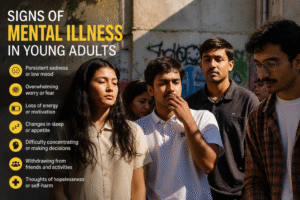
Common Early Signs of Mental Illness in Young Adults
Every individual is different, and not everyone will show the same symptoms. However, mental health professionals often look out for the following patterns when they persist for two weeks or longer and start interfering with daily life.
signs-of-mental-illness-in-young-adults
1. Noticeable Changes in Mood
Persistent sadness, irritability, or mood swings that seem disproportionate to the situation can be an early red flag. This isn’t about having a bad day — it’s a pattern that lingers and affects how someone functions.
2. Withdrawal from Friends and Family
A young adult who once enjoyed socialising but suddenly starts avoiding calls, cancelling plans, or isolating themselves in their room for extended periods may be struggling internally, even if they insist “everything is fine.”
3. Decline in Academic or Work Performance
A sudden drop in grades, missed deadlines, difficulty concentrating, or a general loss of motivation at college or work is often one of the first visible signs that something deeper is going on.
4. Changes in Sleep Patterns
Sleeping far more or far less than usual, frequent nightmares, or an inability to fall or stay asleep can all be connected to underlying emotional distress.
5. Appetite or Weight Fluctuations
Significant, unexplained changes in eating habits or weight — in either direction — are worth paying attention to, especially when paired with other signs on this list.
6. Loss of Interest in Activities Once Enjoyed
When hobbies, sports, or passions that used to bring joy start to feel pointless or exhausting, it can indicate more than simple boredom.
7. Difficulty Managing Emotions
Intense reactions to minor setbacks, frequent crying spells, unexplained anger, or emotional numbness are all signals that someone may be struggling to cope.
8. Excessive Worry or Fear
Constant anxiety about the future, relationships, health, or performance — especially when it feels uncontrollable — can be an early indicator of an anxiety-related condition.
9. Unusual Thoughts or Beliefs
Difficulty distinguishing reality from imagination, paranoia, or expressing thoughts that seem disconnected from reality should never be dismissed and warrant prompt professional evaluation.
10. Increased Use of Alcohol or Substances
Turning to alcohol, vaping, or other substances as a coping mechanism is a common — and often overlooked — sign of underlying emotional pain.
11. Talking About Feeling Hopeless or Worthless
Statements like “nothing matters” or “what’s the point” should always be taken seriously, even if said casually. This is one of the most important signs to never ignore.
12. Physical Complaints Without a Clear Cause
Frequent headaches, stomachaches, fatigue, or other unexplained physical symptoms can sometimes be the body’s way of expressing psychological distress.
Why These Early Signs of Mental Illness in Young Adults Often Go Unnoticed
Young adults are often skilled at masking their struggles — either out of fear of being judged, a desire for independence, or simply not having the vocabulary to describe what they’re feeling. Many families also normalize stress as “part of growing up,” which can delay recognition. Additionally, social media tends to present a curated, filtered version of life, making it harder for both young adults and their families to gauge what’s genuinely going on beneath the surface.
What to Do If You Notice These Signs
If you recognise several of these early signs of mental illness in young adults in yourself or someone you love, here are some constructive first steps:
Start a conversation. Approach the topic gently and without judgment. Simply asking “How have you really been feeling lately?” can open the door.
Listen without trying to fix everything immediately. Sometimes what’s needed most is to feel heard.
Avoid dismissive language. Phrases like “just snap out of it” or “everyone goes through this” can shut down communication.
Encourage professional support. A qualified mental health professional can help identify what’s going on and recommend an appropriate path forward.
Be patient. Recovery and self-understanding take time, and consistent support matters more than quick fixes.
When to Seek Professional Help
If these early signs of mental illness in young adults persist for more than two weeks, worsen over time, or begin to interfere with daily functioning — relationships, academics, work, or self-care — it’s time to consult a mental health professional. Early intervention is strongly associated with better long-term outcomes, making it one of the most valuable steps a young adult or their family can take.
If there is ever a mention of self-harm, suicide, or feeling like life isn’t worth living, this should be treated as urgent, and immediate professional or emergency support should be sought.
Final Thoughts: Recognising the Early Signs of Mental Illness in Young Adults
Recognising the early signs of mental illness in young adults isn’t about labelling normal ups and downs as something clinical — it’s about paying attention to patterns that persist and genuinely affect a person’s quality of life. The earlier these signs are identified, the sooner young adults can access the right support, tools, and guidance to navigate this pivotal stage of life with confidence.
At Delhi Mind Clinic, we understand how overwhelming this journey can feel — for young adults and their families alike. Our team is here to listen, guide, and support you through every step, with compassion and without judgment.
Being able to spot the early signs of mental illness in young adults — and acting on them — is one of the most powerful things a family or individual can do.