For general questions, please send us a message and we’ll get right back to you. You can also call us directly to speak with a member of our service team or insurance expert.
Ehsaas is the name of Delhi’s new mental health and wellbeing programme for school students, parents and teachers. If you have a child in a Delhi school, you have probably heard about it by now. But what does it actually change for your child?
We asked Dr. Paramjeet Singh and Dr. Sugandha Gupta at Delhi Mind Clinic to read through the details and tell us what they really think. Here is a plain-language breakdown.
The figures in this article come from a report by The Pioneer dated 21 November 2026, based on data shared by the Delhi Directorate of Education.
What Is Ehsaas and Why Did Delhi Need It?
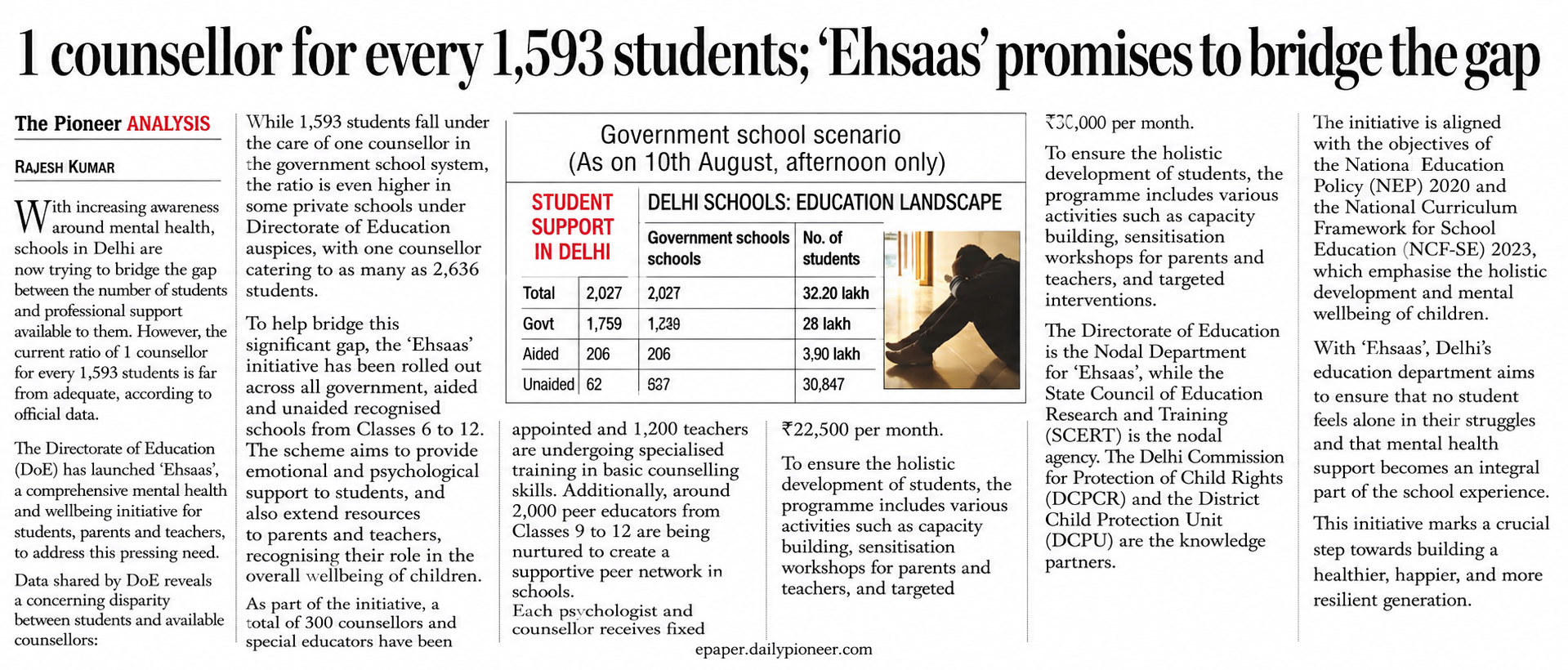
The Directorate of Education launched Ehsaas to give students emotional and psychological support inside school itself. It covers government, aided and unaided recognised schools, from Class 6 to Class 12.
The reason is simple, and a little worrying. According to official data, government schools in Delhi have roughly one counsellor for every 1,593 students. In some private schools the ratio goes up to one counsellor for 2,636 students.
Think about that for a moment. A single person is expected to notice, listen to and support more than a thousand young people.
“Most children don’t walk up and say, ‘I am anxious.’ They go quiet, their marks drop, or they stop wanting to come to school. With numbers like these, those signs are very easy to miss.” — Dr. Paramjeet Singh
7 Things Ehsaas Is Doing Right Now
Here is what the programme has put in place so far, according to the figures shared by the department:
300 counsellors and special educators have been appointed.
1,200 teachers are being trained in basic counselling skills.
Around 2,000 peer educators from Classes 9 to 12 are being prepared to build a supportive network among students.
Workshops for parents and teachers to build awareness and sensitivity.
Capacity-building activities for school staff.
Targeted interventions for students who need extra care.
Support for parents and teachers too, not only for children.
The Directorate of Education is the nodal department, and SCERT is the nodal agency. The Delhi Commission for Protection of Child Rights and the District Child Protection Unit are the knowledge partners.
Dr. Singh’s first reaction was a positive one, with a small caution attached.
“What I like most is that Ehsaas does not leave everything to counsellors alone,” he says. “A teacher who spends six hours a day with a child often notices things before anyone else. If that teacher knows how to respond calmly, a small worry may never turn into a big problem.”
He also points to the peer educator idea. Teenagers usually open up to friends before they open up to adults. A trained classmate who knows when to say, “Let’s talk to someone,” can make a real difference.
His caution? Training teachers in basic counselling skills is a great start, but it does not replace a trained mental health professional. “Basic skills help you listen. They do not help you treat. Children with serious distress still need a qualified expert.”
“Many parents still feel that mental health is something that happens to ‘other’ families,” she says. “Ehsaas speaks to parents directly through workshops, and that matters, because a child’s emotional world is shaped at home first.”
She believes the biggest win could be the change in conversation. When a school openly talks about feelings, stress and exam pressure, children feel it is safe to talk about them too.
“If your child hears the school say ‘it’s okay to ask for help,’ and then hears the same thing at home, that is when things start to improve.”
How Parents Can Support the Ehsaas Initiative at Home
A school programme works best when home supports it. Our doctors suggest a few small habits:
Listen first. Let your child finish speaking before you advise or correct.
Ask better questions. Try “What was the hardest part of your day?” instead of “How were your marks?”
Watch for changes. Sleep, appetite, mood, friendships and school interest are all useful clues.
Stay in touch with teachers. A short call can reveal a lot.
Avoid comparisons. Comparing a child with cousins or classmates usually adds to the stress.
These are simple, but they work, because they tell your child that someone is paying attention.
Signs Your Child May Need Extra Support Beyond Ehsaas
School-level help is valuable, yet some children need more. Consider speaking with a professional if your child shows these signs for more than two weeks:
Constant sadness, irritability or sudden anger
Withdrawing from friends and family
Sharp fall in school performance
Frequent headaches or stomach aches with no medical cause
Fear of going to school
Talking about feeling hopeless or worthless
If your child ever talks about harming themselves, please do not wait. Contact a mental health professional or an emergency helpline immediately.
Can Ehsaas Close the Counsellor Gap? An Honest View
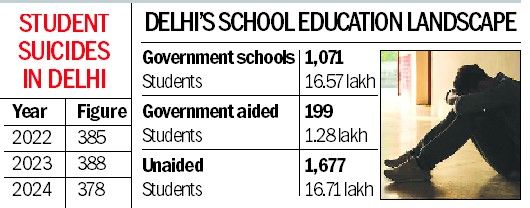
Let us be honest. Adding 300 counsellors and special educators is a big step, but Delhi has more than 2,000 schools and over 32 lakh students. The gap will not disappear overnight.
“No single scheme can fix this alone,” says Dr. Singh. “But Ehsaas moves the country’s capital in the right direction. It treats mental health as part of everyday school life, not as an emergency measure.”
Dr. Gupta agrees: “The real test will be consistency. Training sessions, workshops and peer programmes must continue year after year, not just for one academic session.”
The programme is also in line with the National Education Policy 2020 and the National Curriculum Framework for School Education 2023, both of which stress the holistic development and mental wellbeing of children.
Final Thoughts on Ehsaas
Ehsaas gives Delhi’s schools something they badly needed: a plan. It is not perfect, and it is not a magic fix. Still, it sends a strong message to every child: you are not alone in your struggles.
As parents, teachers and doctors, our job is to make that message real. Listen a little more, judge a little less, and reach out early.
Want to understand your child’s emotional wellbeing better? Visit Delhi Mind Clinic and speak with Dr. Paramjeet Singh, Dr. Sugandha Gupta and our team.