For general questions, please send us a message and we’ll get right back to you. You can also call us directly to speak with a member of our service team or insurance expert.
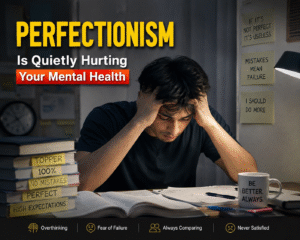
Perfectionism mental health struggles are far more common than most people realise — and far less talked about. We often praise perfectionism. “She’s such a perfectionist” sounds like a compliment. “He pays attention to every little detail” sounds like a strength. In classrooms, offices, and even matrimonial profiles, perfectionism is quietly celebrated as a virtue.
But beneath the polished exterior, the connection between perfectionism and mental health is far closer — and often far more painful — than it appears. What looks like discipline and high standards from the outside can, on the inside, feel like a constant, exhausting battle against never being “good enough.”
At Delhi Mind Clinic, we regularly meet individuals who are high-achieving, hardworking, and outwardly successful — yet privately struggling with anxiety, self-doubt, and burnout. At the root of many of these struggles lies an unaddressed perfectionism mental health pattern.
What Is Perfectionism, Really?
Perfectionism isn’t simply about wanting to do well. It’s a pattern of thinking where:
Your self-worth becomes tied to flawless performance
Mistakes feel like personal failures, not learning opportunities
“Good enough” never actually feels good enough
You set standards that are difficult — sometimes impossible — to meet
Rest or slowing down brings guilt instead of relief
Psychologists often describe perfectionism along a spectrum. Healthy striving pushes you to grow. Unhealthy or maladaptive perfectionism, on the other hand, keeps you trapped in a cycle of pressure, self-criticism, and fear of failure — and this is where perfectionism mental health concerns typically begin.
7 Signs of Perfectionism Mental Health Struggles
Perfectionism doesn’t exist in isolation — it interacts closely with our emotional wellbeing. Here are seven common ways perfectionism mental health struggles show up:
Perfectionism mental health struggles are more common than they seem. Discover 7 signs perfectionism is affecting your wellbeing and how to find balance.
1. Chronic Anxiety
When every task feels like it must be executed flawlessly, the mind stays in a constant state of alertness. Even small errors can trigger disproportionate worry, racing thoughts, or a sense of impending failure.
2. Burnout and Exhaustion
Perfectionists often push themselves far beyond healthy limits — skipping breaks, overworking, and rarely acknowledging their own effort. Over time, this can lead to emotional and physical burnout that feels difficult to recover from.
3. Low Self-Esteem
Ironically, perfectionism is rarely about confidence. It’s often driven by an underlying fear of not being enough. Achievements provide only brief relief before the pressure to perform returns.
4. Procrastination
When the fear of doing something imperfectly becomes overwhelming, many perfectionists delay starting altogether. This creates a frustrating cycle of avoidance followed by guilt.
5. Difficulty in Relationships
Perfectionism can extend beyond personal goals into how we view others — leading to being overly critical, difficulty delegating, or struggling to accept support and closeness.
6. Trouble Sleeping and Physical Tension
Racing thoughts about tomorrow’s tasks, replaying today’s “mistakes,” or an inability to switch off mentally can affect sleep quality, appetite, and overall physical wellbeing.
7. Feeling Like Achievements Are Never Enough
No matter how much is accomplished, the sense of satisfaction is fleeting. This is one of the clearest markers of a perfectionism mental health struggle — success stops feeling rewarding.
Why Perfectionism Mental Health Patterns Develop
Perfectionism rarely appears out of nowhere. It often develops through a combination of:
Upbringing and early conditioning — growing up in environments where love, approval, or attention felt conditional on achievement
Academic or professional pressure — especially in highly competitive settings common across Indian schools, colleges, and workplaces
Social comparison — amplified today through social media, where curated “perfect” lives are constantly on display
Personality traits — such as high conscientiousness or a strong need for control
Fear of judgment or rejection — using flawless performance as a way to avoid criticism
Understanding why perfectionism developed is often the first step toward gently loosening its grip and improving overall perfectionism mental health outcomes.
Expert Insight — Dr. Sugandha Gupta[ Consultant Psychiatrist/Psychologist, Delhi Mind Clinic]
“In my clinical practice, I often see perfectionism disguised as ambition. Patients come in for anxiety or low mood, and it’s only in later sessions that we uncover a deep-rooted belief that they must be flawless to be worthy of love or respect. The first step in therapy is often simply helping them notice this pattern — because most people don’t realise perfectionism is the problem until they see how much of their distress it’s actually driving.”
Signs Perfectionism May Be Affecting Your Mental Health
It may be worth pausing to reflect if you notice:
You feel anxious or restless even after completing tasks well
You find it hard to accept compliments or feel like you don’t deserve them
You avoid starting things unless you’re sure you can do them “perfectly”
You’re your own harshest critic — often harsher than you’d ever be with others
Rest feels like laziness rather than recovery
You measure your worth almost entirely through achievements
If several of these resonate with you, it doesn’t mean something is “wrong” with you — it simply means it may help to explore this pattern with support.
Improving Perfectionism Mental Health: From Perfectionism to Healthy Striving
The goal isn’t to stop caring about doing well — it’s to build a healthier relationship with effort, mistakes, and self-worth. A few gentle shifts that can support better perfectionism mental health:
1. Redefine success. Instead of asking “Was this perfect?”, try asking “Did I try my best with the resources and time I had?”
2. Separate self-worth from performance. Your value as a person isn’t determined by your output. Practicing this distinction — even in small ways — can ease a lot of internal pressure.
3. Allow room for mistakes. Mistakes are part of learning, not evidence of failure. Reframing errors as feedback rather than judgment can be a powerful shift.
4. Practice self-compassion. Notice how you speak to yourself. Would you say the same words to a close friend? If not, it may be time to soften your inner voice.
5. Set realistic, flexible goals. Rigid, all-or-nothing standards often set you up for disappointment. Realistic goals allow progress without constant self-punishment.
6. Seek professional support when needed. When perfectionism starts affecting your daily functioning, relationships, sleep, or peace of mind, speaking with a mental health professional can help you understand the underlying patterns and build sustainable coping strategies.
Expert Insight — Dr. Paramjeet Singh[ Consultant Psychiatrist/Psychologist, Delhi Mind Clinic]
“One thing I tell my patients often is that perfectionism thrives on an ‘all-or-nothing’ way of thinking — either it’s flawless, or it’s a failure. There’s no middle ground in that mindset, and that’s exhausting to live with. A big part of treatment is helping people build tolerance for ‘good enough,’ and slowly, that middle ground starts to feel less threatening and more like relief.”
Perfectionism Mental Health: When to Seek Help
Perfectionism becomes a concern when it starts to interfere with your quality of life — when the pressure to be flawless leaves little room for joy, connection, or rest. If you notice ongoing anxiety, low mood, burnout, or a persistent feeling of “never enough,” reaching out for professional guidance isn’t a sign of weakness — it’s a meaningful step toward long-term wellbeing.
At Delhi Mind Clinic, our team of mental health professionals works closely with individuals to understand the root causes of perfectionism and develop personalised, practical strategies for a healthier, more balanced relationship with achievement and self-worth.
Perfectionism often masquerades as ambition, discipline, or high standards — but when it starts driving anxiety, self-criticism, and burnout, it’s worth paying closer attention to. Good perfectionism mental health isn’t about doing everything flawlessly; it’s about doing things sustainably, with self-compassion, and in a way that allows you to feel genuinely well — not just accomplished.
If perfectionism feels like it’s taking a toll on your mental health, you don’t have to navigate it alone.