For general questions, please send us a message and we’ll get right back to you. You can also call us directly to speak with a member of our service team or insurance expert.
If you are searching for an autism test for kids, chances are something has been on your mind lately. Maybe your toddler still isn’t talking much. Maybe your four-year-old lines up toys for hours but never looks at you when you call. Or maybe a teacher mentioned something at the last parent meeting, and you have been lying awake ever since.
First, take a breath. Noticing is not failing. It is actually the most important step. In this guide, we will walk you through what an autism test for kids really looks like, the early signs to watch for, and what to do next. We have also included practical views from our own specialists, Dr. Sugandha Gupta and Dr. Paramjeet Singh.
What Is an Autism Test for Kids?
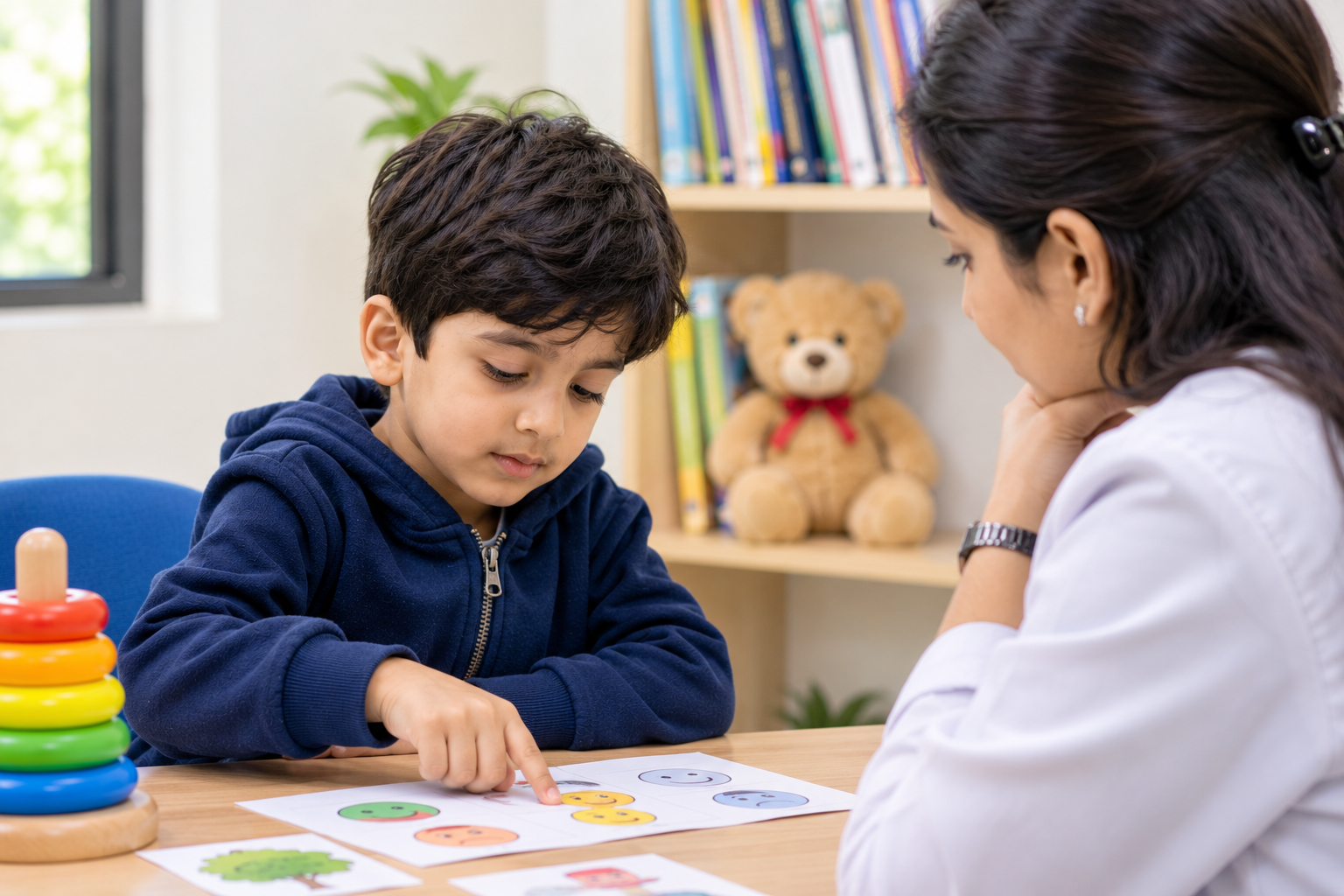
Here is the thing many parents don’t expect: there is no single blood test or scan that confirms autism. An autism test for kids is really a careful assessment. It combines parent interviews, direct observation of the child, play-based activities and standardised screening questionnaires.
Think of it less like an exam and more like a structured conversation, with toys involved.
The goal is simple. A specialist looks at how your child communicates, plays, reacts to people and handles everyday changes. Then they put the full picture together.
Why Early Screening Matters So Much
The brain of a young child learns and adapts at an incredible pace. When support begins early, children often make real gains in speech, social understanding and daily skills.
“Parents often tell us they waited because they were told, ‘He will talk when he is ready.’ Sometimes that is true. But when there are several signs together, waiting can cost valuable time. An early autism test for kids does not label your child. It simply opens the door to the right support.” – Dr. Sugandha Gupta
7 Early Signs That May Call for an Autism Test for Kids
Every child is different, and one sign alone does not mean autism. But if you notice several of these together, it is worth speaking to a specialist.
1. Limited or No Eye Contact
Your baby rarely looks at your face when you talk or smile. Older children may seem to look “through” people.
2. Not Responding to Their Name
By 9 to 12 months, most babies turn when they hear their name. If your child seems to ignore you even though their hearing is fine, mention it to a doctor.
3. Delayed Speech or Loss of Words
No babbling by 12 months, no single words by 16 months, or losing words they once used are all important flags.
4. Repetitive Movements or Play
Hand flapping, spinning, rocking, or lining up objects again and again can be signs, especially when the child gets upset if the pattern is disturbed.
5. Strong Reactions to Sounds, Lights or Textures
Some children cover their ears at the mixer-grinder or refuse certain clothes. Sensory differences are very common in autism.
6. Difficulty Playing with Other Children
Your child may prefer playing alone, or not show interest in pretend play like feeding a doll or talking on a toy phone.
7. Strict Need for Routine
A small change, such as a different route to school or a new cup, may trigger a big meltdown.
How Does an Autism Test for Kids Work? A Step-by-Step Look
Parents are often nervous about what happens inside the clinic. Here is what a typical assessment looks like.
Step 1: Parent Interview
The specialist asks about pregnancy, birth, milestones, sleep, eating, behaviour and family history. Be honest and detailed. There are no wrong answers.
Step 2: Screening Questionnaires
Quick tools such as the M-CHAT-R/F, designed for toddlers between 16 and 30 months, help flag children who need a deeper look. You can read about it on the official M-CHAT website. Remember, a screening is not a diagnosis.
Step 3: Play-Based Observation
The clinician plays with your child and watches how they respond to simple requests, shared attention, pretend play and turn-taking.
Step 4: Developmental and Hearing Checks
Sometimes delayed speech has other causes, such as hearing difficulty or a language delay. Ruling these out is part of a proper evaluation.
Step 5: Discussion and Plan
You receive a clear explanation, not just a report. If autism is identified, the plan may include speech therapy, occupational therapy, behavioural support and parent training.
Can You Do an Autism Test for Kids at Home?
Online checklists can help you organise your thoughts, and many parents find them a useful starting point. But they cannot replace a professional evaluation.
“A home checklist is like a smoke alarm. It tells you something deserves attention, but it cannot tell you what is happening in the room. Please do not self-diagnose, and please do not dismiss concerns because a checklist said ‘low risk’. Trust your instincts and get your child seen.” – Dr. Paramjeet Singh
At What Age Should You Consider an Autism Test for Kids?
Most specialists suggest watching development closely from 12 months. Routine developmental screening is often done around 18 and 24 months. However, an autism test for kids can be done at any age. Many children, especially girls and those with milder signs, are identified only at school age or even later.
So if your child is 6, 9 or 12 and you are still wondering, it is not too late.
What If the Result Says Autism? Common Parent Worries
Hearing the word “autism” can feel heavy. Many parents feel fear, guilt or confusion. Please know that this is a normal reaction.
A few reassuring points from our team:
Autism is not caused by bad parenting.
It is a difference in how the brain develops, and every child has unique strengths.
With the right therapies and a supportive home, many children learn to communicate, make friends and grow in confidence.
“The most powerful part of therapy is the parent. When families understand their child’s way of seeing the world, progress often follows. We always remind families that a diagnosis is a starting point, not a limit.” – Dr. Sugandha Gupta
Tips for Parents Before the Appointment
Note down the specific behaviours you have seen, with examples.
Record short videos of your child at home, playing and speaking.
Bring previous medical, school or therapy reports.
Keep your child fed and rested before the visit.
Come with questions. No question is silly.
When Should You Book an Autism Test for Kids?
Consider booking an evaluation if your child:
Has no words by 16 months or no two-word phrases by 24 months
Has lost skills they previously had
Avoids eye contact or play with others
Shows intense repetitive behaviours or extreme distress with change
Has a sibling with autism, which raises the likelihood
“If you are asking whether you should go, that itself is usually reason enough to have a conversation with a specialist. The worst outcome of an assessment is clarity. The best outcome is early help.” – Dr. Paramjeet Singh
Final Thoughts
An autism test for kids is not about finding something wrong. It is about understanding your child better so you can support them in the way they need. The earlier you start, the more time your child gets to thrive.