For general questions, please send us a message and we’ll get right back to you. You can also call us directly to speak with a member of our service team or insurance expert.
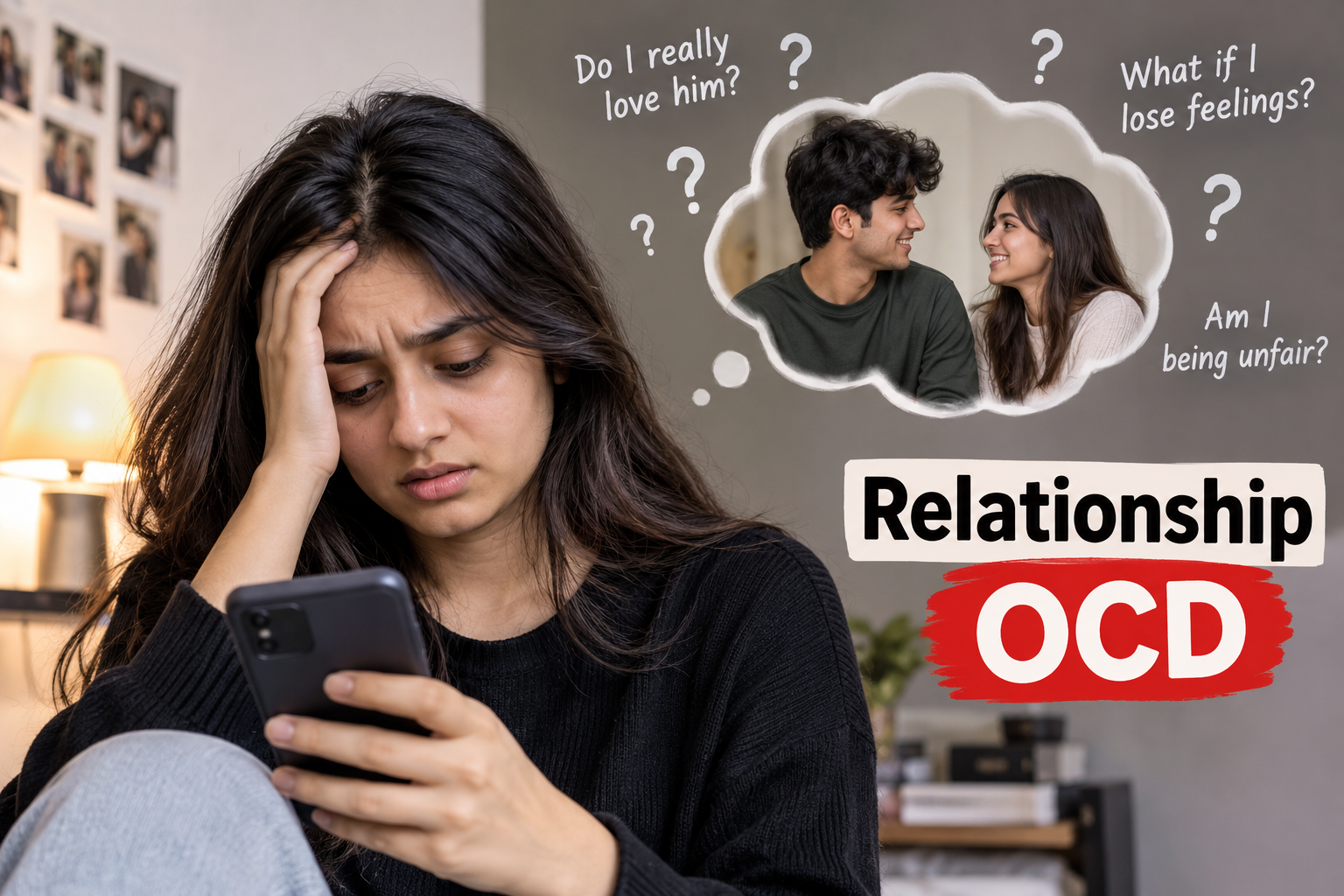
Relationship OCD is one of the most misunderstood forms of obsessive-compulsive disorder. It can make a happy, loving relationship feel like a constant exam you are afraid of failing.
If you keep asking yourself, “Do I really love my partner?” or “What if they are not the right one?”, you are not alone. And you are not a bad partner. You may be dealing with relationship OCD, and it is very treatable.
At Delhi Mind Clinic, we meet many young adults and couples who suffer quietly with this for years. They assume it is “just overthinking”. Let’s look at what is really going on.
relationship-ocd
What Is Relationship OCD?
Relationship OCD (often called ROCD) is a type of OCD where the obsessions and compulsions centre on your romantic relationship. The mind gets stuck on doubts about love, attraction, compatibility or your partner’s flaws.
Everyone has doubts sometimes. With relationship OCD, though, the doubts feel urgent, repetitive and impossible to switch off. You cannot simply “let it go”, however hard you try.
The National Institute of Mental Health explains that OCD involves unwanted thoughts (obsessions) and repeated behaviours (compulsions) carried out to reduce anxiety. In ROCD, the theme is simply your relationship.
7 Signs of Relationship OCD You Should Not Ignore
Not sure if it’s normal worry or relationship OCD? Here are seven common signs.
Constant doubting. You keep questioning whether you truly love your partner, or whether they love you.
Mental checking. You scan your feelings all day: “Do I feel enough butterflies right now?”
Reassurance seeking. You ask your partner, friends or Google the same questions again and again.
Comparing. You compare your partner or your bond with other couples, exes or social media posts.
Focusing on flaws. A small thing, like the way your partner laughs, becomes a huge “red flag”.
Guilt and shame. You feel terrible for having these thoughts, even though you never wanted them.
Relief that doesn’t last. Reassurance calms you for a few minutes, then the doubt returns, often stronger.
If three or more of these sound familiar, it may be worth speaking to a mental health professional.
Relationship OCD vs Normal Relationship Doubts
People often ask us: “How do I know if this is relationship OCD or a real problem in my relationship?”
Normal doubts usually come from real events, like repeated disrespect or very different values. They ease once you talk things through and decide.
Relationship OCD doubts feel like a loop. They show up even when things are going well, and no answer ever feels “certain enough”.
“In relationship OCD, the person is not really searching for truth. They are searching for certainty, and certainty about love simply does not exist. That is why the loop never ends.” – Dr. Sugandha Gupta, Delhi Mind Clinic
What Causes Relationship OCD?
There is no single cause. It is usually a mix of factors:
Anxious or perfectionist personality. People who dislike uncertainty are more vulnerable.
Past experiences. A painful breakup, infidelity or a troubled parental marriage can leave a deep fear of “choosing wrong”.
Biology and genetics. OCD can run in families.
High stress. Exams, job pressure or big life changes can trigger a first episode.
Social media. Constant exposure to “perfect” couples quietly raises the bar.
The International OCD Foundation notes that OCD tends to attach itself to whatever matters most to a person. When love matters deeply, the mind targets love.
How Relationship OCD Affects You and Your Partner
The impact goes well beyond the relationship itself. People tell us they feel exhausted, distracted at work and cut off from their own emotions.
Partners suffer too. Answering “Do you love me?” twenty times a day is draining. Many partners start to feel tested, as if nothing they say is ever enough.
Some people break up again and again, hoping the anxiety will finally stop. It usually doesn’t, because the problem was never the partner. It was the OCD cycle.
“We often see couples who are close to separating, when what they actually need is treatment for the OCD. Once the compulsions reduce, the relationship usually breathes again.” – Dr. Paramjeet Singh, Delhi Mind Clinic
Relationship OCD Treatment: What Really Works
The good news is that relationship OCD responds very well to proper care. Treatment is not about convincing you that you love your partner. It is about changing how you respond to doubt.
Exposure and Response Prevention (ERP) for Relationship OCD
ERP is considered the gold standard therapy for OCD. You slowly face the uncomfortable thought, such as “What if I don’t love them?”, without doing the usual compulsion like checking or seeking reassurance.
It feels hard at first. Over time, the brain learns the thought is not a real threat, and the anxiety fades.
Cognitive Behavioural Therapy (CBT)
CBT helps you spot thinking traps like all-or-nothing thinking, catastrophising and the need for 100% certainty. You learn to see thoughts as thoughts, not facts.
Medical Support When Needed
For some people, a psychiatrist may suggest medical treatment alongside therapy, especially when symptoms are severe. This is always decided after a full evaluation, never by self-diagnosis.
Professional help matters, but these small habits can support your recovery:
Name it. Tell yourself, “This is relationship OCD talking.”
Reduce reassurance. Delay asking by 10 minutes, then 20, then longer.
Stop mental checking. When you catch yourself analysing your feelings, gently return to the task at hand.
Accept uncertainty. No relationship comes with a guarantee. Learning to live with that is a real skill.
Limit social media. Comparing your bond to curated posts feeds the cycle.
Be kind to yourself. Having these thoughts does not make you a bad person.
“My advice to anyone struggling with relationship OCD: do not wait for the doubt to disappear before you act. Healing starts when you stop negotiating with the thought.” – Dr. Sugandha Gupta
How Partners Can Support Someone With Relationship OCD
If your partner has relationship OCD, your support matters a lot. A few things that help:
Stay calm and avoid arguing with the doubts.
Offer warmth, but gently avoid endless reassurance.
Encourage them to seek professional help.
Look after your own mental health too.
Couples sessions can help both of you understand the pattern together.
When Should You See a Doctor About Relationship OCD?
Consider reaching out if the doubts take up more than an hour a day, affect your sleep or work, or push you away from someone you care about. The World Health Organization also stresses that early support leads to better outcomes.
“The earlier someone seeks help for relationship OCD, the quicker the recovery. There is no need to suffer silently or feel ashamed.” – Dr. Paramjeet Singh
Frequently Asked Questions About Relationship OCD
Is relationship OCD real?
Yes. It is a recognised subtype of OCD where obsessions and compulsions revolve around romantic relationships.
Can relationship OCD go away?
With the right therapy, most people see big improvements and learn to manage their symptoms well. Early treatment gives the best results.
Does relationship OCD mean I don’t love my partner?
No. Many people with relationship OCD love their partners deeply. The distress itself shows how much the relationship matters to them.
Final Thoughts
Relationship OCD can feel lonely and confusing, but it is not a life sentence for your love life. With understanding, the right therapy and patience, you can step out of the doubt loop and enjoy your relationship again.
If you or your partner are struggling, our team at Delhi Mind Clinic is here to help. Visit our contact page to book a consultation with Dr. Sugandha Gupta or Dr. Paramjeet Singh, or explore our anxiety treatment services.