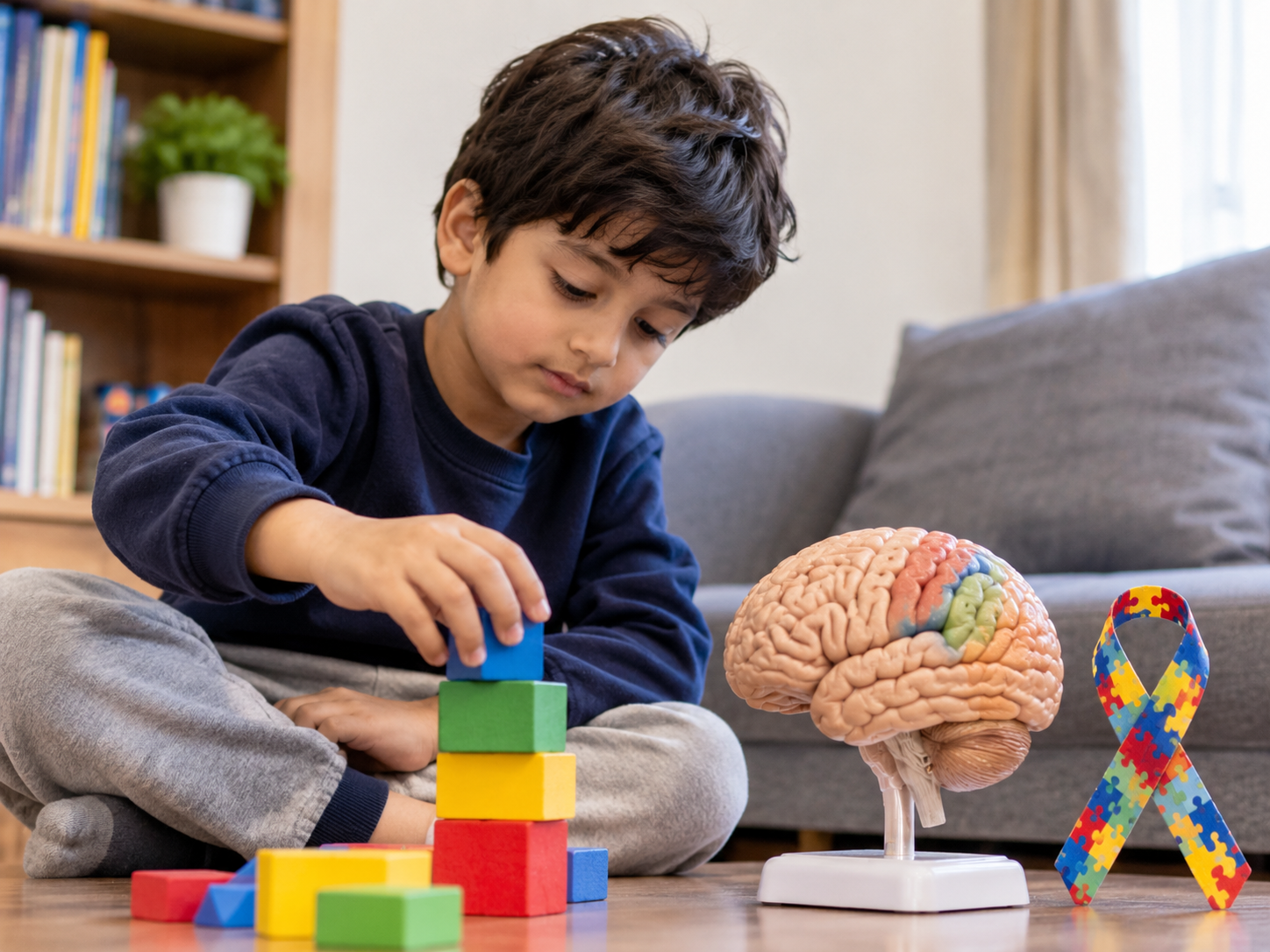
The autism brain works differently, not defectively. That one sentence changes how a lot of families feel on the day of diagnosis. If you are a parent sitting with a new report in your hands and a hundred questions in your head, take a breath. You are in the right place.
At Delhi Mind Clinic, we meet worried and hopeful parents every single week. Most of them ask the same thing: what is actually going on inside my child’s mind? This article answers that in plain language, with a little help from our own doctors.
What Is the Autism Brain, Really?
Autism is a neurodevelopmental condition. That means it shapes the way the brain grows and organises itself from the earliest years of life. The autism brain is not damaged or diseased. It simply develops along a different path.
Research from groups such as the National Institute of Mental Health shows that autism is linked to differences in how brain regions communicate with each other. Think of it like two cities connected by different road systems. Both cities work. The traffic just flows in a different pattern.
Truth 1: The Autism Brain Has Its Own Wiring Pattern
In many autistic people, some brain areas are very strongly connected locally, while long-distance connections between distant regions can work differently. This can explain why a child may notice tiny details that others miss, yet find it tiring to switch quickly between tasks.
It is not a flaw. It is a different style of processing.
Truth 2: Senses Can Feel Louder in the Autism Brain
Have you seen your child cover their ears at a wedding, or refuse a shirt because the tag feels “too much”? That is not misbehaviour.
The autism brain often processes sound, light, touch, taste and smell with more intensity. A crowded market in Delhi can feel like ten radios playing at once. Once parents understand this, meltdowns stop looking like tantrums and start looking like overload.
Small things that help at home
- Keep a quiet corner your child can retreat to
- Offer soft, tag-free clothing
- Give a warning before loud events or changes in routine
- Use headphones in noisy places if your child accepts them
Truth 3: Brain Growth Looks Different in the Early Years
Studies suggest that in some children, early brain growth can follow a different timeline. Certain regions may develop faster at first, while others take their time. This is one reason why signs often show up between 12 and 36 months, such as limited eye contact, delayed speech, or not responding to their name.
The Centers for Disease Control and Prevention notes that early screening matters, because the young brain is remarkably adaptable.
Truth 4: Social and Emotional Signals Are Read Differently
Facial expressions, tone of voice, sarcasm, body language: neurotypical brains pick these up almost automatically. The autism brain often has to work at it consciously, like learning a second language.
So when your child seems distant, they may not be uninterested. They may simply be translating.
Truth 5: The Autism Brain Comes With Real Strengths
We do not say this to “look on the bright side.” It is genuinely observed in clinic.
Many autistic children and adults show:
- Remarkable memory for facts, patterns and routines
- Deep, sustained focus on topics they love
- Strong honesty and a clear sense of fairness
- Original, out-of-the-box thinking
When these strengths are noticed and nurtured, confidence grows fast.
Truth 6: Parenting Does Not Cause Autism
Let us clear this up, because we hear the guilt in many consultations. Autism is not caused by something a mother did, a father said, or a family failed to do. Current evidence points to a mix of genetic and early developmental factors. Cold parenting is not one of them. The World Health Organization is clear on this point as well.
Please put that guilt down. You do not need to carry it.
Truth 7: The Autism Brain Stays Open to Learning
This is the most hopeful one. Brains are plastic, which means they keep forming new connections through experience and practice. Early, steady, child-friendly support (speech therapy, occupational therapy, structured play and parent coaching) can make a real difference to communication, daily skills and independence.
It is never “too late” to start, though earlier is usually easier.
What Our Doctors Say About the Autism Brain
We asked two of our senior specialists to share what they most want families to understand.
“When parents first hear the word autism, they imagine a closed door. I always tell them it is a different door, not a closed one. Once we understand how a child’s brain takes in the world, the right support becomes much clearer.” — Dr. Sugandha Gupta, Delhi Mind Clinic
“The biggest mistake I see is waiting. Families are told to ‘give it time,’ and months go by. A proper assessment is not a label, it is a map. The sooner we have it, the more we can do together.” — Dr. Paramjeet Singh, Delhi Mind Clinic
Both doctors agree on one thing: the child is not the problem. The mismatch between the child and an unprepared environment is where most of the stress comes from.
Early Signs Worth Discussing With a Specialist
Every child is unique, but it is worth speaking to a professional if you notice:
- Little or no response to their name by 12 months
- No pointing or waving by 14 to 18 months
- Delayed speech, or loss of words they once used
- Strong distress with small changes in routine
- Repetitive movements, lining up objects, or very narrow interests
- Difficulty playing and interacting with other children
One sign alone does not mean autism. A pattern across several areas is what a trained clinician looks for.
How to Support an Autism Brain at Home
You do not need special equipment. You need patience, predictability and a lot of warmth.
- Build routines. Visual schedules reduce anxiety.
- Speak simply. Short, clear sentences work better than long instructions.
- Follow their interests. Use their favourite topic to teach new skills.
- Celebrate small wins. Progress is rarely a straight line.
- Look after yourself. A calm parent is the strongest support a child has.
If you would like structured guidance, explore our autism assessment and therapy services, read about child development concerns, or book a consultation with our team.
Autism Brain FAQs
Is the autism brain physically different from other brains? Studies show differences in connectivity and in the timing of growth in certain regions, but these are variations, not damage. No single scan can diagnose autism. Diagnosis is based on a careful clinical assessment.
Can the autism brain change with therapy? Yes. The brain stays adaptable throughout life, and supportive therapies can build new skills and pathways, especially when started early.
Is autism the same in every child? Not at all. It is called a spectrum for a reason. Two autistic children can look completely different from each other.
Final Thoughts
Understanding the autism brain is the first step toward understanding your child. It replaces fear with clarity and guilt with action. Your child is not broken, and you are not alone.
If you have concerns about your child’s development, reach out to the team at Delhi Mind Clinic. A gentle, unhurried conversation with the right specialist can change the direction of a whole family’s journey.