For general questions, please send us a message and we’ll get right back to you. You can also call us directly to speak with a member of our service team or insurance expert.
Open your phone right now, and there’s a good chance you’ll find at least one app promising to “boost your mood,” “reduce your stress,” or “talk you through anxiety.” Over the past few years, AI chatbots and mental health apps have quietly become part of daily life for millions of people — especially younger users who find it easier to type out their feelings to a bot at 2 a.m. than to book an appointment.
At Delhi Mind Clinic, we get asked about this often: “Can an app really help my anxiety?” “Is talking to an AI chatbot the same as therapy?” “Should I trust these apps with my mental health?”
This blog post breaks down what AI chatbots and mental health apps actually do, where they genuinely help, where they fall short, and how to use them wisely — without replacing the human support that real healing often needs.
What Are AI Chatbots and Mental Health Apps, Exactly?
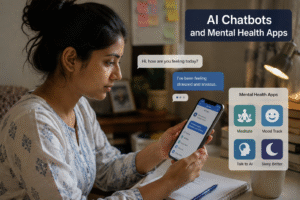
AI chatbots and mental health apps are digital tools designed to support emotional wellbeing. They generally fall into a few categories:
Conversational chatbots that simulate supportive conversation, using natural language processing to respond to how you’re feeling.
Mood and habit trackers that help you log emotions, sleep, and daily patterns over time.
Guided self-help tools offering structured exercises based on approaches like cognitive behavioural techniques, mindfulness, and journaling.
Meditation and relaxation apps that use guided audio, breathing exercises, and calming visuals to reduce stress in the moment.
Some of these tools are built by mental health professionals and grounded in evidence-based frameworks. Others are more casual wellness products with far less clinical rigour behind them — and knowing the difference matters.
Ai-chatbots-and-mental-health-apps
Why Are So Many People Turning to AI Chatbots for Mental Health Support?
The rise of AI chatbots and mental health apps isn’t happening in a vacuum. A few real factors are driving it:
1. Availability, Anytime
Mental health struggles don’t stick to office hours. A chatbot is available at midnight, during a panic moment, or on a quiet Sunday when no clinic is open.
2. Lower Barrier to Starting
For many people, the idea of walking into a clinic feels intimidating. Typing a message to an app feels safer as a first step — especially for those who aren’t ready to speak to a person yet.
3. Anonymity and Reduced Stigma
In a culture where mental health is still surrounded by stigma, an app can feel like a judgment-free space to admit “I’m not okay” for the first time.
4. Affordability
Many mental health apps are free or low-cost, which makes them accessible to people who may not yet be able to afford regular professional sessions.
5. Consistency
Apps don’t get tired, distracted, or busy. They can offer the same calm, structured check-in every single day, which builds a helpful routine for some users.
Where AI Chatbots and Mental Health Apps Genuinely Help
It’s easy to dismiss these tools as “just an app,” but used correctly, they do offer real value:
Building a daily self-awareness habit — logging moods and thoughts helps people notice patterns they’d otherwise miss.
Practising coping skills — breathing exercises, grounding techniques, and journaling prompts are simple but effective tools for everyday stress.
A bridge to professional help — for many people, using an app is the first step that eventually leads them to seek real therapy or counselling.
Support between sessions — for those already working with a therapist, apps can reinforce techniques discussed in session.
Reducing isolation in small moments — sometimes, just having something respond when you’re overwhelmed can feel steadying.
The Real Limitations of AI Chatbots and Mental Health Apps
This is where it’s important to be honest — because your mental health deserves more than good marketing copy.
They Cannot Diagnose You
An AI chatbot cannot understand the full context of your history, your relationships, your body, and your life the way a trained mental health professional can. Patterns that look “mild” in a chat window can sometimes be far more serious in person.
They Cannot Replace Human Connection
Healing often happens through relationship — being truly seen, heard, and understood by another person. No algorithm can fully replicate the safety of a real therapeutic relationship.
Risk in Crisis Situations
If someone is going through a serious mental health crisis, a chatbot is not equipped to provide the urgent, human intervention that’s needed. Relying on an app during a crisis can dangerously delay real help.
Data Privacy Concerns
Not every app is transparent about how your emotional data is stored, used, or shared. Given how sensitive mental health information is, this deserves real scrutiny before you share your innermost thoughts with any platform.
One-Size-Fits-All Responses
Even the most advanced chatbot responds based on patterns in data — not lived clinical judgment. Two people with “the same” symptoms can need completely different approaches, something only a professional assessment can determine.
How to Use AI Chatbots and Mental Health Apps Wisely
If you’re already using — or considering — one of these apps, here’s how to get the most out of it safely:
Treat it as a supplement, not a substitute. Use it alongside professional support, not instead of it.
Choose apps built with clinical input. Look for tools developed with psychologists, psychiatrists, or licensed mental health experts involved in their design.
Check the privacy policy. Understand exactly how your data is stored and whether it’s shared with third parties.
Notice if you’re relying on it to avoid real help. If you find yourself using an app to sidestep talking to a professional about something serious, that’s worth paying attention to.
Know when to escalate. If you’re experiencing persistent low mood, overwhelming anxiety, or thoughts of self-harm, reach out to a mental health professional or a trusted person immediately — don’t rely on an app alone.
What Our Doctors Say
We asked our senior clinicians at Delhi Mind Clinic to share their perspective on this growing trend.
Dr. Paramjeet Singh, Senior Neuropsychiatrist
“In my practice, I’ve seen a growing number of patients — especially young adults — who mention using an AI chatbot before they ever consider seeing a psychiatrist. I don’t see this as a bad thing in itself. For someone hesitant to seek help, an app can lower that first barrier. My concern is when it becomes a substitute rather than a starting point. Conditions like anxiety, depression, or bipolar disorder often present with overlapping symptoms that require a trained clinical eye to differentiate — something no chatbot is equipped to do. I always tell my patients: use these tools if they help you build awareness, but don’t let them delay a proper diagnosis.”
— Dr. Paramjeet Singh, Senior Consultant Neuropsychiatrist, Delhi Mind Clinic
Dr. Sugandha Gupta, Founder & Director, Delhi Mind Clinic
“AI chatbots can’t read body language, tone, or family history — the subtle cues we rely on in a real consultation. Still, they have a place, especially in India where stigma keeps many people from seeking help. If a mood-tracking app helps someone open up for the first time, that’s valuable. Our job as clinicians is to make sure that conversation continues safely, beyond the app.”
We believe technology has a real, growing role to play in mental wellness — especially in making the first step feel less overwhelming. AI chatbots and mental health apps can be a gentle entry point, a daily companion, or a helpful add-on to therapy.
But they are not, and should not be treated as, a replacement for professional care. Mental health is deeply personal, shaped by your history, your body, your relationships, and your circumstances — and that calls for a trained human who can truly listen, assess, and guide you.
If you’ve been using an app to manage stress, anxiety, or low mood and feel like you need more support, that’s not a failure — it’s simply the next right step. Our team at Delhi Mind Clinic is here to offer that human connection, with a safe, non-judgmental space to be heard.
Are AI chatbots and mental health apps safe to use? Many are safe for everyday stress management and self-awareness, but they aren’t equipped to handle serious mental health conditions or crisis situations. Always check an app’s credibility and privacy practices.
Can an AI chatbot replace a therapist? No. Chatbots can support daily coping and self-reflection, but they cannot replace the depth of understanding, diagnosis, and personalised guidance a trained mental health professional provides.
When should I stop relying on an app and see a professional instead? If your symptoms are persistent, intensifying, affecting your daily life, or involve any thoughts of self-harm, it’s time to speak with a mental health professional right away.
Are these apps useful for mild everyday stress? Yes — for general stress, mindfulness, and building healthy routines, many apps offer genuinely helpful, low-pressure support.