For general questions, please send us a message and we’ll get right back to you. You can also call us directly to speak with a member of our service team or insurance expert.
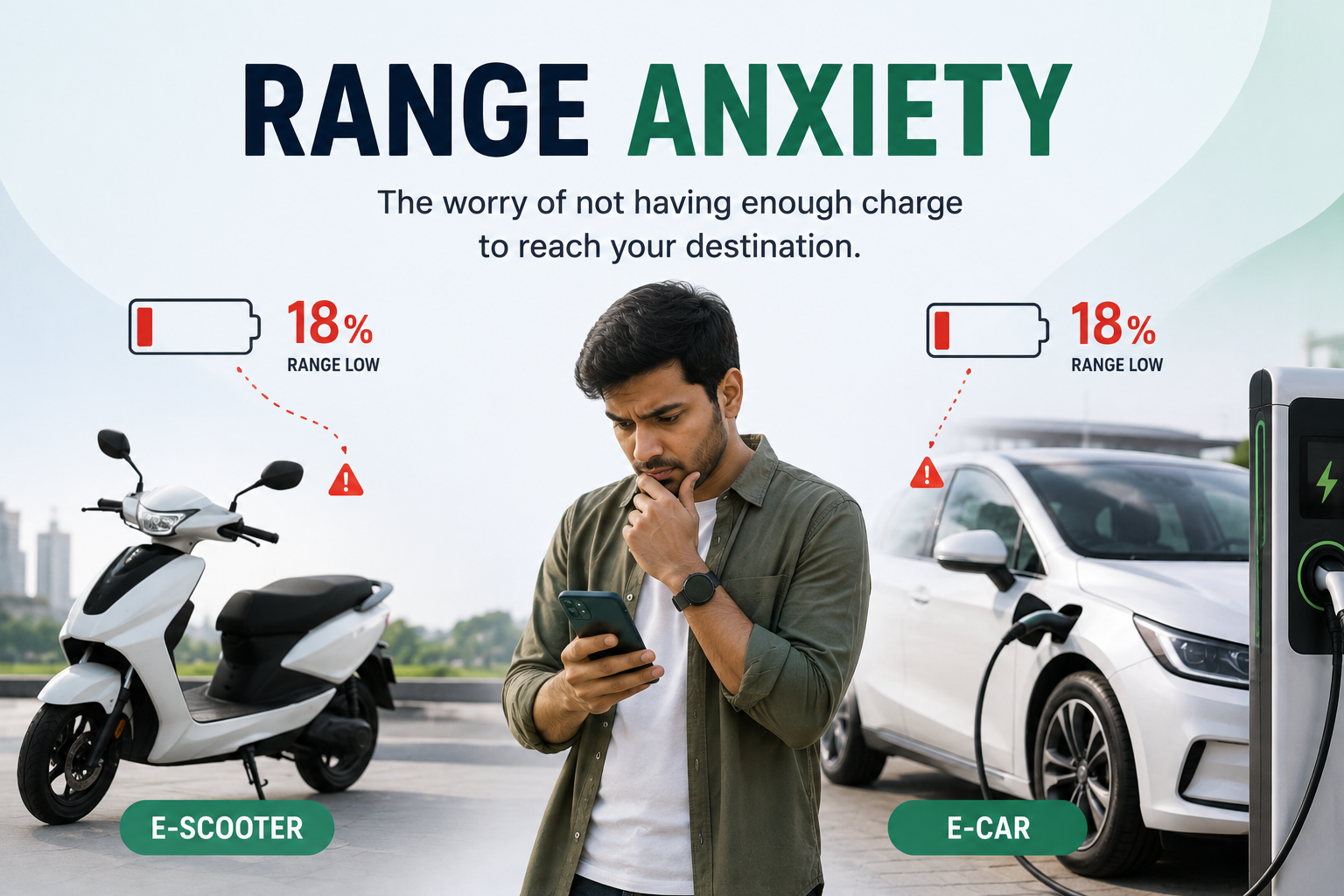
If you’ve ever driven an electric vehicle and found yourself glancing nervously at the battery percentage, calculating whether you’ll make it to the next charging point, you’ve experienced range anxiety. It’s a term that started in the world of electric cars, but at its core, it describes something much more universal — the very human fear of running out of resources before reaching safety.
As more people in Delhi and across India switch to electric vehicles, range anxiety is becoming a common, everyday experience. But what’s actually happening in the mind when this worry sets in? And why does something as practical as a battery gauge trigger such a strong emotional response?
What Is Range Anxiety, Really?
On the surface, range anxiety refers to the worry that an electric vehicle won’t have enough charge to reach its destination or the nearest charging station. But psychologically, it’s not really about the car at all — it’s about uncertainty, control, and consequence.
Our minds are wired to scan for threats and plan for worst-case scenarios. When we can’t be fully certain that our resources (in this case, battery charge) will get us where we need to go, the brain treats this ambiguity as a potential danger — even if the actual risk is small. This is the same mental circuitry that once helped our ancestors ration food, water, or firewood.
range-anxiety
The Psychology Behind the Worry
1. Fear of the Unknown
Humans generally feel more comfortable with certainty, even negative certainty, than with the unknown. Not knowing exactly how far your vehicle can travel creates a mental gap that the brain tries to fill — often with worst-case predictions.
2. Loss of Control
Range anxiety often intensifies in situations where control feels limited — unfamiliar routes, unpredictable traffic, or a shortage of charging infrastructure nearby. When people feel they can’t influence the outcome, anxiety naturally rises.
3. Anticipatory Anxiety
This is anxiety about a future event that hasn’t happened yet. The mind starts rehearsing “what if” scenarios — What if I get stranded? What if there’s no charging station nearby? — well before any real problem occurs. This kind of forward-looking worry is a hallmark of anticipatory anxiety and is common in many everyday situations, not just driving.
4. Negativity Bias
Our brains are naturally more attuned to potential negative outcomes than positive ones. So even when the odds of running out of charge are low, the mind gives disproportionate weight to that small possibility, making the anxiety feel bigger than the actual risk.
Why Range Anxiety Feels So Personal
Interestingly, range anxiety doesn’t affect everyone equally. People who generally tend toward anxious thinking patterns, perfectionism, or a strong need for control often experience it more intensely. For them, the ambiguity of “will I make it or not” can feel less like a minor inconvenience and more like a genuine threat.
This is a useful reminder: range anxiety is less about electric vehicles and more about how an individual’s mind processes uncertainty in general. The same person who worries intensely about battery percentage may also notice similar patterns of worry in other areas of life — work deadlines, health concerns, or travel planning.
“What we often see in our practice is that a specific worry, like range anxiety, is rarely isolated. It’s usually a window into how a person’s mind habitually responds to uncertainty. Someone who feels intense unease over a battery percentage may be experiencing the same underlying pattern in other parts of their life without realising it. Recognising this connection is often the first step toward meaningful change.” — Dr. Sugandha Gupta
Practical Ways to Manage Range Anxiety
The good news is that range anxiety, like most anxiety responses, can be managed with the right strategies.
Plan ahead, but don’t overplan. Knowing your route and charging options in advance reduces uncertainty, but obsessively checking and rechecking can reinforce anxious thinking rather than calm it.
Focus on what you can control. You can’t control every variable on the road, but you can control your planning, your buffer time, and your response if something unexpected happens.
Practice grounding techniques. Simple breathing exercises or mindfulness techniques can help interrupt the spiral of anticipatory “what if” thinking when it arises.
Reframe the worry. Instead of asking “What if I run out of charge?” try asking “What is the actual likelihood of this happening, and what would I realistically do if it did?” This shifts the mind from catastrophic thinking to problem-solving.
Notice the pattern, not just the trigger. If you find that this kind of anxious anticipation shows up in many parts of your life — not just driving — it may be worth exploring the underlying thought patterns with a mental health professional.
When Everyday Anxiety Becomes Something More
For most people, range anxiety is a mild, situational worry that fades once they gain more experience or confidence with their vehicle and its charging routine. But for some, this same pattern of anticipatory worry, need for control, and catastrophic thinking shows up repeatedly across different areas of life — driving, work, relationships, or health.
If you notice that anxious “what if” thinking is a frequent visitor in your daily life and is affecting your peace of mind or day-to-day functioning, it may be helpful to speak with a mental health professional. Understanding the root patterns behind your anxiety can make a meaningful difference — not just in how you handle a low battery gauge, but in how you navigate uncertainty in general.
“Anticipatory worry, like the kind people describe with range anxiety, becomes a concern when it starts to generalise — when the mind begins applying that same ‘what if something goes wrong’ lens to everyday situations that don’t warrant it. The goal isn’t to eliminate uncertainty from life, because that isn’t possible. The goal is to build a healthier relationship with it, so uncertainty doesn’t automatically translate into distress.” — Dr. Paramjeet Singh
Range anxiety is a perfect example of how modern technology can bring old psychological patterns to the surface. The fear itself isn’t really about kilometers left on a battery — it’s about our very human relationship with uncertainty, control, and the unknown.
Recognizing this can be empowering. The next time you feel that flicker of worry over a battery percentage, remember: it’s not really about the car. It’s about how your mind is wired to handle uncertainty — and that’s something you can learn to manage with awareness and the right support.