For general questions, please send us a message and we’ll get right back to you. You can also call us directly to speak with a member of our service team or insurance expert.
Recognising the signs of depression early can make a significant difference in a person’s quality of life. Depression is one of the most common mental health conditions in the world today, yet it often goes unnoticed — even by the people experiencing it. Many mistake the signs of depression for “just a bad phase,” stress, or tiredness. But depression is a real, treatable medical condition.
At Delhi Mind Clinic, we believe that awareness is the first step toward healing. In this article, we break down the most common signs of depression, why they occur, and when it’s time to seek professional support.
What Is Depression?
Depression (clinically known as Major Depressive Disorder) is more than just feeling sad or having a low day. It is a persistent mental health condition that affects how a person thinks, feels, and functions in daily life. It can impact anyone — regardless of age, gender, profession, or background — and often develops gradually, making the signs of depression easy to overlook.
Common Signs of Depression
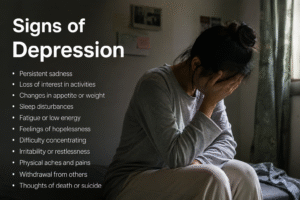
The signs of depression don’t look the same for everyone. Some people show visible emotional distress, while others mask it well behind a “normal” routine. Here are the most common signs of depression to watch out for:
11-signs-of-depression
1. Persistent Sadness or Low Mood
A continuous feeling of sadness, emptiness, or hopelessness that lasts for most of the day, nearly every day, for two weeks or longer.
2. Loss of Interest in Activities
Losing interest or pleasure in hobbies, work, socialising, or activities that were once enjoyable — often referred to as “anhedonia.”
3. Fatigue and Low Energy
Feeling constantly tired, drained, or physically heavy, even after adequate rest or sleep.
4. Changes in Sleep Patterns
This can go either way — difficulty falling or staying asleep (insomnia), or sleeping far more than usual (hypersomnia).
5. Changes in Appetite or Weight
Noticeable increase or decrease in appetite, leading to unintended weight gain or weight loss.
6. Difficulty Concentrating
Trouble focusing, making decisions, or remembering things — often affecting work performance or daily tasks.
7. Feelings of Worthlessness or Guilt
Persistent negative self-talk, excessive guilt over past mistakes, or a deep sense of not being “good enough.”
8. Irritability or Restlessness
Depression doesn’t always look like sadness — it can also show up as irritability, frustration, or restlessness, especially in men and younger individuals.
9. Withdrawal from Social Life
Pulling away from family, friends, or social commitments, and preferring isolation over connection.
10. Physical Symptoms Without a Clear Cause
Unexplained headaches, body aches, digestive issues, or other physical complaints that don’t respond to typical treatment.
11. Thoughts of Death or Self-Harm
In more severe cases, individuals may experience persistent thoughts about death, dying, or self-harm. This is a sign that requires immediate professional attention.
Why Early Recognition Matters
Depression tends to worsen without support. What starts as mild low mood can, over time, affect relationships, career performance, physical health, and overall well-being. Learning to spot the signs of depression early allows for timely intervention — through therapy, lifestyle changes, and professional guidance — which greatly improves outcomes.
When Should You Seek Help?
If you or someone you know has been experiencing several signs of depression for two weeks or more, and they are affecting daily functioning, it’s time to consult a mental health professional. Depression is not a sign of weakness — it is a medical condition, and like any other health issue, it responds well to appropriate care and support.
Expert Insight
Dr. Sugandha Gupta notes: “In clinical practice, one of the most overlooked signs of depression is a change in a person’s baseline energy and motivation. Patients often describe it as ‘just feeling off’ for weeks, without realising it’s a pattern worth addressing. Early conversations — even before a formal diagnosis — can make treatment far more effective.”
Dr. Paramjeet Singh adds: “Depression frequently presents differently across age groups and genders. In my experience, irritability and physical complaints are common presentations that get dismissed as ‘stress’ rather than recognised as signs of depression. A thorough evaluation helps rule out other causes and ensures the right course of care.”
Depression can be invisible to the outside world, but its impact is very real. Understanding the signs of depression — in yourself or a loved one — is a powerful first step toward getting the right support. You don’t have to navigate it alone.
At Delhi Mind Clinic, our team of experienced mental health professionals is here to help you understand what you’re going through and guide you toward a path of recovery, with compassion and confidentiality at every step.
If you recognise these signs in yourself or someone close to you, reaching out for professional support is a sign of strength, not weakness.