For general questions, please send us a message and we’ll get right back to you. You can also call us directly to speak with a member of our service team or insurance expert.
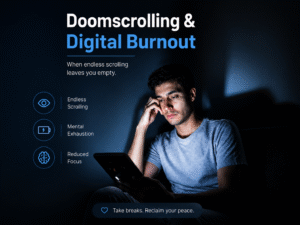
Doomscrolling & digital burnout have quietly become two of the most common mental health struggles of our always-online age. It’s 1 AM. You told yourself “just five more minutes” an hour ago. Your thumb keeps swiping — bad news, an argument in the comments, a stranger’s crisis, another headline that makes your stomach tighten. You’re exhausted, anxious, and somehow still not putting the phone down.
If this sounds familiar, you’re not alone — and you’re not lacking willpower. This pattern has a name: doomscrolling. And when it becomes a daily habit, it can lead to something bigger: digital burnout. Together, doomscrolling and digital burnout can chip away at your focus, sleep, and emotional resilience without you even realizing it.
At Delhi Mind Clinic, we’re seeing more people — students, working professionals, and parents alike — struggling with the mental toll of constant screen exposure. Let’s break down what’s really happening in your mind, and what you can do about it.
Doomscrolling & digital burnout
What Is Doomscrolling & Digital Burnout?
Doomscrolling refers to the compulsive habit of continuously scrolling through negative, distressing, or anxiety-inducing news and content, even when it makes you feel worse. It often happens late at night, during idle moments, or as an automatic response to stress. When this habit repeats day after day, it evolves into digital burnout — a deeper state of mental and emotional exhaustion. Understanding doomscrolling & digital burnout as two connected stages of the same problem is the first step toward addressing both.
The term “doomscrolling” gained popularity during global crises, when people found themselves glued to updates about tragedy, conflict, or uncertainty. But doomscrolling didn’t disappear once the headlines calmed down — it has quietly become a daily habit for millions of smartphone users, feeding directly into the wider pattern of digital burnout.
Why Do We Doomscroll? The Psychology Behind It
Doomscrolling isn’t a character flaw — it’s your brain doing exactly what it evolved to do, in an environment it was never designed for.
The negativity bias: Human brains are wired to pay closer attention to threats and danger. Negative news captures our attention far more powerfully than positive news, a survival mechanism from a time when spotting danger quickly kept us alive.
The need for closure: Uncertainty is uncomfortable. Scrolling can feel like an attempt to “stay informed” or find resolution, even though the endless feed rarely offers one.
Dopamine-driven design: Social media and news apps are built to keep you engaged. Every swipe offers the possibility of something new, triggering small dopamine hits that keep you coming back — a loop very similar to the mechanics of a slot machine.
Emotional avoidance: Sometimes scrolling isn’t about the news at all. It’s a way to numb out, avoid a difficult emotion, or delay dealing with something uncomfortable in real life.
From Doomscrolling to Digital Burnout: How the Cycle Builds
When doomscrolling becomes a daily pattern, it can snowball into digital burnout — a state of mental, emotional, and even physical exhaustion caused by prolonged and excessive screen engagement. This is the point where doomscrolling & digital burnout stop being separate issues and start reinforcing each other.
Common signs of doomscrolling & digital burnout include:
Persistent low mood, irritability, or a sense of dread
Difficulty concentrating or feeling mentally “foggy”
Disrupted sleep, or feeling tired even after sleeping
Increased anxiety about world events you have no control over
A nagging urge to check your phone, paired with guilt or frustration when you do
Feeling disconnected from people around you, despite being constantly “connected” online
Reduced motivation for work, hobbies, or things you used to enjoy
If several of these sound familiar, your mind may be signaling that it needs a reset — not more information, but more rest.
The Hidden Cost: How This Affects Your Mental Health
Constant exposure to distressing content keeps your nervous system in a low-grade state of alert. Over time, this can:
Heighten baseline anxiety, even when nothing is actively wrong
Make it harder to distinguish real threats from perceived ones
Interfere with sleep quality, which in turn affects mood regulation
Reduce your tolerance for uncertainty and everyday stress
Create a false sense of helplessness, as you absorb problems you cannot personally solve
The irony is that doomscrolling often begins with a desire to feel more informed or in control — but it frequently leaves people feeling more anxious and powerless instead.
How to Break the Doomscrolling & Digital Burnout Cycle: 7 Practical Steps
Recovery doesn’t require quitting your phone entirely. It’s about rebuilding a healthier relationship with information and screen time. Here are 7 practical, sustainable strategies to recover from doomscrolling & digital burnout:
1. Set “Information Windows”
Instead of checking news or social media throughout the day, choose two or three specific times to catch up. This limits the constant low-level anxiety of an ever-refreshing feed.
2. Use the “Pause and Notice” Technique
Before opening an app, pause for a moment and ask: “What am I hoping to feel right now?” This small check-in builds awareness of the emotional triggers behind the habit.
3. Create Phone-Free Zones and Times
Keep your phone out of the bedroom, and avoid screens for the first and last 30 minutes of your day. Mornings and nights are especially vulnerable windows for doomscrolling.
4. Curate Your Feed Intentionally
Unfollow or mute accounts that consistently leave you feeling anxious or drained. You don’t have to disengage from the world — just be selective about the lens you view it through.
5. Replace, Don’t Just Restrict
Willpower alone rarely works. Replace scrolling time with something equally accessible — a short walk, journaling, calling a friend, or a few minutes of quiet breathing.
6. Practice Grounding Techniques
When you notice anxiety rising from something you’ve read, try grounding yourself in the present moment — feel your feet on the floor, notice five things you can see, and take a few slow breaths. This helps shift your nervous system out of alert mode.
7. Reconnect With What You Can Control
Redirect some of that mental energy toward small, actionable steps in your own life — even something as simple as tidying a space or completing a task. This counters the sense of helplessness that doomscrolling often creates.
When to Seek Professional Support for Doomscrolling & Digital Burnout
Occasional doomscrolling is common and manageable with self-help strategies. However, if you notice ongoing anxiety, persistent low mood, sleep disturbances, or a sense of being emotionally overwhelmed that doesn’t improve, it may be time to talk to a mental health professional.
Doomscrolling & digital burnout, left unaddressed, can contribute to more significant difficulties with anxiety and mood over time. A trained therapist or counsellor can help you understand your personal triggers, build coping strategies, and address any underlying stress or anxiety that the habit may be masking.
In a world where information is endless and immediate, doomscrolling can feel almost unavoidable. But awareness is the first step toward change. By recognizing the pattern, understanding why it happens, and gently building healthier digital habits, you can protect yourself from doomscrolling & digital burnout without disconnecting from the world entirely.
Your mind deserves rest — not just from work, but from the constant noise of information overload.
At Delhi Mind Clinic, we help individuals navigate anxiety, stress, and the mental health challenges of modern digital life. If you’re feeling overwhelmed, exhausted, or stuck in unhealthy digital habits, reach out to our team for compassionate, professional support.
Have you ever wondered why some people find it so hard to sit still, stay organised, or finish a task even when they genuinely want to? For many, the answer lies in a condition called ADHD. Despite being one of the most talked-about mental health conditions today, it is still widely misunderstood.
If you’ve typed “what is ADHD” into a search bar recently, you’re not alone — millions of people ask this question every year. In this article, we break down what is ADHD, along with its symptoms, causes, types, and common myths — in simple, everyday language.
What is adhd
What is ADHD?
ADHD stands for Attention-Deficit/Hyperactivity Disorder. It is a neurodevelopmental condition that affects how the brain manages attention, impulse control, and activity levels. In simple terms, ADHD makes it harder for a person to focus, sit still, plan ahead, or control impulsive reactions — not because they aren’t trying, but because their brain is wired to process attention and self-control differently.
ADHD is not a result of laziness, poor parenting, or lack of discipline. It is a genuine, well-researched medical condition that affects both children and adults, and it can influence school performance, work life, relationships, and everyday routines.
Who Does ADHD Affect?
ADHD is often thought of as a “childhood condition,” but that’s a myth. While it is usually first noticed in childhood, ADHD frequently continues into the teenage years and adulthood. Many adults are diagnosed later in life, often after recognising the same patterns in their own children.
It affects people across all backgrounds, genders, and intelligence levels. In fact, many people with ADHD are highly creative, energetic, and capable of remarkable focus on things they find genuinely interesting — a phenomenon often called “hyperfocus.”
Common Symptoms of ADHD
To fully understand what ADHD looks like day to day, it helps to know that symptoms are generally grouped into two categories: inattention and hyperactivity-impulsivity. Not everyone experiences both equally.
Signs of Inattention
Difficulty focusing on tasks, conversations, or instructions
Getting easily distracted by unrelated thoughts or surroundings
Frequently losing items like keys, phones, or documents
Struggling to organise tasks or manage time
Forgetting daily responsibilities or appointments
Avoiding tasks that require sustained mental effort
Signs of Hyperactivity and Impulsivity
Feeling restless or fidgety, even in calm situations
Talking excessively or interrupting others
Difficulty waiting for one’s turn
Acting without thinking through consequences
A constant feeling of being “on the go”
It’s important to remember that occasionally forgetting things or feeling restless doesn’t mean someone has ADHD. A proper diagnosis looks at whether these patterns are persistent, appear across multiple settings (like home, school, and work), and significantly affect daily functioning.
Types of ADHD
Mental health professionals generally classify ADHD into three types:
Predominantly Inattentive Type – Difficulty focusing, organising, and following through on tasks, without significant hyperactivity.
Predominantly Hyperactive-Impulsive Type – Restlessness and impulsive behaviour, with fewer attention-related difficulties.
Combined Type – A mix of both inattentive and hyperactive-impulsive symptoms, which is the most commonly diagnosed type.
What Causes ADHD?
Understanding what causes ADHD is just as important as understanding what is ADHD in the first place. Researchers don’t point to a single cause. Instead, it’s believed to result from a combination of factors, including:
Genetics – ADHD often runs in families.
Brain structure and function – Differences in areas of the brain responsible for attention and self-control.
Environmental factors – Such as exposure to certain substances during pregnancy or premature birth.
Early developmental factors – Certain complications during pregnancy or birth may increase the likelihood.
It’s worth stressing again: ADHD is not caused by too much screen time, sugar intake, or poor parenting, though these popular myths still circulate widely.
How is ADHD Diagnosed?
Once you understand what is ADHD in theory, the next natural question is how it’s actually diagnosed. There is no single test — like a blood test or scan — that can diagnose ADHD. Instead, a qualified mental health professional evaluates a person through:
Detailed conversations about symptoms and their history
Behavioural questionnaires and rating scales
Input from parents, teachers, or close family members (especially for children)
Ruling out other conditions that can mimic ADHD symptoms, such as anxiety or sleep issues
If you notice persistent patterns of inattention, restlessness, or impulsivity that are affecting daily life, it’s worth consulting a mental health professional for a proper evaluation rather than self-diagnosing based on social media content.
Common Myths About ADHD
“ADHD isn’t a real condition, kids just need discipline.” False — ADHD is a recognised neurodevelopmental condition backed by decades of research.
“Only hyperactive boys have ADHD.” False — girls and adults often present with quieter, inattentive symptoms that go unnoticed for years.
“People with ADHD can’t focus on anything.” False — many people with ADHD can hyperfocus intensely on tasks they find engaging.
“ADHD goes away after childhood.” False — many people continue to experience symptoms well into adulthood.
Living Well with ADHD
Now that you know what is ADHD and how it presents, it’s worth remembering that a diagnosis is not a limitation — it’s a better understanding of how your brain works. With the right support system, including structured routines, professional guidance, and, where needed, therapy or counselling, individuals with ADHD can lead successful, fulfilling lives. Many thrive in careers that value creativity, quick thinking, and adaptability.
When Should You See a Specialist?
If you or your child are experiencing ongoing difficulty with focus, organisation, restlessness, or impulse control that is affecting school, work, or relationships, it’s a good idea to speak with a qualified mental health professional. Early evaluation and support can make a meaningful difference in day-to-day life.
Understanding what ADHD is — and recognising it early — is the first step toward getting the right support.
At Delhi Mind Clinic, our team helps individuals and families understand ADHD better through professional evaluation and personalised care plans. If you have concerns about yourself or a loved one, reach out to us to book a consultation.
1. What is ADHD in simple words? ADHD is a condition that affects the brain’s ability to manage attention, impulses, and activity levels, making it harder to focus, stay organised, or sit still.
2. Can adults have ADHD? Yes. ADHD often continues into adulthood, and many adults are diagnosed later in life after recognising lifelong patterns.
3. Is ADHD the same as being lazy or undisciplined? No. ADHD is a genuine neurodevelopmental condition, not a character flaw or a result of poor discipline.
4. Can ADHD be managed? Yes. With professional guidance, structured routines, and appropriate support, individuals with ADHD can manage symptoms effectively and lead productive lives.
5. How do I know if I should get evaluated for ADHD? If inattention, restlessness, or impulsivity is persistent, appears across different areas of your life, and is affecting your daily functioning, consider speaking with a mental health professional.
Your heart is racing. Your chest feels tight. The room seems to be closing in, and for a few terrifying minutes, you’re convinced something is seriously wrong — even though nothing around you has actually changed. If this sounds familiar, you’re not alone, and you’re not “overreacting.” You may be experiencing panic anxiety disorder, one of the most common — and most misunderstood — mental health conditions in India today.
In this article, we break down what panic anxiety disorder really is, the surprising facts most people don’t know about it, the latest statistics from India and around the world, and how to recognise it in yourself or someone you love.
panic anxiety order
What Is Panic Anxiety Disorder?
Panic anxiety disorder (often simply called panic disorder) is a type of anxiety disorder marked by recurrent, unexpected panic attacks — sudden waves of intense fear that peak within minutes and are accompanied by physical symptoms such as a racing heart, sweating, trembling, shortness of breath, chest discomfort, dizziness, or a feeling of losing control or “going crazy.”
What sets panic disorder apart from an occasional stressful moment is the pattern: the attacks are recurring, often come without an obvious trigger, and are followed by weeks or months of persistent worry about when the next one will strike. Over time, this fear can lead people to avoid places, situations, or even everyday activities they associate with a previous attack.
15 Interesting Facts About Panic Anxiety Disorder
It’s not “just stress.” Panic attacks involve real, measurable physiological changes — a surge of adrenaline, a spike in heart rate, and rapid, shallow breathing — that your body triggers as if you were in actual physical danger.
You can’t “think” your way out of a panic attack in the moment. Because the amygdala (the brain’s alarm centre) hijacks the response, panic attacks often feel completely disconnected from logic, even to people who know, rationally, that they are safe.
Panic attacks usually peak within 10 minutes. Most panic attacks reach their most intense point quickly and then begin to subside, even though it can feel like it lasts much longer.
Many people mistake it for a heart attack. Chest tightness, a pounding heart, and breathlessness are so convincing that panic disorder is one of the leading reasons people visit emergency rooms, only to be told their heart is perfectly fine.
Panic disorder often runs alongside agoraphobia. Left unaddressed, some people begin avoiding crowded places, public transport, or being far from home for fear of having an attack somewhere they can’t easily leave.
It can start at any age, but often begins in the late teens or twenties. Major life transitions, academic pressure, or career stress are common windows during which symptoms first appear.
Women are diagnosed more often than men. Across almost every population studied, panic and anxiety disorders are consistently more common in women than in men.
Genetics play a role — but so does environment. Having a close family member with panic disorder increases your likelihood of developing it, but life stress, trauma, and even certain personality traits also contribute.
Panic disorder is highly treatable. With the right combination of therapy, lifestyle changes, and professional guidance, most people see significant improvement — many go on to live completely panic-free lives.
It’s more common than most people realise. Panic disorder is one of the most frequently experienced anxiety conditions worldwide, yet it remains one of the least openly discussed.
Urban living may increase risk. Research from India has found that people living in cities report higher rates of anxiety disorders than those in rural areas — likely linked to lifestyle pace, pollution, and work pressure.
Panic attacks are not dangerous, even though they feel life-threatening. No one has ever died from a panic attack itself — but the fear it creates is very real and deserves real support.
Avoidance makes it worse, not better. The more a person avoids situations that trigger anxiety, the smaller their world tends to become — which is why early, professional intervention matters.
Sleep and panic disorder are deeply connected. Poor sleep can trigger panic symptoms, and panic disorder itself often disrupts sleep — creating a cycle that’s important to break early.
Awareness is growing, but the treatment gap remains huge. Despite rising conversation around mental health, a large proportion of people with panic and anxiety disorders in India never seek professional help.
Panic & Anxiety Disorder: The Numbers That Matter
Numbers can be a wake-up call. Here’s what recent research tells us:
Anxiety is the most common mental health condition in the world, affecting roughly 300–360 million people globally, according to World Health Organization estimates.
Nearly 1 in 4 adults will experience an anxiety disorder at some point in their life, with lifetime prevalence estimated around 31% in major population surveys.
In India, anxiety disorders affect an estimated 3–3.3% of the population, according to India’s National Mental Health Survey (NMHS) and related research — translating to tens of millions of people nationwide.
Among Indian adults, the National Mental Health Survey found panic disorder specifically affects roughly 1 in 200 people at some point in their lives, with a smaller but still significant number experiencing it currently.
Anxiety disorders are consistently more prevalent among women than men, a pattern confirmed across Indian and global studies alike.
People living in urban Indian metros report higher rates of anxiety disorders compared to those in rural regions, reflecting the pressures of city life.
On a global scale, lifetime prevalence of panic attacks (a broader experience than full panic disorder) has been estimated at over 13% — meaning more than 1 in 8 people will experience at least one panic attack in their lifetime.
Perhaps most strikingly, only a minority of people with anxiety disorders ever receive professional treatment — the “treatment gap” remains one of the biggest challenges in mental healthcare, in India and worldwide.
These numbers tell a clear story: panic anxiety disorder is common, it’s real, and it is significantly under-treated — not because help doesn’t work, but because too few people reach out for it.
Common Signs of a Panic Attack
If you’re wondering whether what you experienced was a panic attack, here are some of the hallmark signs:
Sudden, intense fear or a sense of impending doom
A racing or pounding heartbeat
Shortness of breath or a choking sensation
Chest pain or tightness
Trembling, shaking, or sweating
Dizziness, lightheadedness, or feeling faint
Nausea or stomach discomfort
Numbness or tingling sensations
Chills or sudden heat flushes
A feeling of detachment from yourself or your surroundings
Fear of losing control or “going crazy”
If these symptoms occur repeatedly, and are followed by ongoing worry about future attacks or a change in your behaviour to avoid triggering situations, it may be time to speak with a mental health professional.
The most encouraging fact about panic anxiety disorder is also the simplest: it responds very well to professional support. The earlier someone reaches out, the sooner they can break the cycle of fear, avoidance, and physical symptoms that keeps panic disorder going.
You don’t have to wait until symptoms feel unbearable. Whether it’s understanding your triggers, learning practical coping tools, or working through the underlying causes with a qualified mental health expert, help is available — and it works.
If you or someone you know is experiencing recurring panic attacks or persistent anxiety, Delhi Mind Clinic is here to help you understand what you’re going through and find a path forward that fits your life.
This article is for general awareness and informational purposes only and is not a substitute for professional diagnosis or care. If you are experiencing distressing symptoms, please consult a qualified mental health professional.
Every July 11, something quietly remarkable happens: the world pauses, just for a moment, to think about a number so large it’s almost impossible to picture. 8.3 billion. That’s how many people share this planet with you right now.
world-population-day
Welcome to World Population Day — a day that isn’t about counting heads for the sake of it, but about understanding how that number touches everything from housing and jobs to, perhaps surprisingly, your peace of mind.
At Delhi Mind Clinic, we spend our days helping people navigate the stresses of modern life. And if you look closely, so many of those stresses — crowded cities, competitive workplaces, the constant hum of “too many people, too little space” — trace back to one root idea: population. So this year, we’re marking World Population Day a little differently, by connecting the dots between global numbers and everyday mental wellbeing.
What Is World Population Day, Really?
World Population Day was established by the United Nations Development Programme in 1989, inspired by an extraordinary moment two years earlier. On July 11, 1987, the world’s population crossed 5 billion people — an event so significant it was informally called the “Day of Five Billion.” Newspapers everywhere ran the story, and for the first time, ordinary people around the world started asking: what happens when we keep growing like this?
Since then, July 11 has become an annual checkpoint — a day for governments, researchers, and communities to reflect on population growth, reproductive health, gender equality, and sustainable development.
World Population Day 2026 Theme
This year’s official UNFPA theme is “Realizing the hopes and aspirations of young people – today and for the future.” It’s built on a massive global survey of more than 100,000 young adults aged 18–39 across 73 countries, exploring what they want from relationships, family, and the future — and what’s standing in their way. Spoiler: it’s rarely a lack of desire to build a life. It’s cost of living, job insecurity, and housing pressure — the very things that quietly chip away at mental health too.
Fascinating Facts About World Population Day
Here are some facts worth sharing on your social feed this July 11:
It took all of human history — hundreds of thousands of years — for the population to reach 1 billion. It then took just 200 years to multiply sevenfold.
The world adds roughly 200,000 to 220,000 people every single day — that’s a mid-sized city’s worth of new people, daily.
Every 14 months or so, humanity adds another 100 million people to the planet.
India is now the most populous country on Earth, having overtaken China in April 2023, with an estimated 1.45 billion people in 2026 — nearly 17.5% of humanity.
Asia is home to about 4.85 billion people — more than half of everyone alive today.
More than half the world’s population is under the age of 30. This is, quite literally, a young planet.
Global population growth has been slowing since it peaked in 1963, and current growth sits around 0.83% a year.
The Statistics Behind the Story
Numbers tell a story of their own. Here’s where the world stands as we mark World Population Day 2026:
Metric
Figure
Current global population
~8.3 billion
Population in 2050 (projected)
~9.7 billion
Projected peak population
10.3–10.9 billion (around the 2080s)
India’s population (2026)
~1.45 billion
Share of world population under 30
Over 50%
Daily net population growth
~200,000–220,000 people
One statistic from UNFPA’s latest global survey stands out in particular: across a 14-country study covering more than a third of the world’s population, 18% of adults of reproductive age said they expect to end up with fewer or more children than they actually wanted — not because they didn’t want a family, but because of cost, job insecurity, and housing pressure. Behind every population statistic is a deeply human, and often deeply stressful, decision.
The Hidden Link Between Population and Mental Health
This is where the conversation gets personal — and where it connects directly to what we see every day at Delhi Mind Clinic.
1. Crowded cities, lonelier minds. It sounds contradictory, but living surrounded by millions of people is one of the most common paths to isolation. Urban crowding is consistently associated with higher stress levels, sensory overload, and a sense of anonymity that can quietly erode emotional wellbeing.
2. The pressure of “not enough to go around.” When population grows faster than jobs, housing, or infrastructure, competition intensifies. That competition — for school seats, job interviews, even a parking spot — becomes a daily source of anxiety for millions of people, especially in dense urban centres like Delhi.
3. Family planning is a mental health decision, not just a demographic one. The idea of choosing if, when, and how many children to have is tied closely to emotional wellbeing, relationship stability, and a sense of control over one’s own future. When people feel they can’t make that choice freely — due to financial pressure or social expectation — it takes a real emotional toll.
4. A young, ambitious population needs mental health support more than ever. With over half of the world under 30, this generation faces academic pressure, job market competition, and social media comparison at a scale no previous generation has. Investing in youth mental health isn’t optional anymore — it’s central to how the next few decades will unfold.
5. Environmental anxiety is real — and it’s growing. Climate change, resource scarcity, and questions about the future are increasingly cited by young adults as reasons to delay or reconsider having children. This isn’t pessimism; it’s a rational response that deserves compassionate, professional support rather than dismissal.
How You Can Observe World Population Day 2026
You don’t need a grand gesture to participate meaningfully:
Explore real data through the UNFPA World Population Dashboard
Start a conversation with friends or family about population, sustainability, or mental wellbeing
Support local sustainability initiatives — even small actions like water conservation count
Check in on your own stress levels if city life, work pressure, or future planning feels overwhelming
Share verified facts and statistics using #WorldPopulationDay to help others engage with accurate information
It’s easy to get lost in billions and percentages, but World Population Day is ultimately not about numbers — it’s about people. Every single digit in “8.3 billion” represents someone navigating their own hopes, pressures, relationships, and mental health journey, just like you.
If the pace of modern life, urban pressure, or future anxiety has been weighing on you, know that you’re far from alone — and that support is always available. At Delhi Mind Clinic, we’re here to help you find calm, clarity, and balance, no matter how crowded the world outside gets.
Have you ever had a thought so disturbing, so out of character, that it left you shaken — wondering what it says about you as a person? If that thought kept coming back, uninvited, no matter how hard you tried to push it away, you may have experienced what mental health professionals call OCD thoughts.
At Delhi Mind Clinic, we meet many people every week who are quietly struggling with these thoughts — too afraid or embarrassed to talk about them. This blog post is here to help you understand what OCD thoughts actually are, why they happen, and what you can do to feel more in control of your own mind.
ocd-thoughts
What Are OCD Thoughts?
OCD thoughts, also known as intrusive thoughts, are unwanted, repetitive thoughts, images, or urges that show up in the mind uninvited. They are a core feature of Obsessive-Compulsive Disorder (OCD), a mental health condition where a person experiences persistent obsessions (the thoughts) and often feels driven to perform compulsions (repeated behaviours or mental rituals) to reduce the distress those thoughts cause.
The important thing to understand is this: having an intrusive thought does not mean you want to act on it, or that it reflects your true character or desires. In fact, research shows that almost everyone experiences strange, unwanted thoughts from time to time. The difference with OCD is how the mind reacts to them — with intense anxiety, guilt, or fear — and how much effort goes into trying to control, suppress, or “fix” the thought.
7 Common Types of OCD Thoughts
OCD thoughts can take many forms, and they often centre around a person’s deepest values or fears — which is exactly what makes them so distressing. Some common themes include:
Contamination thoughts — fear of germs, dirt, or illness spreading to oneself or loved ones
Harm thoughts — sudden, unwanted images of hurting someone, even a loved one, despite having no desire to do so
Checking thoughts — persistent doubt about whether a door was locked, a stove was switched off, or a task was done “correctly”
Symmetry and order thoughts — an overwhelming need for things to feel “just right” or evenly arranged
Religious or moral thoughts (scrupulosity) — fear of having sinned, offended a higher power, or acted immorally
Relationship-focused thoughts — constant doubt about whether one truly loves their partner or is with the “right” person
Sexual intrusive thoughts — unwanted and distressing sexual images or ideas that feel completely against one’s values
If any of these sound familiar, please know this: you are not alone, and you are not a bad person for having these thoughts.
Why Do OCD Thoughts Happen?
It’s natural to ask, “Why is this happening to me?” While researchers are still learning about the exact causes, a combination of factors is usually involved:
Biological factors — differences in brain circuitry involved in decision-making, risk assessment, and habit formation
Genetic factors — a family history of OCD or anxiety-related conditions can increase likelihood
Personality traits — a strong sense of responsibility or a tendency toward perfectionism can make someone more prone to obsessive thinking
Life stress — major life changes, trauma, or prolonged stress can trigger or worsen symptoms
The way the brain responds to the thought — this is key. In OCD, the brain assigns unusually high importance and danger to a passing thought, which is what turns a fleeting idea into a looping, distressing obsession
Understanding this can be a relief in itself: OCD thoughts are not a reflection of who you are — they are a symptom of how the brain is processing anxiety.
The OCD Thought Cycle
One reason OCD thoughts feel so relentless is because they tend to follow a predictable cycle:
Intrusive thought → Anxiety/Distress → Urge to “neutralise” the thought (through a compulsion, reassurance-seeking, or avoidance) → Temporary relief → Thought returns, often stronger
This cycle is what keeps OCD alive. The compulsion may bring short-term relief, but it actually reinforces the brain’s belief that the thought was dangerous and needed to be dealt with — making the next thought even more powerful.
7 Ways to Cope With OCD Thoughts
While professional support is often essential for long-term relief (more on that below), there are healthy strategies that can help you manage OCD thoughts day to day:
1. Label the Thought, Don’t Fight It
Instead of trying to push the thought away, try mentally noting: “This is an OCD thought.” Naming it creates a small but powerful distance between you and the thought.
2. Avoid Seeking Constant Reassurance
It’s tempting to ask others “Are you sure I locked the door?” or to Google your symptoms repeatedly. While this feels helpful in the moment, it actually strengthens the OCD cycle over time.
3. Practice Mindful Observation
Try to observe the thought as if it were a cloud passing in the sky — present, but not something you need to hold onto, judge, or act upon.
4. Resist the Urge to Perform Compulsions
This is difficult, but every time a compulsion is resisted, the brain slowly learns that the thought was never as dangerous as it seemed.
5. Keep a Thought Journal
Writing down intrusive thoughts (without judgment) can help you notice patterns and reduce their emotional charge over time.
6. Prioritise Sleep, Movement, and Routine
A well-regulated nervous system is more resilient. Regular sleep, physical activity, and a stable daily routine can meaningfully reduce the intensity of intrusive thoughts.
7. Be Kind to Yourself
Shame and self-criticism tend to fuel the OCD cycle further. Self-compassion, on the other hand, helps calm the nervous system and creates space for healing.
When Should You Seek Professional Help?
Occasional unwanted thoughts are part of being human. But if you notice that:
The thoughts are frequent, distressing, and hard to control
You spend an hour or more a day dealing with these thoughts or related rituals
The thoughts are interfering with your work, relationships, or daily functioning
You’re avoiding people, places, or situations because of these thoughts
…it may be time to speak with a mental health professional. OCD is a well-understood, highly treatable condition, and structured therapeutic approaches — particularly those focused on gradually facing feared thoughts without performing compulsions — have helped countless people regain control of their minds.
At Delhi Mind Clinic, our team takes a compassionate, non-judgmental approach to help you understand your thoughts, break the OCD cycle, and build lasting mental resilience.
If you’re dealing with OCD thoughts, please remember: the content of the thought is not a reflection of your character, your desires, or your future. It’s a symptom — and symptoms can be treated.
You don’t have to carry this alone. Reaching out for support is not a sign of weakness; it’s one of the most courageous steps you can take toward peace of mind.
Ready to take the next step? [Book a confidential consultation with Delhi Mind Clinic] and start your journey toward a calmer, clearer mind.
Frequently Asked Questions (FAQs)
Q1. Are OCD thoughts dangerous? No. OCD thoughts, however disturbing, are almost never acted upon. Their distressing nature is actually a sign of how strongly they go against a person’s true values.
Q2. Can OCD thoughts go away on their own? For some people, mild intrusive thoughts fade with time and stress reduction. However, persistent or distressing OCD thoughts usually respond best to professional, structured support.
Q3. Does everyone with intrusive thoughts have OCD? Not necessarily. Most people experience occasional intrusive thoughts. OCD is diagnosed when these thoughts become frequent, distressing, and are accompanied by compulsions or significant impairment in daily life.
Q4. Can lifestyle changes help with OCD thoughts? Yes — while they aren’t a substitute for professional care, good sleep, regular exercise, stress management, and mindfulness practices can meaningfully support overall treatment.
Positive and negative symptoms of schizophrenia are the two core categories used by mental health professionals to describe this complex condition.
Schizophrenia is one of the most misunderstood mental health conditions. Movies and media often portray it as “split personality” or purely violent behavior, but the clinical reality is very different. Schizophrenia is a complex psychiatric disorder that affects how a person thinks, feels, and perceives reality — and its symptoms are broadly classified into two categories: positive symptoms and negative symptoms.
Understanding this distinction is important not just for patients and families, but for anyone who wants to recognize early warning signs and seek timely professional help. In this article, we break down both symptom categories in simple, easy-to-understand language.
Understanding Positive and Negative Symptoms of Schizophrenia
Before diving in, it’s worth clearing up a common misconception. In psychiatry, “positive” does not mean “good,” and “negative” does not mean “bad.”
Positive symptoms refer to experiences or behaviors that are added to a person’s normal functioning — things that appear that shouldn’t normally be there, such as hallucinations or delusions.
Negative symptoms refer to normal functions or abilities that are reduced or taken away — such as motivation, emotional expression, or social engagement.
Think of it this way: positive symptoms are an excess of something, while negative symptoms are a deficit of something.
Positive Symptoms of Schizophrenia
Positive symptoms are usually the most visible and are often what first brings a person to clinical attention. They represent a distortion or exaggeration of normal mental functions.
1. Hallucinations
Hallucinations involve sensing things that aren’t actually present. The most common type is auditory hallucinations — hearing voices that others cannot hear. These voices may comment on the person’s actions, argue with each other, or give commands. Hallucinations can also involve sight, smell, touch, or taste, though these are less common.
2. Delusions
Delusions are strongly held false beliefs that persist even when there is clear evidence against them. Common types include
Persecutory delusions — believing one is being watched, followed, or harmed by others.
Grandiose delusions — believing one has special powers, wealth, or importance.
Referential delusions — believing that ordinary events, objects, or comments carry a special, personal meaning.
3. Disorganized Thinking
A person may have trouble organizing their thoughts logically. This can show up as jumping quickly between unrelated topics, losing track of a conversation midway, or making loose connections between ideas that don’t logically follow one another.
4. Disorganized Speech
Closely linked to disorganized thinking, this involves speech that is difficult to follow — giving answers that don’t relate to the question asked, mixing up words, or stringing sentences together in a way that lacks a clear, logical structure.
5. Disorganized or Abnormal Motor Behavior
This can range from childlike silliness to unpredictable agitation. In some cases, it may include unusual postures, a lack of responsiveness (catatonia), or repetitive, purposeless movements.
Negative Symptoms of Schizophrenia
Negative symptoms are often subtler, develop gradually, and are frequently mistaken for laziness, depression, or personality traits — which is why they often go unrecognized for a long time. They tend to have a significant impact on a person’s day-to-day quality of life and social functioning.
1. Reduced Emotional Expression (Flat Affect)
The person may show little to no facial expression, reduced eye contact, and a monotone voice, even when they are experiencing strong emotions internally.
2. Avolition (Lack of Motivation)
A noticeable difficulty in starting or following through with goal-directed activities — this can affect basic self-care, work, or hobbies that the person previously enjoyed.
3. Social Withdrawal
A tendency to pull away from friends, family, and social situations, often accompanied by a reduced desire for close relationships.
4. Reduced Speech Output (Alogia)
The person may speak very little, give brief, empty replies, or take unusually long pauses before responding.
5. Anhedonia
A diminished ability to experience pleasure from activities that were once enjoyable, such as hobbies, food, or spending time with loved ones.
Why the Difference Between Positive and Negative Symptoms of Schizophrenia Matters
Recognizing whether symptoms fall into the positive or negative category helps mental health professionals:
Understand the overall pattern and severity of the condition
Track how a person is responding to treatment over time
Identify areas that need additional support, such as social skills training or family therapy, alongside medical care
Differentiate schizophrenia from other conditions, since negative symptoms in particular can overlap with depression
It’s also worth noting that many people with schizophrenia experience a mix of both symptom types, and the intensity of each can fluctuate over time.
Cognitive Symptoms: The Often-Overlooked Third Category
Alongside positive and negative symptoms, many people with schizophrenia also experience cognitive difficulties, such as:
Trouble with concentration and attention
Difficulty with working memory
Slower processing speed
Challenges with planning and decision-making
These symptoms are less talked about but can significantly affect a person’s ability to study, work, and manage daily responsibilities.
When Should You Seek Professional Help?
Early intervention makes a meaningful difference in the long-term outlook for schizophrenia. Consider reaching out to a mental health professional if you or a loved one notice:
Hearing or seeing things others don’t
Persistent, unusual beliefs that don’t change despite evidence
A noticeable decline in motivation, hygiene, or social interaction
Withdrawal from friends, family, or previously enjoyed activities
Difficulty organizing thoughts or communicating clearly
Schizophrenia is a manageable condition with the right combination of professional care, therapy, family support, and lifestyle adjustments. The earlier it is recognized, the better the outcomes tend to be.
“Final Thoughts on Positive and Negative Symptoms of Schizophrenia
Positive and negative symptoms represent two very different sides of schizophrenia — one adds unusual experiences, the other takes away normal functioning. Understanding both helps reduce stigma, encourages early recognition, and supports more compassionate care for those affected.
If you or someone you know is showing signs of schizophrenia, don’t wait to seek professional guidance. A qualified psychiatrist or mental health expert can provide an accurate assessment and a personalized care plan.