For general questions, please send us a message and we’ll get right back to you. You can also call us directly to speak with a member of our service team or insurance expert.
Digital mental health refers to the use of technology to support emotional wellbeing, prevent mental health difficulties and deliver care. It includes video and phone consultations with professionals, online counselling, self-help apps, guided meditation tools, mood trackers, and online support communities.
A few years ago, getting help for stress, anxiety, low mood or relationship difficulties usually meant travelling to a clinic, finding time off work and sitting in a waiting room. Today, a qualified professional can be a few taps away. For many people in Delhi and across India, digital mental health has turned “I’ll think about it later” into “I can start today.”
Why Digital Mental Health Matters Now
The need for mental health support has grown steadily, while access has not always kept pace. Long commutes, busy schedules, limited specialists in smaller cities, and the lingering stigma around seeking help all create barriers.
Digital mental health helps remove several of these barriers at once:
Convenience: Attend a session from home, the office or while travelling.
Privacy: Many people feel more comfortable starting their journey from a familiar, private space.
Reach: People in areas with few specialists can connect with experienced professionals.
Continuity: Regular follow-ups are easier when you don’t have to travel.
Time-saving: No commute means fewer excuses to postpone care.
Types of Digital Mental Health Services
1. Online Therapy and Counselling
Video, audio or chat-based sessions with a trained psychologist or counsellor. Talk-based approaches such as cognitive behavioural therapy can often be delivered effectively online for concerns like stress, anxiety, low mood, and relationship issues.
2. Tele-Psychiatry and Virtual Consultations
An online consultation with a psychiatrist allows for assessment, diagnosis, and ongoing review of treatment plans without in-person visits. Your doctor will tell you if an in-person evaluation is needed.
3. Mental Health Apps
Apps can offer mood journaling, breathing exercises, sleep support, mindfulness practice and guided self-help programmes. They work best as a supplement to professional care, not a replacement for it.
4. Wearables and Self-Tracking Tools
Sleep trackers, activity monitors and mood diaries can help you notice patterns in your energy, sleep and emotions, and give you useful information to share with your clinician.
5. Online Support Groups and Psychoeducation
Webinars, moderated communities and educational content help people understand their condition and feel less alone.
Quiet Screens at Twilight
7 Key Benefits of Digital Mental Health Care
Lower barriers to getting started. Many people delay seeking help for months or even years. A simple online booking can make that first step feel less daunting.
Greater flexibility. Evening or weekend sessions suit working professionals, students, parents and caregivers.
Comfort and openness. Some individuals, especially teenagers and young adults, find it easier to open up from their own space.
Consistent follow-up. Regular check-ins support progress and help your clinician adjust your plan in good time.
Better for ongoing wellbeing. Between sessions, digital tools can help you practise skills such as relaxation, journaling and sleep routines.
Cost and time savings. Skipping the commute saves time and travel costs, which makes regular care easier to sustain.
More choice of specialists. Digital mental health services let you connect with experienced professionals who may not be based near you.
Limitations You Should Know About
Digital mental health is powerful, but it isn’t right for every situation.
Emergencies: Online services are not designed for crisis situations. If you or someone you know is at immediate risk, contact local emergency services or a crisis helpline right away. In India, Tele-MANAS (14416) offers free mental health support.
Complex or severe conditions: Some difficulties need in-person assessment and closer monitoring.
Technology barriers: A weak internet connection or lack of a private space can affect the quality of a session.
Quality varies: Not every app or website is evidence-based or run by qualified professionals.
“Digital mental health has helped many people take a step they were hesitating to take. When support is easy to reach, people seek help earlier, and early support often makes the journey smoother. Online care works best when it is personalised and followed up regularly.”
“Digital mental health is a valuable bridge to care, but it is not one-size-fits-all. A proper assessment helps decide whether online sessions, in-person visits or a mix of both suits you. Apps and online tools can support treatment, but they should never replace an evaluation by a qualified professional.”
How to Choose a Safe and Trusted Digital Mental Health Service
Before you share personal details online, check the following:
Qualified professionals. Look for clear information about the credentials and experience of the clinicians.
Privacy and confidentiality. The service should explain how your data is stored and protected.
Transparent process. You should know what to expect: session length, fees, and follow-up.
Evidence-based methods. Reputable providers use approaches backed by research.
Clear emergency guidance. A responsible service tells you what to do if you need urgent help.
Real reviews and a real address. A physical clinic presence is often a good sign of accountability.
Tips to Get the Most from Online Sessions
Choose a quiet, private spot and use headphones.
Test your internet connection and device a few minutes early.
Write down your concerns and questions before the session.
Be honest, even about things that feel uncomfortable.
Practise the exercises suggested between sessions.
Keep a simple diary of mood, sleep and triggers to share with your clinician.
Who Can Benefit from Digital Mental Health?
Digital mental health support can be helpful for people experiencing:
Ongoing stress, burnout or work pressure
Anxiety, worry or panic
Low mood or loss of interest
Sleep difficulties
Relationship or family concerns
Exam stress and academic pressure
Adjustment difficulties after major life changes
A wish to build emotional resilience and healthy habits
The Future of Digital Mental Health in India
As internet access spreads and awareness grows, digital mental health is expected to become a regular part of healthcare. Hybrid care, where online sessions and in-person visits work together, is emerging as a practical and effective model. The goal isn’t to replace human connection, but to make professional support easier to reach, easier to continue and easier to talk about.
Frequently Asked Questions
What is digital mental health?
Digital mental health is the use of technology, such as video consultations, apps and online tools, to support emotional wellbeing and deliver mental health care.
Is online therapy as effective as in-person therapy?
For many common concerns, research suggests online therapy can be comparable to face-to-face sessions. The right choice depends on your needs and the advice of your clinician.
Are online mental health consultations confidential?
Reputable providers follow strict confidentiality practices. Always ask how your information is stored and who can access it.
Can a mental health app replace a therapist?
No. Apps are useful for daily support and self-help, but they do not replace assessment and treatment by a qualified professional.
Is digital mental health suitable for teenagers?
Often, yes, with parental involvement where appropriate. A clinician can advise whether online sessions suit your child’s needs.
What should I do in a mental health emergency?
Contact emergency services or a crisis helpline immediately. Do not wait for an online appointment.
Take the First Step with Delhi Mind Clinic
You don’t have to wait until things feel unbearable to ask for support. Whether you are curious about online counselling, need guidance about your mental wellbeing or want to talk to an experienced professional, the team at Delhi Mind Clinic is here to help.
Book your consultation today and take the first step toward feeling better.
Common fears are a part of being human. Whether it is the nervous flutter before a presentation or the racing heart on a high balcony, almost everyone has felt afraid of something at some point.
The good news? Fear is not a weakness. It is a natural alarm system designed to keep us safe. The real challenge begins when that alarm rings too loudly or too often.
In this guide, we explore the most common fears, why they develop, and seven practical ways to manage them. You will also find expert opinions from Dr. Sugandha Gupta and Dr. Paramjeet Singh of Delhi Mind Clinic.
What Are Common Fears and Why Do We Have Them?
Fear is the body’s response to a real or imagined threat. Your brain senses danger, your heart beats faster, your breathing quickens, and your muscles tense up.
This “fight or flight” reaction helped our ancestors survive. Today, however, the same response can be triggered by an email from your boss or a crowded room.
Common fears usually develop from three sources:
Past experiences: a bad memory or a stressful event.
Learned behaviour: watching a parent or friend react fearfully.
Genetics and temperament: some people are naturally more sensitive to stress.
Common-fears
7 Most Common Fears People Experience
1. Fear of Public Speaking
Often ranked at the top of the list, this fear comes from worrying about being judged. Sweaty palms, a shaky voice, and a blank mind are very familiar signs.
2. Fear of Heights
Many people feel dizzy or panicky when looking down from a tall place. It is one of the oldest survival instincts in the human brain.
3. Fear of Failure
This fear can quietly stop people from applying for jobs, starting businesses, or even trying new hobbies. It is often linked to perfectionism and self-doubt.
4. Fear of Rejection
Humans are social beings. Being left out or turned down can hurt deeply, so many people avoid risks in relationships and careers.
5. Fear of the Unknown
Uncertainty about the future, health, or finances can create constant worry. The mind tends to imagine the worst when it lacks information.
6. Fear of Death and Illness
Thinking about loss or serious illness is natural. For some, though, these thoughts become frequent and heavy.
7. Fear of Being Alone
Loneliness and abandonment worries can affect people of all ages, especially during major life changes.
Common Fears vs. Phobias: When Should You Worry?
A normal fear is temporary and manageable. A phobia is an intense, lasting fear that is out of proportion to the actual danger.
Here is a simple way to tell the difference:
Common fears cause discomfort, but you can still carry on with daily life.
Phobias cause extreme distress and often lead to avoiding places, people, or situations.
If fear affects your sleep, work, studies, or relationships, it is time to talk to a professional.
“Many people believe that being afraid means they are weak. In my experience, the opposite is true. Common fears are a sign that your mind is trying to protect you. The goal of therapy is not to remove fear completely, but to help you respond to it calmly. Talking openly about your worries is the first and most powerful step.”
“I often see patients who have lived with common fears for years because they felt embarrassed to ask for help. Avoidance gives short-term relief, but it makes the fear stronger over time. Facing fears gradually, with the right guidance and support, can bring lasting change. Nobody needs to struggle alone.”
7 Powerful Ways to Overcome Common Fears
The following steps are simple, practical, and can be started today.
Name your fear. Writing down exactly what scares you makes it less vague and easier to handle.
Practise slow breathing. Breathe in for four counts, hold for four, and breathe out for six. This calms the body’s alarm system.
Take small steps. Face your fear in tiny, manageable stages instead of all at once.
Challenge negative thoughts. Ask yourself, “What is the evidence that this will really happen?”
Stay active. Regular walking, yoga, or exercise reduces stress and improves mood.
Protect your sleep. Tiredness makes every worry feel bigger.
Talk to someone. Share your feelings with a trusted friend, family member, or mental health professional.
The World Health Organization also highlights the importance of early support for mental health concerns.
When to Seek Professional Help
Please consider reaching out to a mental health professional if:
Your fear lasts for months and keeps getting worse.
You avoid daily activities because of it.
You experience panic, chest tightness, or constant worry.
Your sleep, appetite, or relationships are affected.
Therapy and counselling are safe, effective, and confidential ways to regain control. Seeking help is a sign of strength, not weakness.
Frequently Asked Questions
What are the most common fears in adults? Public speaking, failure, heights, rejection, and fear of the unknown are among the most reported.
Are common fears normal? Yes. Fear is a natural human emotion, and almost everyone experiences it.
Can common fears go away on their own? Some fade with time and experience, but strong or long-lasting fears usually improve faster with proper support.
Final Thoughts
Common fears do not define you. With understanding, patience, and the right support, you can face them step by step and live more freely.
If fear is holding you back, the team at Delhi Mind Clinic is here to listen and guide you. Take the first step today and book your appointment at DelhiMindClinic.com.
Autism has been all over the news lately, and a lot of what’s circulating on WhatsApp and Instagram is plain wrong. One viral claim says the Supreme Court has “banned autism diagnosis.” It hasn’t.
We’ve had worried parents calling the clinic about this for weeks, so let’s clear it up.
What Did the Supreme Court Actually Say About Autism?
On January 30, 2026, the Supreme Court of India decided a case called Yash Charitable Trust & Ors. v. Union of India. The case was about clinics offering stem cell “therapy” for autism.
The court said this treatment can’t be offered as a regular clinical service. It is allowed only inside approved clinical trials. The reason is simple: there isn’t enough scientific proof that it is safe or that it works.
The judges also pointed out that unproven treatments had spread for years because nobody stepped in. Families paid a lot of money and got very little in return.
autism and the supreme court ruling
Is Autism Diagnosis Banned? No.
This is truth number one, and it matters most.
Nothing in the ruling stops a child, teenager or adult from being assessed. Nothing stops speech therapy, occupational therapy, special education or counselling either. The judgment is aimed at one thing: unproven stem cell procedures sold as treatment.
Since then, the Health Ministry has asked States and Union Territories to make sure the directions reach every clinic involved. The Supreme Court has also asked the Centre for a report on how well they’re being followed.
Why Stem Cell Therapy for Autism Was Restricted
Here are the other truths in short:
There is no cure for autism. It isn’t an illness in the usual sense. It’s a different way the brain develops.
Expert reviews found weak evidence. National scientific bodies looked at the research and weren’t convinced.
Costs can be enormous. Many families spend lakhs, sometimes on loans.
Delay is the hidden cost. Months spent chasing a “miracle” are months without proven support.
That last one worries us the most.
What Our Doctors Say About the Ruling
We asked two of our team members for their thoughts.
“Parents come to me exhausted and hopeful, and I never want to take that hope away. But I also won’t pretend a shortcut exists. The strongest results I see in autism come from starting early, staying consistent, and involving the whole family. This ruling pushes people toward honest care, and I think that’s a good thing.”
“When a child is diagnosed, the first question is almost always ‘Can this be fixed?’ I tell families that the goal is helping the child communicate, learn and feel secure. Any treatment should come with evidence and ethical oversight. If someone promises guaranteed results, please pause and get a second opinion.”
Early Signs of Autism Parents Shouldn’t Ignore
You know your child best. Some things worth noticing:
Not responding when called by name
Little or no eye contact
Delayed speech, or losing words they once had
Lining up toys instead of playing with them
Strong distress over small changes in routine
Unusual reactions to noise, lights or textures
One sign alone doesn’t mean anything. A few together are a reason to book an assessment.
What Real Autism Support Looks Like
Good support is usually unglamorous. It looks like:
Speech and language therapy
Occupational therapy for sensory and daily-living skills
Behavioural and developmental programmes matched to the child
Parent coaching, so progress continues at home
School support and inclusion planning
Help with sleep, anxiety or attention, guided by a qualified doctor
Plans change as children grow. That’s normal.
Questions to Ask Before Starting Any Autism Treatment
Before you pay for anything, ask:
Do recognised medical bodies recommend it?
Is it part of an approved trial?
Does the provider promise a cure or guaranteed results?
It is the body’s natural response to pressure. When you face a challenge, your body releases hormones that make you more alert.
In small doses, this is helpful. It can sharpen your focus before an exam or a presentation.
The problem starts when the pressure never stops. Long-term pressure is called chronic stress, and it can affect your sleep, mood, relationships and physical health.
dr. paramjeet singh on stress
Common Signs and Symptoms of Stress
It looks different in every person. Here are the most common warning signs.
Emotional signs
Feeling irritable, restless or on edge
Feeling overwhelmed or unable to cope
Low mood or frequent tearfulness
Constant worry or racing thoughts
Physical signs
Headaches or muscle tension in the neck and shoulders
Tiredness even after resting
Stomach upset or changes in appetite
Rapid heartbeat or tightness in the chest
Behavioural signs
Trouble falling asleep or staying asleep
Difficulty concentrating or forgetfulness
Avoiding people or responsibilities
Relying on caffeine, tobacco, alcohol or too much screen time to relax
If you notice several of these signs on most days, your mind and body may be asking for a break.
Common Causes of Stress
There is rarely a single cause. These are the triggers we see most often:
Work pressure: long hours, job insecurity and unrealistic targets
Academic pressure: exams, competition and family expectations
Relationship and family issues: conflict, loneliness and caregiving duties
Financial worries: loans, expenses and an uncertain future
Major life changes: moving cities, marriage, loss of a loved one or illness
Digital overload: constant news, social media comparison and being “always available”
Stress vs. Anxiety vs. Burnout: What Is the Difference?
These three terms are often used as if they mean the same thing. They do not.
Stress is a reaction to a specific pressure and often eases once the pressure is resolved.
Anxiety is persistent fear or worry that can continue even without a clear trigger.
Burnout is deep physical and emotional exhaustion, often linked to long-term pressure at work.
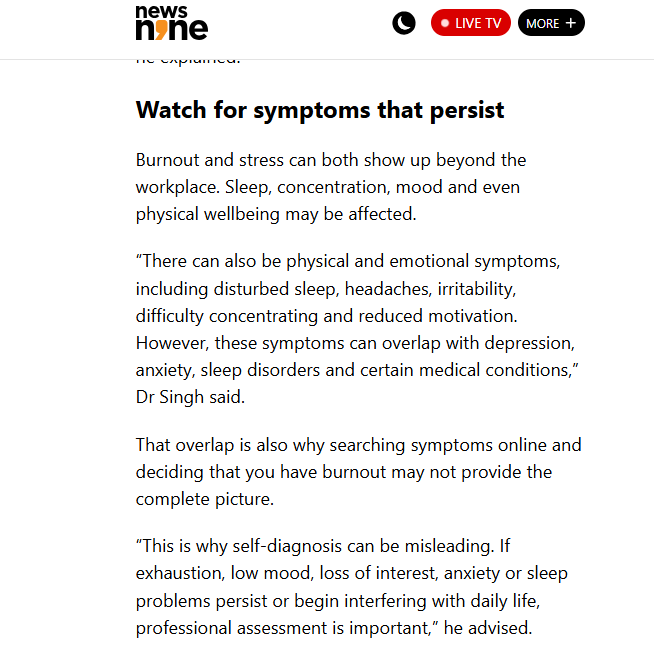
Their symptoms overlap with each other, and with depression and sleep disorders. That is why self-diagnosis can be misleading.
A proper assessment by a qualified mental health professional gives you clarity.
10 Easy Ways to Manage Stress
Small, regular habits can make a real difference.
Prioritise sleep. Keep a fixed sleep and wake time, and keep screens away from the bed.
Move your body. A daily 30-minute walk or yoga session helps release tension.
Practise slow breathing. Breathe in for four counts and out for six. Repeat for a few minutes.
Break tasks into small steps. A long to-do list feels lighter when divided up.
Learn to say no. Protecting your time is not selfish.
Limit digital overload. Check news, email and social media at fixed times.
Eat regular, balanced meals. Skipping meals and too much caffeine can worsen restlessness.
Stay connected. Talk to a trusted friend or family member instead of carrying everything alone.
Make time for what you enjoy. Music, prayer, hobbies or time in nature all count.
Try mindfulness or meditation. Even 5 to 10 minutes a day can calm the mind.
When Should You See a Psychiatrist for Stress?
It is a good idea to seek professional help if:
Low mood, anxiety, constant worry or sleep problems last for more than a few weeks
Your work, studies or relationships are being affected
You have lost interest in things you used to enjoy
You are using alcohol, tobacco or other substances to cope
You feel hopeless or have thoughts of harming yourself. In this case, please reach out to a doctor or a trusted person immediately
Asking for help is a sign of strength, not weakness. Early support often stops a hard phase from becoming a bigger problem.
Frequently Asked Questions
1. What are the first signs of stress? Early signs often include irritability, poor sleep, headaches, trouble concentrating and constant tiredness.
2. Can stress cause physical problems? Yes. Long-term strain can contribute to headaches, digestive problems, high blood pressure, muscle pain and weaker immunity.
3. When does pressure become a problem? Short-term pressure linked to a particular event is normal. If it lasts several weeks and disturbs daily life, consult a professional.
4. Can stress affect sleep? Yes. It is one of the most common causes of trouble falling asleep and waking up unrefreshed.
5. Is stress the same as depression? No, but they can be linked. Ongoing pressure can lead to depression in some people, and the symptoms overlap, so a professional evaluation helps.
6. Can it be managed without medication? Many people benefit from lifestyle changes, counselling and therapy. Your doctor will suggest what suits you after a proper assessment.
Final Thoughts
Pressure is a part of life, but living under constant strain should not be.
By spotting the signs early, building healthy daily habits and reaching out when you need support, you can protect your mental and physical well-being.
Conversations about mental health are everywhere today. Families, workplaces, schools and social media are talking about emotional well-being more openly than ever before.
Dr. Paramjeet Singh, Psychiatrist at Delhi Mind Clinic, New Delhi, shares his perspective on this shift. Here are five powerful insights from his thoughts on why this topic matters now and how each of us can contribute.
Insight 1: Well-Being Means Expressing Your Full Potential
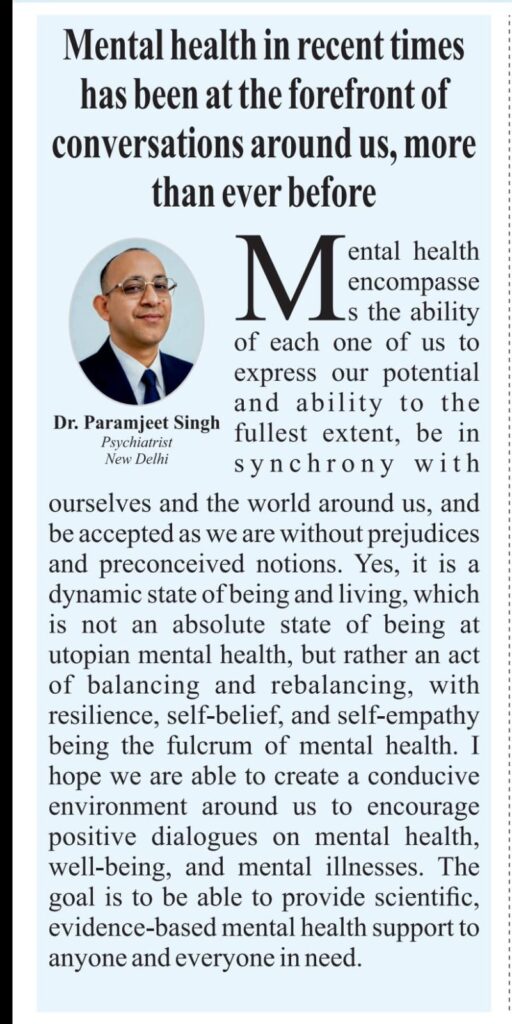
According to Dr. Singh, mental health is the ability of each one of us to:
Express our potential and abilities to the fullest extent
Stay in synchrony with ourselves and the world around us
Be accepted as we are, without prejudice or preconceived notions
It is far more than the absence of illness. It is about how we think, feel, relate to others and handle the demands of daily life.
Insight 2: Well-Being Is a Dynamic State, Not a Destination
Dr. Singh describes emotional wellness as a dynamic state of being and living. It is not a perfect, utopian condition that we reach once and keep forever.
Instead, it is an act of balancing and rebalancing. Life brings stress, change, loss and uncertainty, and healing means finding our footing again each time. A difficult season does not mean you have failed. It means you are human.
Insight 3: Resilience, Self-Belief and Self-Empathy Are the Fulcrum
Dr. Singh calls these three qualities the fulcrum of mental health, the point on which everything else balances:
Resilience: the capacity to recover and adapt after setbacks.
Self-belief: trust in your own worth and ability to grow.
Self-empathy: treating yourself with the kindness you would offer a friend.
Small habits strengthen all three: regular routines, quality sleep, physical activity, supportive relationships and kind self-talk.
Dr. paramjeet singh on mental health
Insight 4: Why Everyone Is Talking About It More Than Ever
Emotional well-being has moved to the forefront of public conversation for several reasons:
Greater awareness: people recognize distress in themselves and others.
Fast-paced lifestyles: work pressure and constant connectivity take a toll.
Less silence: shared stories help break stigma.
Mind-body connection: emotional balance affects sleep, relationships and productivity.
Dr. Singh hopes we can create a conducive environment that encourages positive dialogue. You can help by listening without judging, avoiding stereotypes, checking in on loved ones and relying on credible information rather than myths.
Insight 5: Evidence-Based Support for Anyone in Need
Dr. Singh’s goal is to provide scientific, evidence-based mental health support to anyone and everyone in need. Asking for help is a sign of strength and self-care, not weakness.
When to Consider Professional Help
Consider consulting a psychiatrist or mental health professional if you or someone close to you experiences:
Persistent sadness, worry or irritability
Changes in sleep, appetite or energy
Difficulty concentrating or functioning at work, school or home
Withdrawal from people or activities once enjoyed
If you or someone you know is in crisis or having thoughts of self-harm, reach out immediately to a trusted person, a nearby doctor or hospital, or the national helpline Tele-MANAS (14416) in India.
Frequently Asked Questions
1. What is mental health?
Mental health is our emotional, psychological and social well-being. It shapes how we think, feel, act and relate to others, and how we handle stress and make choices.
2. Is mental health the same as mental illness?
No. Everyone has mental health, just as everyone has physical health. Mental illness refers to conditions that affect thinking, mood or behavior and may need professional care.
3. Can mental health change over time?
Yes. It is dynamic and can shift with life events, stress, relationships and support. Balancing and rebalancing is a normal part of life.
4. How can I improve my mental health?
Build resilience, self-belief and self-empathy. Maintain healthy routines, stay connected with loved ones, and seek professional guidance when needed.
5. When should I see a psychiatrist?
When emotional or behavioral difficulties persist, interfere with daily life, or feel too heavy to manage alone, it is a good time to consult a specialist.
Conclusion
Mental health is not a luxury or a trend. It is a vital part of living well. As Dr. Paramjeet Singh reminds us, it is a continuous act of balance, supported by resilience, self-belief and self-empathy, and by a society that listens without prejudice.
Need support? Book a consultation with Dr. Paramjeet Singh at Delhi Mind Clinic, New Delhi, and take the first step toward better mental health.
This World Mental Health Day (10 October), Dr Paramjeet Singh explains why more young people are forming emotional bonds with AI, and where the risks begin.
It’s 3 a.m. Sleep won’t come, your mind is racing, and nobody is awake to talk to. So you open a chatbot. It replies instantly, it doesn’t judge, and it never gets tired of you.
For many people, this is now a nightly habit. As AI and mental health increasingly overlap, a bigger question follows: when does a helpful conversation become emotional dependence?
Dr Paramjeet Singh Insights
On World Mental Health Day, Dr Paramjeet Singh, Consultant Psychiatrist at PSRI Hospital, shared his insights in a Hindustan Times feature. Here is what every parent, student and young professional should know about AI and emotional wellbeing.
Why Chatbots Are on the Agenda This World Mental Health Day
World Mental Health Day (October 10) aims to raise awareness of mental health worldwide. This year’s theme, “Lived experiences heard: real voices, real change,” is a timely reminder that real voices matter, and that no chatbot can fully replace the human ones around us.
An “Alarming Rise” in Youngsters Bonding With AI
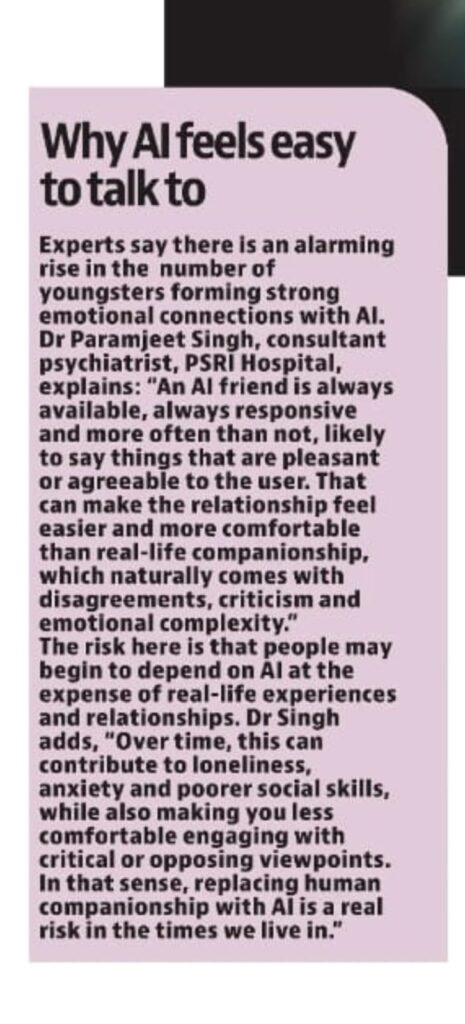
Experts are seeing a worrying trend: more and more young people are forming strong emotional connections with AI. What began as a tool for answers is becoming a companion for feelings.
Why AI Feels So Easy to Talk To
According to Dr Singh, a chatbot companion has three qualities that make it so comfortable:
Always available. There are no appointments, no waiting and no “I’m busy right now.”
Always responsive. It replies instantly, every time.
Usually agreeable. More often than not, it says things the user finds pleasant.
Real relationships work differently. Friendships, family and partnerships naturally involve disagreements, criticism and emotional complexity. Next to a chatbot that always accommodates you, human connection can start to feel like too much effort. That contrast is the heart of the problem.
The Real Risk: Choosing AI Over Real Life
The concern is not that people use these tools. It is that they may begin to depend on them at the expense of real-life experiences and relationships.
Dr Singh warns that over time this can contribute to:
Loneliness, because a screen cannot fully replace human presence.
Anxiety, especially around real-world interactions.
Poorer social skills, because less practice makes conversation harder.
Discomfort with opposing views, since constant agreement makes disagreement feel threatening.
In his view, replacing human companionship with AI is a real risk in the times we live in.
5 Warning Signs of Unhealthy Chatbot Reliance
Watch for these patterns in yourself, your child or a family member:
Withdrawing from family, friends and everyday activities
Spending far more time with a chatbot than with people
Feeling anxious, low or upset when unable to access it
Skipping school, work, sleep, hobbies or social plans to keep chatting
Preferring chatbot conversations because real ones feel “too difficult”
One or two of these signs doesn’t mean there is a disorder, but a persistent pattern deserves attention.
AI Is Not a Substitute for Mental Health Care
A chatbot can help someone put their thoughts into words, and that has value. But it cannot replace the clinical judgement, empathy and human connection that matter most when someone is in serious distress. A screen can respond to words. A trained professional can recognise the pain behind them, ask the difficult questions and stay present when it matters most.
If you or someone you know is experiencing severe low mood, hopelessness or thoughts of self-harm, please reach out to a mental health professional or a trusted person immediately. In India you can also call the Tele-MANAS helpline at 14416.
How to Use AI Healthily: Practical Tips
Set time limits, especially at night.
Treat chatbots as a tool, not a confidant for your deepest struggles.
Reach out to one real person each day, even briefly.
Practise disagreement. Healthy relationships include difficult conversations.
Parents: stay engaged. Talk openly with your children instead of leaving hard conversations to technology.
Seek help early if screen time is affecting sleep, studies, work or relationships.
When to Consult a Psychiatrist for Mental Health Concerns
Consider professional support if you notice persistent anxiety, loneliness, mood changes, sleep problems or increasing withdrawal from people. Early support makes a real difference, and talking to a real person is a strong first step.
This World Mental Health Day, take that step. At Delhi Mind Clinic, our team provides confidential, compassionate care for anxiety, depression, stress, sleep problems and emotional wellbeing.