For general questions, please send us a message and we’ll get right back to you. You can also call us directly to speak with a member of our service team or insurance expert.
Have you ever said something in the heat of the moment that you deeply regretted later? Or felt your heart race, your jaw clench, and your patience vanish within seconds? If so, you’re not alone. Anger is one of the most natural human emotions — but when it takes over, it can strain relationships, hurt your career, and take a toll on your mental and physical health.
The good news is that controlling temper is a skill, not a personality trait. Just like any skill, controlling temper can be learned, practiced, and strengthened over time. In this blog, we’ll walk you through why we lose our temper, the warning signs to watch for, and practical strategies for controlling temper that you can start using today.
Why Do We Lose Our Temper?
Anger usually doesn’t appear out of nowhere. It’s often the tip of the iceberg, sitting on top of deeper emotions like stress, fear, hurt, exhaustion, or feeling disrespected. Common triggers include:
Work pressure or unrealistic deadlines
Feeling unheard or misunderstood in relationships
Financial stress or uncertainty
Sleep deprivation and burnout
Past unresolved emotional wounds
Understanding why your temper flares up is the first step toward controlling temper effectively, since you can’t manage what you don’t understand.
Warning Signs Your Temper Is Taking Over
Before you’re able to manage anger, it helps to recognize its early signs:
A racing heartbeat or tight chest
Clenched fists or jaw
Raised voice or rapid speech
Racing, negative thoughts
An urge to walk away, slam something, or say something hurtful
Catching these signals early gives you a valuable window to pause before reacting — and this window is where controlling temper truly becomes possible.
controlling temper
10 Effective Ways of Controlling Temper
1. Pause Before You React
The moment you feel anger rising, give yourself a few seconds before responding. Even a short pause can prevent words or actions you might regret, and it’s often the simplest technique for controlling temper in the moment.
2. Practice Deep Breathing
Slow, deep breaths signal your nervous system to calm down. Try inhaling for four counts, holding for four, and exhaling for four — repeat until you feel steadier.
3. Step Away From the Situation
If possible, physically remove yourself from the triggering situation for a few minutes. A short walk or change of scenery can help reset your emotional state.
4. Identify the Real Trigger
Ask yourself: “What am I really upset about?” Often, anger masks deeper feelings like disappointment, insecurity, or exhaustion. Naming the real issue reduces its intensity.
5. Use “I” Statements Instead of Blame
Saying “I feel frustrated when this happens” is far more constructive than “You always do this.” It opens a conversation instead of starting a conflict.
6. Exercise Regularly
Physical activity is one of the most effective natural outlets for built-up tension and stress, making it easier to stay level-headed in tense moments. Many people find that regular exercise becomes their most reliable tool for controlling temper long-term.
7. Improve Your Sleep Quality
Poor sleep lowers your tolerance for frustration. Prioritizing 7–8 hours of quality sleep can significantly improve emotional regulation.
8. Practice Mindfulness or Meditation
Regular mindfulness practice trains your brain to observe emotions without immediately acting on them, creating space between feeling and reaction.
9. Journal Your Triggers
Writing down what makes you angry — and how you responded — helps you spot patterns and prepare better responses for next time.
10. Seek Professional Support When Needed
If anger feels uncontrollable, frequent, or is affecting your relationships and work, speaking with a mental health professional can help you understand the root cause and develop personalized coping strategies.
Expert Insight on Controlling Temper
Dr. Sugandha Gupta notes: “Many people believe controlling temper means bottling up emotions, but that’s not true. It’s about creating a gap between the trigger and your response — a gap where you get to choose how you react instead of letting the emotion choose for you. With consistent practice, this becomes far more natural than most people expect.”
Dr. Paramjeet Singh adds: “In my practice, I often see that anger is a secondary emotion — it’s usually covering up hurt, fear, or stress that hasn’t been addressed. Once we help a person identify and work through what’s really underneath the anger, the outbursts naturally start to reduce.”
When Should You Seek Help for Anger Issues?
While occasional anger is normal, it may be time to seek professional guidance if you notice:
Frequent outbursts that feel disproportionate to the situation
Difficulty calming down even after time has passed
Anger affecting your relationships, work, or health
Feelings of guilt or regret after angry episodes
Physical aggression or fear of losing control
Anger management support isn’t just for people in crisis — it’s a proactive step toward emotional well-being and healthier relationships, and it plays a big role in successfully controlling temper over the long run.
Final Thoughts on Controlling Temper
Controlling temper isn’t about suppressing your emotions — it’s about understanding them and responding in ways that align with who you want to be. With consistent practice, self-awareness, and the right support system, controlling temper becomes second nature rather than a constant struggle.
If you or someone you know is struggling to manage anger, Delhi Mind Clinic offers compassionate, professional guidance to help you build lasting emotional balance. Reach out today to take the first step toward controlling temper and living a calmer, more balanced life.
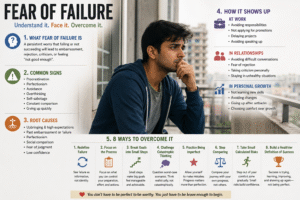
Have you ever avoided applying for a job you really wanted, stayed silent in a meeting out of fear of saying the “wrong” thing, or put off starting something new because you were terrified it wouldn’t work out? If this sounds familiar, you may be dealing with a fear of failure — a psychological pattern that affects far more people than you might think.
Fear of failure, sometimes called atychiphobia in its more intense form, isn’t about being lazy, unmotivated, or lacking ambition. In fact, it often affects highly capable, driven individuals who care deeply about doing well. Left unaddressed, it can quietly hold people back from careers, relationships, and personal growth.
In this article, we’ll explore what fear of failure really is, why it develops, how it shows up in everyday life, and practical strategies to work through it.
What Is Fear of Failure?
Fear of failure is an intense, persistent worry about not succeeding — to the point that it influences your decisions, behaviour, and even your sense of self-worth. It goes beyond the normal nervousness most people feel before an exam, interview, or big presentation.
For someone experiencing fear of failure, the thought of failing can feel more distressing than the failure itself. This fear can be so overwhelming that it leads to avoidance — skipping opportunities altogether just to escape the possibility of not measuring up.
Common Signs of Fear of Failure
Fear of failure can look different from person to person, but some common patterns include:
fear of failure
Procrastination on important tasks or goals
Perfectionism — needing everything to be flawless before moving forward
Avoiding new challenges or opportunities for growth
Overthinking decisions to the point of feeling stuck
Self-sabotage, such as not fully trying so failure can be blamed on lack of effort rather than ability
Seeking constant reassurance from others before taking action
Physical symptoms like a racing heart, sweating, or nausea before attempting something important
Negative self-talk, such as “I’m not good enough” or “What’s the point of trying?”
Difficulty accepting feedback, even when it’s constructive
If several of these resonate with you, it may be worth exploring where this fear is coming from.
What Causes Fear of Failure?
Fear of failure rarely comes from a single source. It usually develops through a combination of experiences, upbringing, and personality factors, including:
1. Childhood Experiences and Upbringing
Growing up in an environment with high expectations, harsh criticism, or conditional approval (where love or praise felt tied to achievement) can create a deep-rooted association between failure and rejection.
2. Past Experiences of Failure or Public Embarrassment
A particularly painful failure — especially one that happened publicly — can leave a lasting emotional imprint, making the brain want to avoid similar situations at all costs.
3. Perfectionistic Tendencies
People who hold themselves to extremely high standards often equate anything less than perfect with failure, making the fear more intense and frequent.
4. Comparison and Social Pressure
In today’s hyper-connected world, constant comparison with others’ curated success on social media can amplify feelings of inadequacy and heighten the fear of falling short.
5. Fear of Judgment
For many, the fear isn’t really about failing itself — it’s about what others will think. This fear of judgment or losing respect and status can be a powerful driver of avoidance behaviour.
“In my clinical practice, I often see fear of failure masquerading as procrastination or ‘lack of motivation.’ In reality, the person cares so much about the outcome that the anxiety around it becomes paralysing. The first step is always helping them separate their self-worth from their performance.”— Dr. Sugandha Gupta, Psychiatrist, Delhi Mind Clinic
How Fear of Failure Affects Daily Life
When left unchecked, fear of failure doesn’t just affect big life decisions — it can quietly shape everyday behaviour:
At work: Avoiding leadership roles, new projects, or promotions despite being qualified
In relationships: Holding back from vulnerability or commitment out of fear of “failing” at the relationship
In personal growth: Avoiding hobbies, creative pursuits, or fitness goals because of fear of not being “good enough” at them
In mental well-being: Contributing to chronic stress, low self-esteem, and in some cases, symptoms of anxiety
Over time, this avoidance can create a cycle: the more you avoid situations, the more your confidence erodes, which in turn strengthens the fear.
8 Ways to Overcome Fear of Failure
The good news is that fear of failure is highly manageable with the right strategies and support. Here are some approaches that can help:
1. Reframe What Failure Means
Instead of viewing failure as the opposite of success, try seeing it as part of the process. Many of the world’s most successful individuals attribute their growth to lessons learned from failing first. Ask yourself: “What can I learn from this, regardless of the outcome?”
2. Set Realistic, Process-Focused Goals
Shift your focus from outcome-based goals (“I must get this exact result”) to process-based goals (“I will prepare well and give my best effort”). This reduces the all-or-nothing pressure that fuels fear.
3. Challenge Perfectionism
Practice allowing yourself to do things imperfectly. Completing a task at 80% is often far more valuable than never starting because it isn’t perfect.
4. Break Tasks into Smaller Steps
Large goals can feel overwhelming and increase fear. Breaking them into smaller, manageable steps makes the process feel less intimidating and builds confidence with each small win.
5. Practice Self-Compassion
Notice your inner critic and consciously replace harsh self-talk with the kind of encouragement you’d offer a close friend. Self-compassion has been shown to reduce fear-driven avoidance.
6. Visualize Success — and Survivable Failure
Instead of only visualizing success, also visualize what would happen if things didn’t go as planned. Most people realize that even in a “worst case” scenario, they would cope and move forward — this can be surprisingly reassuring.
7. Take Small, Consistent Action
Facing small fears repeatedly, in manageable doses, helps retrain your brain to see challenging situations as safe rather than threatening. Momentum builds courage.
8. Seek Professional Support
When fear of failure significantly impacts your career, relationships, or overall well-being, speaking with a mental health professional can help you understand the root causes and build personalised strategies to move forward with confidence.
“Fear of failure that goes untreated for years often doesn’t stay confined to one area of life — it spreads. A person who avoids risk at work may start avoiding it in relationships too. What looks like ‘playing it safe’ is frequently an anxiety pattern that responds very well to the right therapeutic approach, once it’s identified.”— Dr. Paramjeet Singh, Psychiatrist, Delhi Mind Clinic
When Should You Seek Help?
While mild fear of failure is common and manageable on your own, it may be time to seek professional guidance if you notice:
The fear is stopping you from pursuing important goals or opportunities
It’s affecting your relationships, career, or academic performance
You experience significant anxiety, sleep disturbances, or physical symptoms tied to this fear
You find yourself avoiding activities you once enjoyed
The fear is accompanied by persistent low mood, self-doubt, or hopelessness
A qualified psychologist or counsellor can help identify the underlying patterns driving your fear and work with you to build lasting coping strategies through structured, evidence-based approaches.
Fear of failure is a deeply human experience — but it doesn’t have to define your choices or limit your potential. By understanding where this fear comes from and actively practising strategies to manage it, you can build the confidence to take meaningful steps forward, even when the outcome isn’t guaranteed.
Remember: growth rarely comes from certainty. It comes from being willing to try, even when you’re afraid.
If fear of failure is holding you back from living the life you want, professional support can make a real difference. At Delhi Mind Clinic, our team is here to help you understand your fears and build the confidence to move forward.
Frequently Asked Questions (FAQs)
Q1. Is fear of failure a mental illness? Fear of failure itself is not classified as a mental illness, but when intense and persistent, it can be a specific phobia (atychiphobia) or be linked with anxiety-related conditions. A mental health professional can help assess this.
Q2. Why do successful people also fear failure? Success doesn’t eliminate fear of failure — in fact, high achievers often fear failure due to high personal standards, fear of losing status, or past experiences tied to achievement and approval.
Q3. Can fear of failure be completely cured? While it may not disappear entirely, fear of failure can be significantly reduced and managed so it no longer controls your decisions or limits your growth.
Q4. How is fear of failure different from normal nervousness? Nervousness is a temporary, situational response, while fear of failure is a persistent pattern that influences decision-making and often leads to avoidance, even when the stakes are low.
Q5. Should I see a therapist for fear of failure? If this fear is significantly affecting your career, relationships, or emotional well-being, speaking with a therapist can help you understand the root cause and develop effective coping strategies.
If you’ve noticed yourself doing the bare minimum at work lately — logging off exactly on time, avoiding extra projects, feeling emotionally distant from a job you once cared about — you’re not alone. This behavior has a name: quiet quitting. And more often than not, it isn’t laziness. It’s a quiet, often unspoken response to workplace anxiety. The relationship between quiet quitting and workplace anxiety is closer than most people realize, and understanding it can change how you respond to burnout at work.
At Delhi Mind Clinic, we’re seeing a growing number of working professionals — from IT employees to corporate managers — describe the same pattern: exhaustion, disengagement, and a persistent sense of dread about going to work. Understanding the connection between quiet quitting and workplace anxiety is the first step toward addressing it in a healthy, sustainable way.
What Is Quiet Quitting?
quiet-quitting-and-workplace-anxiety
Quiet quitting doesn’t mean actually quitting your job. It refers to doing only what your job description requires — nothing more, nothing less. No late-night emails, no extra volunteering, no going “above and beyond.”
While it may look like a boundary-setting trend on social media, for many people it’s a coping mechanism. It’s what happens when someone feels overwhelmed, undervalued, or emotionally unsafe at work but isn’t ready — or able — to leave. This is exactly where quiet quitting and workplace anxiety start to overlap: the withdrawal isn’t really about the job description, it’s about protecting an already-stretched nervous system.
The Hidden Link Between Quiet Quitting and Workplace Anxiety
Workplace anxiety often shows up long before someone consciously decides to disengage. It can look like:
Constant worry about making mistakes or being judged by colleagues
Racing thoughts before meetings or performance reviews
Difficulty concentrating due to a persistent sense of unease
Trouble sleeping the night before a workday
Physical symptoms like a racing heart, tight chest, or fatigue tied to work stress
When this anxiety goes unaddressed for months, the mind instinctively looks for ways to protect itself. Quiet quitting becomes a form of emotional self-preservation — a way to reduce exposure to a source of stress without walking away from income, stability, or identity tied to the job.
In other words: quiet quitting is frequently a symptom, not the problem itself.
Why Workplace Anxiety Is on the Rise
Several factors are converging to make workplace anxiety more common, especially among younger professionals in fast-paced urban environments like Delhi:
Blurred work-life boundaries — Remote and hybrid work have made it harder to switch off, leading to chronic low-grade stress.
Constant connectivity — Notifications and always-on culture keep the nervous system in a state of alert.
High-performance expectations — Competitive workplaces often reward overwork, making rest feel like falling behind.
Job insecurity — Layoffs and economic uncertainty add a persistent undercurrent of worry.
Lack of psychological safety — Fear of criticism or being seen as “not a team player” discourages people from speaking up about their struggles.
7 Signs Your Quiet Quitting Is Rooted in Workplace Anxiety
Not all quiet quitting is anxiety-driven — sometimes it’s simply healthy boundary-setting. But when quiet quitting and workplace anxiety are linked, you’ll often notice these seven signs:
You feel anxious even thinking about work outside office hours
Your motivation dropped sharply after a specific stressful event (criticism, conflict, missed promotion)
You feel disproportionately relieved on weekends and dread Sunday evenings
You’ve started avoiding meetings, feedback conversations, or interactions with certain colleagues
Your self-worth feels tied to work performance, and you’re protecting yourself from potential failure
You notice physical tension — a tight chest, shallow breathing, or a racing heart — before logging in
You’ve stopped speaking up in meetings even when you have something valuable to contribute
If several of these resonate, your disengagement may be less about the job itself and more about how your mind and body are responding to sustained workplace stress.
How to Address Quiet Quitting and Workplace Anxiety Together
Addressing quiet quitting and workplace anxiety at the same time — rather than treating them as separate issues — tends to produce more lasting results. Here’s where to start:
1. Name What You’re Feeling
Simply identifying “I think I’m anxious about work” rather than “I hate my job” can shift how you approach the problem — from avoidance to understanding.
2. Set Boundaries Without Guilt
Healthy boundaries — like not checking email after a certain hour — are different from quiet quitting driven by fear. Boundaries come from self-respect; anxiety-driven withdrawal comes from self-protection. Both can look similar from the outside, but they feel very different internally.
3. Identify Specific Triggers
Is it a particular manager, project, meeting format, or workload volume? Anxiety often has specific triggers rather than being about “everything.” Pinpointing these makes the problem feel more manageable.
4. Talk to Someone You Trust
Whether it’s a colleague, mentor, or mental health professional, voicing what you’re experiencing can reduce the isolation that often deepens workplace anxiety.
5. Reconnect With What Originally Motivated You
Sometimes disengagement is really burnout in disguise. Revisiting what once felt meaningful about your work — even in small ways — can help you distinguish exhaustion from true disinterest.
6. Seek Professional Support When Needed
When anxiety starts interfering with sleep, concentration, relationships, or your overall sense of well-being, it may be time to speak with a mental health professional. Left unaddressed, workplace anxiety can affect not just your career but your broader mental health.
Expert Perspective
Dr. Sugandha Gupta notes that quiet quitting is increasingly common among clients who present with what looks like low motivation but is, on closer exploration, unaddressed workplace anxiety. “Many professionals come to us describing themselves as ‘just tired of the job,'” she explains. “But when we look closer, what we often find is a nervous system that has been on high alert for months — anticipating criticism, replaying conversations, dreading Monday mornings. Disengaging becomes the mind’s way of creating distance from a source of chronic stress, even when the person can’t quite name what’s happening.”
Dr. Paramjeet Singh adds that the challenge is distinguishing this from a normal, healthy response to overwork. “Not everyone who sets boundaries at work is anxious — some are simply making a wise decision to protect their time and energy. What we look for clinically is the emotional tone behind the withdrawal. Is it calm and deliberate, or is it driven by dread, fear of failure, or avoidance? That distinction changes how we approach treatment, and it’s something we always explore carefully with our clients before assuming either extreme.”
Both experts agree on one point: the link between quiet quitting and workplace anxiety should be treated as a signal worth paying attention to, not dismissed as a workplace trend or a personal failing. Left unexamined, it can either resolve on its own with better boundaries, or deepen into more significant anxiety and burnout that requires professional support.
Physical symptoms (headaches, fatigue, appetite changes) linked to work stress
Difficulty functioning at work or in personal relationships
Feelings of hopelessness or persistent low mood alongside anxiety
At Delhi Mind Clinic, our team helps working professionals understand the root causes of quiet quitting and workplace anxiety and build sustainable strategies to manage them — so that stepping back from a job doesn’t have to mean stepping back from yourself.
Final Thoughts
Quiet quitting isn’t a character flaw, and it isn’t always a red flag either. But when it’s driven by unspoken anxiety, it’s worth paying attention to. The connection between quiet quitting and workplace anxiety is real, and recognizing it can help you respond to what your mind and body are actually telling you — before burnout takes over completely.
If workplace anxiety is affecting your daily life, you don’t have to navigate it alone. Reach out to Delhi Mind Clinic to speak with a mental health professional who can help you find clarity and balance.
Frequently Asked Questions
Is quiet quitting a mental health issue? Not by itself — but the link between quiet quitting and workplace anxiety means it can be a sign of underlying anxiety, burnout, or stress that deserves attention, especially if it’s a sudden or significant change in behavior.
How is workplace anxiety different from normal work stress? Occasional stress is a natural response to deadlines or challenges. Workplace anxiety is more persistent — it involves ongoing worry, dread, or physical symptoms that don’t ease even when the immediate stressor passes.
Can quiet quitting be a healthy response? Yes, when it reflects intentional boundary-setting rather than fear or avoidance. Understanding your own experience of quiet quitting and workplace anxiety helps you tell the two apart — the key difference lies in whether the choice comes from self-respect or self-protection.
When should I see a mental health professional for workplace anxiety? If anxiety is affecting your sleep, concentration, relationships, or overall well-being for more than a few weeks, it’s a good time to seek professional support.
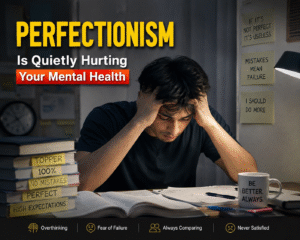
Perfectionism mental health struggles are far more common than most people realise — and far less talked about. We often praise perfectionism. “She’s such a perfectionist” sounds like a compliment. “He pays attention to every little detail” sounds like a strength. In classrooms, offices, and even matrimonial profiles, perfectionism is quietly celebrated as a virtue.
But beneath the polished exterior, the connection between perfectionism and mental health is far closer — and often far more painful — than it appears. What looks like discipline and high standards from the outside can, on the inside, feel like a constant, exhausting battle against never being “good enough.”
At Delhi Mind Clinic, we regularly meet individuals who are high-achieving, hardworking, and outwardly successful — yet privately struggling with anxiety, self-doubt, and burnout. At the root of many of these struggles lies an unaddressed perfectionism mental health pattern.
What Is Perfectionism, Really?
Perfectionism isn’t simply about wanting to do well. It’s a pattern of thinking where:
Your self-worth becomes tied to flawless performance
Mistakes feel like personal failures, not learning opportunities
“Good enough” never actually feels good enough
You set standards that are difficult — sometimes impossible — to meet
Rest or slowing down brings guilt instead of relief
Psychologists often describe perfectionism along a spectrum. Healthy striving pushes you to grow. Unhealthy or maladaptive perfectionism, on the other hand, keeps you trapped in a cycle of pressure, self-criticism, and fear of failure — and this is where perfectionism mental health concerns typically begin.
7 Signs of Perfectionism Mental Health Struggles
Perfectionism doesn’t exist in isolation — it interacts closely with our emotional wellbeing. Here are seven common ways perfectionism mental health struggles show up:
Perfectionism mental health struggles are more common than they seem. Discover 7 signs perfectionism is affecting your wellbeing and how to find balance.
1. Chronic Anxiety
When every task feels like it must be executed flawlessly, the mind stays in a constant state of alertness. Even small errors can trigger disproportionate worry, racing thoughts, or a sense of impending failure.
2. Burnout and Exhaustion
Perfectionists often push themselves far beyond healthy limits — skipping breaks, overworking, and rarely acknowledging their own effort. Over time, this can lead to emotional and physical burnout that feels difficult to recover from.
3. Low Self-Esteem
Ironically, perfectionism is rarely about confidence. It’s often driven by an underlying fear of not being enough. Achievements provide only brief relief before the pressure to perform returns.
4. Procrastination
When the fear of doing something imperfectly becomes overwhelming, many perfectionists delay starting altogether. This creates a frustrating cycle of avoidance followed by guilt.
5. Difficulty in Relationships
Perfectionism can extend beyond personal goals into how we view others — leading to being overly critical, difficulty delegating, or struggling to accept support and closeness.
6. Trouble Sleeping and Physical Tension
Racing thoughts about tomorrow’s tasks, replaying today’s “mistakes,” or an inability to switch off mentally can affect sleep quality, appetite, and overall physical wellbeing.
7. Feeling Like Achievements Are Never Enough
No matter how much is accomplished, the sense of satisfaction is fleeting. This is one of the clearest markers of a perfectionism mental health struggle — success stops feeling rewarding.
Why Perfectionism Mental Health Patterns Develop
Perfectionism rarely appears out of nowhere. It often develops through a combination of:
Upbringing and early conditioning — growing up in environments where love, approval, or attention felt conditional on achievement
Academic or professional pressure — especially in highly competitive settings common across Indian schools, colleges, and workplaces
Social comparison — amplified today through social media, where curated “perfect” lives are constantly on display
Personality traits — such as high conscientiousness or a strong need for control
Fear of judgment or rejection — using flawless performance as a way to avoid criticism
Understanding why perfectionism developed is often the first step toward gently loosening its grip and improving overall perfectionism mental health outcomes.
Expert Insight — Dr. Sugandha Gupta[ Consultant Psychiatrist/Psychologist, Delhi Mind Clinic]
“In my clinical practice, I often see perfectionism disguised as ambition. Patients come in for anxiety or low mood, and it’s only in later sessions that we uncover a deep-rooted belief that they must be flawless to be worthy of love or respect. The first step in therapy is often simply helping them notice this pattern — because most people don’t realise perfectionism is the problem until they see how much of their distress it’s actually driving.”
Signs Perfectionism May Be Affecting Your Mental Health
It may be worth pausing to reflect if you notice:
You feel anxious or restless even after completing tasks well
You find it hard to accept compliments or feel like you don’t deserve them
You avoid starting things unless you’re sure you can do them “perfectly”
You’re your own harshest critic — often harsher than you’d ever be with others
Rest feels like laziness rather than recovery
You measure your worth almost entirely through achievements
If several of these resonate with you, it doesn’t mean something is “wrong” with you — it simply means it may help to explore this pattern with support.
Improving Perfectionism Mental Health: From Perfectionism to Healthy Striving
The goal isn’t to stop caring about doing well — it’s to build a healthier relationship with effort, mistakes, and self-worth. A few gentle shifts that can support better perfectionism mental health:
1. Redefine success. Instead of asking “Was this perfect?”, try asking “Did I try my best with the resources and time I had?”
2. Separate self-worth from performance. Your value as a person isn’t determined by your output. Practicing this distinction — even in small ways — can ease a lot of internal pressure.
3. Allow room for mistakes. Mistakes are part of learning, not evidence of failure. Reframing errors as feedback rather than judgment can be a powerful shift.
4. Practice self-compassion. Notice how you speak to yourself. Would you say the same words to a close friend? If not, it may be time to soften your inner voice.
5. Set realistic, flexible goals. Rigid, all-or-nothing standards often set you up for disappointment. Realistic goals allow progress without constant self-punishment.
6. Seek professional support when needed. When perfectionism starts affecting your daily functioning, relationships, sleep, or peace of mind, speaking with a mental health professional can help you understand the underlying patterns and build sustainable coping strategies.
Expert Insight — Dr. Paramjeet Singh[ Consultant Psychiatrist/Psychologist, Delhi Mind Clinic]
“One thing I tell my patients often is that perfectionism thrives on an ‘all-or-nothing’ way of thinking — either it’s flawless, or it’s a failure. There’s no middle ground in that mindset, and that’s exhausting to live with. A big part of treatment is helping people build tolerance for ‘good enough,’ and slowly, that middle ground starts to feel less threatening and more like relief.”
Perfectionism Mental Health: When to Seek Help
Perfectionism becomes a concern when it starts to interfere with your quality of life — when the pressure to be flawless leaves little room for joy, connection, or rest. If you notice ongoing anxiety, low mood, burnout, or a persistent feeling of “never enough,” reaching out for professional guidance isn’t a sign of weakness — it’s a meaningful step toward long-term wellbeing.
At Delhi Mind Clinic, our team of mental health professionals works closely with individuals to understand the root causes of perfectionism and develop personalised, practical strategies for a healthier, more balanced relationship with achievement and self-worth.
Perfectionism often masquerades as ambition, discipline, or high standards — but when it starts driving anxiety, self-criticism, and burnout, it’s worth paying closer attention to. Good perfectionism mental health isn’t about doing everything flawlessly; it’s about doing things sustainably, with self-compassion, and in a way that allows you to feel genuinely well — not just accomplished.
If perfectionism feels like it’s taking a toll on your mental health, you don’t have to navigate it alone.
It’s the 1st of the month again. Your salary lands in your account — and within minutes, half of it is gone. Home loan EMI. Car loan EMI. Credit card bill. Personal loan instalment. What’s left has to somehow stretch until the next payday.
If your stomach tightens just reading that sentence, you’re not alone. Across Indian cities, more and more people are quietly carrying the weight of EMIs — and along with it, a kind of stress that rarely gets talked about openly.
At Delhi Mind Clinic, we’re increasingly seeing people whose anxiety, sleeplessness, and low mood trace back not to a single dramatic event, but to something more ordinary and persistent: debt. This blog post looks at how EMI stress affects mental health, the signs to watch for, and what actually helps.
What Is EMI Stress?
EMI stress refers to the chronic psychological and emotional strain caused by the pressure of repaying loans — home loans, car loans, personal loans, education loans, or credit card dues — through fixed monthly instalments.
Unlike a one-time financial setback, EMI stress is recurring. It shows up every single month, often for years at a stretch. This repetitive nature is exactly what makes it so mentally exhausting. It’s not one hard day — it’s hundreds of hard days, strung together.
With easy loan approvals, “buy now, pay later” schemes, and rising costs of housing and education, more Indians — especially young professionals and middle-class families — are taking on debt earlier and in larger amounts. The convenience of borrowing often arrives well before the emotional preparedness to manage it.
EMI STRESS
The Hidden Link Between Debt and Mental Health
Money problems and mental health are far more connected than most people realise. Debt doesn’t just affect your bank balance — it affects how you think, feel, sleep, and relate to the people around you.
1. Chronic Anxiety
Constantly calculating whether you’ll be able to pay this month’s EMI creates a background hum of worry that never fully switches off. This isn’t the sharp, short-lived anxiety of a single stressful event — it’s a low, grinding anxiety that colours everyday life.
2. Sleep Disturbances
Many people with EMI stress report lying awake at night, replaying their expenses, or waking up at 3 a.m. thinking about a due date. Poor sleep, in turn, worsens mood, concentration, and the ability to cope with stress — creating a difficult cycle.
3. Irritability and Strained Relationships
Financial pressure often spills over into personal relationships. Couples may argue more frequently about money. Parents may feel unable to say yes to their children’s requests. Even small disagreements can feel bigger when there’s an unspoken financial tension underneath.
4. Low Self-Worth and Shame
In a culture where financial stability is often tied to self-image and social status, being in debt can trigger deep feelings of shame or inadequacy — even when the debt was taken for entirely reasonable reasons, like buying a home or funding an education.
5. Avoidance and Denial
Some people cope with EMI stress by avoiding it altogether — not opening bank statements, ignoring calls from lenders, or postponing conversations about money with their partner. While this offers short-term relief, it usually allows the problem, and the stress around it, to grow.
6. Physical Symptoms
Mental health and physical health are closely linked. Prolonged financial stress can show up as headaches, fatigue, digestive issues, muscle tension, or a general sense of being “on edge” throughout the day.
7. Difficulty Concentrating and Decision Fatigue
When part of your mental bandwidth is constantly occupied by money worries, it leaves less room for focus at work, patience with everyday tasks, or clear decision-making. This is sometimes called the “cognitive tax” of financial stress — even small, unrelated decisions can start to feel overwhelming.
Signs That EMI Stress Is Affecting Your Mental Health
It can be hard to recognise when everyday financial worry has tipped into something that needs attention. Some signs to watch for include:
Feeling anxious or panicky around the time EMIs are due
Difficulty falling or staying asleep due to money-related thoughts
Avoiding checking your bank balance or opening bills
Increased irritability, especially in conversations about money
Withdrawing from friends or family to avoid spending on outings
Persistent low mood, fatigue, or loss of interest in things you used to enjoy
Feeling hopeless about ever being “debt-free”
Physical symptoms like headaches, chest tightness, or stomach issues with no clear medical cause
If several of these sound familiar, it may be worth speaking with a mental health professional — not because you’re “weak” for feeling this way, but because chronic stress genuinely deserves support and care.
Why EMI Stress Often Goes Unspoken
In many Indian households, money is treated as a taboo topic — discussed in hushed tones, if at all. This silence can make EMI stress especially isolating. People assume everyone else is managing fine, when in reality, many are quietly struggling with the same worries.
This silence also delays help-seeking. Someone may talk openly about a headache but stay quiet for years about the anxiety keeping them up at night over a loan. Naming EMI stress as a real, valid source of mental strain is the first step toward addressing it.
Healthy Ways to Cope With EMI Stress
While a mental health professional can help you work through the emotional impact of debt, there are also everyday strategies that can ease the burden.
Separate the practical problem from the emotional weight. Debt is a financial problem, but it’s normal for it to carry emotional weight too. Try to address both — the numbers and the feelings — rather than only focusing on one.
Get a clear picture of your finances. Vague worry is often worse than the actual numbers. Sitting down and listing your total debt, monthly EMIs, and income can feel uncomfortable at first, but clarity usually reduces anxiety more than avoidance does.
Talk about it. Whether it’s your partner, a trusted friend, or a financial advisor, talking about EMI stress openly can lighten the emotional load and often opens up practical solutions you hadn’t considered alone.
Avoid comparison. Social media often shows curated versions of other people’s financial lives. Comparing your EMIs, salary, or lifestyle to others’ online highlight reels tends to increase stress rather than help.
Build small, sustainable routines. Regular sleep, movement, and moments of rest matter more during financially stressful periods, not less. These aren’t luxuries — they’re what help your mind and body handle ongoing pressure.
Consider professional guidance — for both money and mind. A financial advisor can help you restructure or plan around your debt. A mental health professional can help you process the anxiety, shame, or strain that debt has created. The two often work best together.
Know that debt does not define your worth. This is easy to say and hard to internalise — but it’s true. A loan reflects a financial decision, often a reasonable one made for a home, education, or family need. It does not reflect your value as a person.
Expert Opinion
Dr. Sugandha Gupta notes: “In my clinical practice, I see EMI stress present less like a single crisis and more like a slow erosion of a person’s baseline calm. People come in describing themselves as ‘fine’ — but when we look closely, financial worry is quietly shaping their sleep, their patience with family, and how they see themselves. The first step is simply naming it as a legitimate stressor, not a personal failing.”
Dr. Paramjeet Singh adds: “What I find most important is helping people separate the practical debt problem from the emotional story they’ve built around it — shame, fear of judgment, a sense of having failed. Once we address that emotional layer alongside practical financial planning, people often find it far easier to cope, even before the debt itself is fully resolved.”
When to Seek Professional Support
If EMI stress is starting to affect your sleep, relationships, concentration, or overall sense of wellbeing for weeks at a time, it’s worth reaching out for support. This is especially important if you notice:
Persistent feelings of hopelessness or being “trapped”
Anxiety that interferes with daily functioning
Withdrawal from people or activities you used to enjoy
Ongoing conflict at home centred around money
Thoughts of self-harm or feeling like there’s no way out
Financial stress, when left unaddressed, can quietly deepen into anxiety or depressive patterns that benefit from professional care. Reaching out isn’t a sign of failure — it’s a sign of self-awareness.
EMIs are a normal part of modern financial life — but the stress they bring doesn’t have to be carried in silence. Debt affects mental health in real, measurable ways, from disrupted sleep to strained relationships to a persistent undercurrent of anxiety. Recognising this connection is the first step toward feeling more in control — both of your finances and your emotional wellbeing.
At Delhi Mind Clinic, we understand that financial stress is one of the most common, yet least discussed, contributors to anxiety and emotional strain today. If EMI stress is affecting how you feel, sleep, or function day to day, our team is here to listen and support you through it — with compassion, and without judgment.
Struggling with financial stress and its impact on your mental health? Reach out to Delhi Mind Clinic today to speak with a mental health professional who understands.
We live in a world where connecting with someone is easier than ever.
A message can reach someone instantly. A video call can bring two people together across thousands of kilometres. Social media can give us hundreds or even thousands of contacts, followers and online communities.
Yet, despite all this connectivity, many people still experience a deep sense of loneliness.
This raises an important question:
Social-Media-Loneliness
Has social media actually brought us closer, or has it sometimes made us feel more disconnected from the people around us?
This issue was recently discussed in a television news programme featuring Dr. Sugandha Gupta, Senior Psychiatrist and Founder & Director of Delhi Mind Clinic, along with other speakers. The discussion explored why people can feel lonely despite being constantly connected online, how excessive digital engagement can affect relationships, and what families and communities can do to rebuild meaningful connections.
What Is Social Media Loneliness?
Social media loneliness refers to the feeling of emotional disconnection that can exist despite having frequent online interactions.
A person may receive messages throughout the day, have hundreds of followers and regularly interact with people online, yet still feel that there is nobody with whom they can genuinely share their worries, fears or difficult experiences.
This is an important distinction.
Being digitally connected is not always the same as feeling emotionally connected.
A like, comment, emoji or short message can provide momentary interaction. However, meaningful relationships usually require time, trust, understanding and genuine presence.
The World Health Organization has identified loneliness and social isolation as important public health concerns. Its 2025 Commission on Social Connection reported that approximately one in six people worldwide experience loneliness, with younger people among the groups experiencing particularly high levels.
Why Are People Feeling Lonely Despite Having So Many Online Connections?
There is no single reason behind loneliness. Social media may be one factor among several, including changes in family life, work patterns, urban lifestyles, relationship difficulties and reduced face-to-face interaction.
The television discussion highlighted several possible contributors.
1. Online interaction can replace real-world interaction
When much of our free time is spent scrolling, messaging or watching content, there may be less time available for conversations with family members, friends and neighbours.
A person can spend hours interacting with people online without having a meaningful face-to-face conversation during the entire day.
Over time, this can create an unusual situation:
More communication, but less emotional connection.
2. The pressure to appear happy online
Social media often presents carefully selected versions of people’s lives.
People usually share achievements, celebrations, holidays, attractive photographs and positive experiences. Difficult moments may remain private.
As a result, someone scrolling through social media may begin comparing their ordinary life with other people’s carefully presented highlights.
This can create thoughts such as:
“Everyone else is happier than me.”
“Everyone has more friends than I do.”
“Why am I not living like this?”
“Something must be wrong with my life.”
Such comparisons can make existing feelings of loneliness more noticeable.
3. The need for constant validation
Likes, comments, followers and messages can sometimes become a source of validation.
The problem begins when a person’s sense of self-worth becomes strongly dependent on online reactions.
If a post receives less attention than expected, the person may feel rejected or ignored. If it receives attention, the positive feeling may be temporary, creating a desire for more validation.
This can turn social media into a cycle of checking, comparing and seeking approval.
4. Fear of rejection in real life
The discussion also touched upon an important psychological issue: people may sometimes find online interaction easier than real-world relationships because face-to-face relationships involve vulnerability and the possibility of rejection.
Online platforms can provide a controlled environment where people can choose what to share, whom to follow and how they want to present themselves.
But real relationships require us to deal with disagreement, disappointment, misunderstanding and vulnerability.
Avoiding these experiences completely may make genuine relationships harder to build.
Dr. Sugandha Gupta on the Growing Digital Disconnect
Social-Media-Awareness
During the discussion, Dr. Sugandha Gupta highlighted that technology has gradually become an ordinary part of modern life. From radio and television to mobile phones and social media, every technological development has changed how people communicate.
The challenge, she explained, is not simply the existence of technology but how much and how intensely we use it.
She also pointed to the changes that occurred during the COVID-19 period, when social restrictions made digital communication one of the primary ways people stayed connected. For many people, those digital habits continued even after normal social interaction returned.
Her comments highlight an important principle:
The goal should not necessarily be to eliminate technology. The goal is to learn where to draw the line.
This is particularly important for young people, who have grown up surrounded by smartphones, online entertainment and social platforms.
Is Social Media Always Bad for Mental Health?
No.
Social media can provide genuine benefits.
It can help people:
Stay connected with relatives living far away
Maintain friendships
Find communities with similar interests
Access educational information
Discover opportunities
Express creativity
Receive social support
Communicate during difficult circumstances
For someone living away from family, a video call can be extremely meaningful.
The concern is therefore not simply social media use, but unhealthy or excessive patterns of use that begin interfering with sleep, relationships, responsibilities, physical activity or emotional well-being.
WHO similarly emphasizes that digital tools should be used wisely to enhance rather than replace human relationships.
Young People May Be Particularly Vulnerable
Young people are among the groups that deserve particular attention.
Adolescence and early adulthood are periods when identity, friendships, confidence and social skills are developing.
If much of a young person’s social experience takes place through screens, opportunities for face-to-face interaction may decrease.
The discussion highlighted concerns around children receiving smartphones at very young ages, increasing screen exposure and parents sometimes using phones as an easy way to keep children occupied.
This does not mean that parents should completely isolate children from technology.
Instead, families can create healthier boundaries around its use.
What Can Families Do?
Parents often tell children to reduce their screen time while spending much of their own time on their phones.
This can create resistance.
A healthier approach is to make digital boundaries a family habit rather than a punishment for children.
For example:
Create a phone-free family meal
Choose one meal each day when everyone keeps their phones away.
The objective is simple: eat together, talk and listen.
Create a technology-free hour
Families can experiment with one hour without unnecessary screen use.
That hour can be used for conversation, walking, games, hobbies, music or simply spending time together.
The discussion specifically emphasized the importance of families sitting together and creating periods without technology.
Parents should lead by example
Children notice what adults do.
If parents constantly check notifications while asking children to put their phones away, the message becomes confusing.
Healthy digital habits should therefore begin with adults as well.
Encourage offline activities
Sports, hobbies, music, community events, festivals, exercise and social activities can create opportunities for genuine interaction.
The television discussion also highlighted schools, colleges and residential communities as places where more in-person activities can help people reconnect.
How Can You Reduce Social Media Loneliness?
You don’t necessarily have to delete every social media application.
Instead, start by examining your relationship with technology.
Ask yourself:
Do I use social media because I genuinely want to connect, or because I feel uncomfortable being alone?
Do I feel better after using it, or more anxious and dissatisfied?
Am I spending more time online than I spend talking to people around me?
Do I check my phone automatically whenever I have nothing to do?
Have I stopped participating in activities that I previously enjoyed?
Your answers can help you identify whether your digital habits are supporting your well-being or interfering with it.