For general questions, please send us a message and we’ll get right back to you. You can also call us directly to speak with a member of our service team or insurance expert.
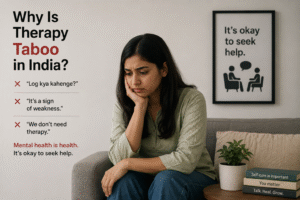
Why is therapy taboo in India? It’s a question more people are typing into search bars than ever before, yet one that still doesn’t get talked about openly at home. Walk into most Indian households and bring up the topic of seeing a therapist, and you’ll likely notice a shift in the room — a pause, a change of subject, maybe even a nervous laugh. Despite growing awareness about mental health globally, therapy still carries a quiet stigma in India.
At Delhi Mind Clinic, we speak with people every day who tell us the hardest part of getting help wasn’t the therapy itself — it was working up the courage to seek it. Understanding why therapy is taboo in India is the first step toward changing that narrative, both for individuals and for society as a whole.
Why Is Therapy Taboo in India? Key Reasons Explained
1. Mental Health Is Still Misunderstood
For generations, mental health struggles have been misread as personal weakness, a “phase,” or something that will pass with time, willpower, or prayer. Unlike a broken bone or a fever, emotional pain isn’t visible — and what isn’t visible is often dismissed. This lack of understanding creates a barrier before a person even considers walking into a therapist’s office.
2. Family Reputation and “Log Kya Kahenge”
In many Indian families, personal struggles aren’t just personal — they’re seen as a reflection on the entire family. This is a big part of the answer to why is therapy taboo in India — the fear of judgment, often summarized in the phrase “log kya kahenge” (what will people say), keeps countless individuals from admitting they’re struggling, let alone seeking professional support. Therapy, in this context, can feel like an admission that something is “wrong” with the family, not just the individual.
3. Confusing Therapy With Being “Mad”
Part of why is therapy taboo in India comes down to persistent myths — like the belief that therapy is only for people who are “crazy” or “unstable.” This outdated association means that many people avoid therapy simply because they don’t want to be associated with a label they see as shameful — even though therapy is just as relevant for everyday stress, relationship issues, grief, or simply wanting to understand oneself better.
4. Cultural Emphasis on Resilience and Silence
Indian culture often celebrates emotional resilience — the ability to endure hardship quietly and keep moving forward. While resilience is valuable, this cultural conditioning can also discourage people from expressing vulnerability. Talking about emotional pain can be seen as “giving in” rather than as a sign of self-awareness and strength.
5. Lack of Mental Health Literacy
Many people simply don’t know what therapy actually involves. Without accurate information, misconceptions fill the gap — that therapy means lying on a couch talking about your childhood forever, that it’s only for “serious” cases, or that a good friend or family member can offer the same support. This lack of literacy makes people underestimate how effective and practical therapy can actually be.
6. The Role of Religion and Traditional Beliefs
In some communities, emotional distress is still explained through spiritual or religious lenses rather than psychological ones — another quiet answer to why is therapy taboo in India in more traditional households. While faith and spirituality can offer genuine comfort, relying on them exclusively — instead of alongside professional support — can delay someone from getting help that could meaningfully improve their quality of life.
7. Generational Gaps: Why Is Therapy Taboo in India Among the Youth?
Younger generations in India are increasingly open to therapy, often influenced by global conversations on social media and greater exposure to mental health education. However, this openness doesn’t always translate across generations, which is part of the answer to why is therapy taboo in India even for people who personally don’t see it that way. Many people still hesitate to discuss therapy with parents or elders, fearing disapproval or a dismissive response.
why is therapy taboo in india
What Mental Health Experts Have to Say
To understand why is therapy taboo in India from a clinical perspective, we reached out to our own clinicians at Delhi Mind Clinic.
Dr. Sugandha Gupta notes that much of the hesitation she sees in her practice isn’t about a lack of awareness, but about fear of exposure. “Many of my clients tell me they researched therapy for months before ever booking a session. The information was never the barrier — the fear of being seen walking into a clinic, or someone finding out, was. We need to normalize therapy the same way we’ve normalized going to a gym or seeing a dietician — as routine self-care, not as a last resort.”
Dr. Paramjeet Singh points out that the taboo often runs deepest within families rather than among individuals themselves. “I’ve had young adults come in fully convinced therapy will help them, but they’re more worried about explaining it to their parents than about the therapy itself. That tells us the stigma isn’t really about the person seeking help — it’s about outdated beliefs still held by the generation before them. Change happens when families start seeing therapy as an investment in a person’s future, not as a family failure.”
Their perspectives echo a common theme: the taboo around therapy in India isn’t rooted in the practice itself, but in the fear of judgment that surrounds it — a fear that only weakens as more people speak openly about their experiences.
Why Breaking This Taboo Matters
Untreated emotional struggles don’t just disappear — they often show up in relationships, work performance, physical health, and overall quality of life. Seeking therapy isn’t a sign of failure; it’s a proactive step toward understanding yourself, building healthier relationships, and navigating life’s challenges with better tools.
The stigma around therapy in India is slowly changing. More people are talking openly about their experiences, more workplaces are acknowledging mental well-being, and more young people are choosing to prioritize their emotional health without shame. Every open conversation chips away a little more at why is therapy taboo in India in the first place.
If you’ve been hesitant to seek therapy because of what others might think, know this: prioritizing your mental well-being is not selfish or shameful — it’s an act of self-respect. At Delhi Mind Clinic, we create a safe, non-judgmental space for individuals to explore their thoughts and emotions at their own pace, free from labels or assumptions.
So, why is therapy taboo in India? As we’ve seen, it isn’t about therapy itself — it’s about fear, misunderstanding, and inherited beliefs that are slowly losing their grip. Breaking this taboo doesn’t happen overnight, but it starts with conversations like this one — and with individuals brave enough to challenge outdated beliefs by choosing to prioritize their own mental health.
Ready to take that first step? Reach out to Delhi Mind Clinic to learn more about how therapy can support your emotional well-being in a space built on empathy, confidentiality, and understanding.
FOMO and comparison anxiety from Instagram Reels are two of the most common — and least talked about — sources of everyday stress today. You open the app for “just two minutes.” Forty-five minutes later, you put your phone down feeling restless, a little empty, and strangely dissatisfied with your own life. Your friend’s Goa trip, a colleague’s promotion post, a stranger’s perfectly lit apartment tour — none of it was about you, yet somehow it left you comparing your behind-the-scenes to everyone else’s highlight reel.
If this feels familiar, you’re not alone. This pattern is especially common among young professionals and students in cities like Delhi navigating fast-paced, hyper-connected lives.
In this article, we’ll unpack what’s actually happening in your mind when Reels trigger this anxiety, why it’s more common than you think, and practical, judgment-free ways to manage it.
What Exactly Is FOMO and Comparison Anxiety from Instagram Reels?
FOMO and comparison anxiety from Instagram Reels work together, but they’re slightly different experiences. FOMO is the uneasy feeling that other people are having more rewarding experiences than you — and that you’re missing out on them. Comparison anxiety goes a step further: it’s the discomfort or self-doubt that arises when you measure your own life, body, career, or relationships against carefully curated snapshots of someone else’s.
Instagram Reels are almost engineered to trigger both. The short, fast-paced, algorithm-driven format shows you an endless stream of:
Vacations, parties, and “perfect” weekends
Career wins, promotions, and financial milestones
Idealized bodies, skin, and fitness transformations
Picture-perfect relationships and family moments
What you rarely see is the effort, editing, financial stress, retakes, or personal struggles behind these clips. Your brain, however, doesn’t always make that distinction — it reacts to what it sees as if it were the full, unfiltered truth.
FOMO-and-comparison-anxiety-from-Instagram-Reels
Why Reels Specifically Feel Harder Than Other Social Media
Not all social media feels the same, and Reels are a big reason why FOMO and comparison anxiety from Instagram Reels can feel more intense than what you experience on other platforms:
1. Rapid-fire content delivery Unlike a slow-scrolling feed, Reels serve one high-stimulation clip after another. This constant novelty keeps your brain in a heightened, reactive state, leaving little time to process or contextualize what you’re seeing.
2. Algorithmic amplification The algorithm learns what keeps you watching — often content that triggers strong emotional reactions, including envy or inadequacy — and shows you more of it.
3. Passive, one-way consumption You’re watching, not necessarily interacting. This passive scrolling has been linked to lower mood compared to active engagement, like messaging friends directly.
4. Blurring of “real” and “curated” Reels often feel more spontaneous and authentic than posed photos, which paradoxically makes the comparison feel more real and personal.
Signs You Might Be Experiencing FOMO and Comparison Anxiety from Instagram Reels
This kind of anxiety doesn’t always look dramatic. It often shows up in quiet, everyday ways:
Feeling anxious, low, or irritable after scrolling, without an obvious reason
Repeatedly checking to see what others are doing when you’re alone or bored
Feeling like your life, body, or achievements are “not enough” after watching Reels
Difficulty being fully present at your own gatherings because you’re thinking about other events
Sleep disruption from late-night scrolling “just to see what’s new”
A dip in self-esteem that seems to track with how much time you spent online that day
If several of these sound familiar, it doesn’t mean something is “wrong” with you — it means your mind is responding, quite normally, to a very unnatural amount of curated comparison.
Why This Matters More Than We Often Admit
It’s easy to dismiss FOMO and comparison anxiety from Instagram Reels as “just social media” or something to laugh off. But research and clinical observation increasingly point to a real link between heavy, passive social media consumption and increased feelings of anxiety, low self-worth, and dissatisfaction with one’s own life — particularly among people already prone to comparing themselves to others.
Left unaddressed, chronic comparison anxiety can quietly erode confidence, strain relationships, and make it harder to feel content with genuine, meaningful progress in your own life.
“In my practice, I see this almost every week — clients who can’t quite explain why they feel low or restless, until we trace it back to an hour of scrolling Reels the night before. The mind isn’t built to process hundreds of curated ‘best moments’ from other people’s lives in a single sitting, and it responds the way it would to any repeated stressor — with anxiety, irritability, or a dip in self-worth.” — Dr. Sugandha Gupta
[Psychologist, Delhi Mind Clinic]
7 Practical Ways to Manage FOMO and Comparison Anxiety from Instagram Reels
You don’t need to delete your accounts or swear off Reels forever to manage FOMO and comparison anxiety from Instagram Reels. Small, sustainable shifts tend to work far better than extreme ones.
1. Notice the Pattern Before You Judge It
Before reaching for solutions, simply notice: What time of day do you scroll most? What mood are you in right before and after? Awareness alone reduces the automatic, unconscious nature of the habit.
2. Curate Your Feed Intentionally
Unfollow or mute accounts that consistently leave you feeling worse about yourself, even if you “should” like them. Follow accounts that inform, inspire practically, or make you genuinely laugh.
3. Set Boundaries Around Passive Scrolling
Try designating specific times for social media rather than scrolling reactively whenever you feel bored or anxious. Even simple steps like turning off auto-play or setting app time limits can interrupt the automatic scroll cycle.
4. Practice the “Behind the Clip” Reframe
When you catch yourself comparing, gently remind yourself: this is one curated 15-second moment, not a full life. Ask: “What effort, editing, or context might be missing here?”
5. Reconnect with Offline Sources of Self-Worth
Comparison anxiety thrives when our sense of value depends on external validation. Spend time on activities — hobbies, relationships, skills — where your worth isn’t measured in likes or views.
6. Talk About It
Comparison anxiety can feel embarrassing to admit, but it’s incredibly common. Talking to a friend, family member, or a mental health professional about these feelings often reduces their intensity almost immediately.
7. Practice a Nightly Digital Wind-Down
Avoid scrolling Reels in the last 30–60 minutes before bed. Late-night comparison scrolling is especially likely to affect sleep quality and next-day mood, so replacing it with reading, journaling, or simply talking to someone can make a noticeable difference over time.
“What’s changed in recent years is the speed of exposure. A generation ago, you might compare yourself to a handful of neighbours or classmates. Today, a teenager or young professional can be exposed to hundreds of ‘better’ lives before breakfast. It’s not a character flaw or a lack of gratitude — it’s a completely understandable response to an environment the human brain was never designed for. The good news is that with awareness and small, consistent changes, most people find real relief fairly quickly.” —Dr. Paramjeet Singh
When to Consider Professional Support for FOMO and Comparison Anxiety from Instagram Reels
Occasional FOMO is a normal part of modern life. However, if you notice that comparison anxiety is:
Persisting for weeks or months
Affecting your sleep, appetite, or concentration
Making you withdraw from real-life relationships or activities
Linked to ongoing low mood, excessive self-criticism, or anxiety in other areas of life
…it may be worth speaking with a mental health professional. A qualified psychologist or counsellor can help you understand the underlying patterns driving the anxiety and build coping strategies tailored to you — not just generic advice, but an approach that fits your specific life and mind.
Final Thoughts on FOMO and Comparison Anxiety from Instagram Reels
Instagram Reels aren’t going anywhere, and neither is the occasional pang of “everyone else seems to be doing better than me.” But that feeling doesn’t have to run your day — or your self-esteem. By understanding why FOMO and comparison anxiety from Instagram Reels happen, and making small, intentional changes to how you engage with social media, you can enjoy scrolling without letting it quietly chip away at how you feel about your own life.
If comparison anxiety or FOMO has been affecting your mood, sleep, or confidence for a while now, know that support is available, and reaching out is a sign of self-awareness, not weakness.
Frequently Asked Questions
Is FOMO and comparison anxiety from Instagram Reels a mental health condition? FOMO itself isn’t a clinical diagnosis, but persistent FOMO and comparison anxiety from Instagram Reels can contribute to or worsen anxiety and low mood, especially in people already vulnerable to these patterns.
Why do Reels feel worse than regular Instagram posts? Reels are fast, algorithm-driven, and consumed passively, which tends to intensify FOMO and comparison anxiety from Instagram Reels compared to slower, more deliberate feed browsing.
Can reducing screen time alone fix comparison anxiety? Reducing screen time helps, but lasting change usually comes from combining mindful usage habits with building self-worth from offline sources and, when needed, professional support.
When should I see a therapist for FOMO and comparison anxiety from Instagram Reels? If the anxiety persists for weeks, disrupts daily functioning, or is accompanied by low mood or withdrawal from real-life activities, it’s a good time to consult a mental health professional.
Have you ever said something in the heat of the moment that you deeply regretted later? Or felt your heart race, your jaw clench, and your patience vanish within seconds? If so, you’re not alone. Anger is one of the most natural human emotions — but when it takes over, it can strain relationships, hurt your career, and take a toll on your mental and physical health.
The good news is that controlling temper is a skill, not a personality trait. Just like any skill, controlling temper can be learned, practiced, and strengthened over time. In this blog, we’ll walk you through why we lose our temper, the warning signs to watch for, and practical strategies for controlling temper that you can start using today.
Why Do We Lose Our Temper?
Anger usually doesn’t appear out of nowhere. It’s often the tip of the iceberg, sitting on top of deeper emotions like stress, fear, hurt, exhaustion, or feeling disrespected. Common triggers include:
Work pressure or unrealistic deadlines
Feeling unheard or misunderstood in relationships
Financial stress or uncertainty
Sleep deprivation and burnout
Past unresolved emotional wounds
Understanding why your temper flares up is the first step toward controlling temper effectively, since you can’t manage what you don’t understand.
Warning Signs Your Temper Is Taking Over
Before you’re able to manage anger, it helps to recognize its early signs:
A racing heartbeat or tight chest
Clenched fists or jaw
Raised voice or rapid speech
Racing, negative thoughts
An urge to walk away, slam something, or say something hurtful
Catching these signals early gives you a valuable window to pause before reacting — and this window is where controlling temper truly becomes possible.
controlling temper
10 Effective Ways of Controlling Temper
1. Pause Before You React
The moment you feel anger rising, give yourself a few seconds before responding. Even a short pause can prevent words or actions you might regret, and it’s often the simplest technique for controlling temper in the moment.
2. Practice Deep Breathing
Slow, deep breaths signal your nervous system to calm down. Try inhaling for four counts, holding for four, and exhaling for four — repeat until you feel steadier.
3. Step Away From the Situation
If possible, physically remove yourself from the triggering situation for a few minutes. A short walk or change of scenery can help reset your emotional state.
4. Identify the Real Trigger
Ask yourself: “What am I really upset about?” Often, anger masks deeper feelings like disappointment, insecurity, or exhaustion. Naming the real issue reduces its intensity.
5. Use “I” Statements Instead of Blame
Saying “I feel frustrated when this happens” is far more constructive than “You always do this.” It opens a conversation instead of starting a conflict.
6. Exercise Regularly
Physical activity is one of the most effective natural outlets for built-up tension and stress, making it easier to stay level-headed in tense moments. Many people find that regular exercise becomes their most reliable tool for controlling temper long-term.
7. Improve Your Sleep Quality
Poor sleep lowers your tolerance for frustration. Prioritizing 7–8 hours of quality sleep can significantly improve emotional regulation.
8. Practice Mindfulness or Meditation
Regular mindfulness practice trains your brain to observe emotions without immediately acting on them, creating space between feeling and reaction.
9. Journal Your Triggers
Writing down what makes you angry — and how you responded — helps you spot patterns and prepare better responses for next time.
10. Seek Professional Support When Needed
If anger feels uncontrollable, frequent, or is affecting your relationships and work, speaking with a mental health professional can help you understand the root cause and develop personalized coping strategies.
Expert Insight on Controlling Temper
Dr. Sugandha Gupta notes: “Many people believe controlling temper means bottling up emotions, but that’s not true. It’s about creating a gap between the trigger and your response — a gap where you get to choose how you react instead of letting the emotion choose for you. With consistent practice, this becomes far more natural than most people expect.”
Dr. Paramjeet Singh adds: “In my practice, I often see that anger is a secondary emotion — it’s usually covering up hurt, fear, or stress that hasn’t been addressed. Once we help a person identify and work through what’s really underneath the anger, the outbursts naturally start to reduce.”
When Should You Seek Help for Anger Issues?
While occasional anger is normal, it may be time to seek professional guidance if you notice:
Frequent outbursts that feel disproportionate to the situation
Difficulty calming down even after time has passed
Anger affecting your relationships, work, or health
Feelings of guilt or regret after angry episodes
Physical aggression or fear of losing control
Anger management support isn’t just for people in crisis — it’s a proactive step toward emotional well-being and healthier relationships, and it plays a big role in successfully controlling temper over the long run.
Final Thoughts on Controlling Temper
Controlling temper isn’t about suppressing your emotions — it’s about understanding them and responding in ways that align with who you want to be. With consistent practice, self-awareness, and the right support system, controlling temper becomes second nature rather than a constant struggle.
If you or someone you know is struggling to manage anger, Delhi Mind Clinic offers compassionate, professional guidance to help you build lasting emotional balance. Reach out today to take the first step toward controlling temper and living a calmer, more balanced life.
Have you ever avoided applying for a job you really wanted, stayed silent in a meeting out of fear of saying the “wrong” thing, or put off starting something new because you were terrified it wouldn’t work out? If this sounds familiar, you may be dealing with a fear of failure — a psychological pattern that affects far more people than you might think.
Fear of failure, sometimes called atychiphobia in its more intense form, isn’t about being lazy, unmotivated, or lacking ambition. In fact, it often affects highly capable, driven individuals who care deeply about doing well. Left unaddressed, it can quietly hold people back from careers, relationships, and personal growth.
In this article, we’ll explore what fear of failure really is, why it develops, how it shows up in everyday life, and practical strategies to work through it.
What Is Fear of Failure?
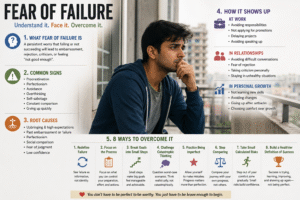
Fear of failure is an intense, persistent worry about not succeeding — to the point that it influences your decisions, behaviour, and even your sense of self-worth. It goes beyond the normal nervousness most people feel before an exam, interview, or big presentation.
For someone experiencing fear of failure, the thought of failing can feel more distressing than the failure itself. This fear can be so overwhelming that it leads to avoidance — skipping opportunities altogether just to escape the possibility of not measuring up.
Common Signs of Fear of Failure
Fear of failure can look different from person to person, but some common patterns include:
fear of failure
Procrastination on important tasks or goals
Perfectionism — needing everything to be flawless before moving forward
Avoiding new challenges or opportunities for growth
Overthinking decisions to the point of feeling stuck
Self-sabotage, such as not fully trying so failure can be blamed on lack of effort rather than ability
Seeking constant reassurance from others before taking action
Physical symptoms like a racing heart, sweating, or nausea before attempting something important
Negative self-talk, such as “I’m not good enough” or “What’s the point of trying?”
Difficulty accepting feedback, even when it’s constructive
If several of these resonate with you, it may be worth exploring where this fear is coming from.
What Causes Fear of Failure?
Fear of failure rarely comes from a single source. It usually develops through a combination of experiences, upbringing, and personality factors, including:
1. Childhood Experiences and Upbringing
Growing up in an environment with high expectations, harsh criticism, or conditional approval (where love or praise felt tied to achievement) can create a deep-rooted association between failure and rejection.
2. Past Experiences of Failure or Public Embarrassment
A particularly painful failure — especially one that happened publicly — can leave a lasting emotional imprint, making the brain want to avoid similar situations at all costs.
3. Perfectionistic Tendencies
People who hold themselves to extremely high standards often equate anything less than perfect with failure, making the fear more intense and frequent.
4. Comparison and Social Pressure
In today’s hyper-connected world, constant comparison with others’ curated success on social media can amplify feelings of inadequacy and heighten the fear of falling short.
5. Fear of Judgment
For many, the fear isn’t really about failing itself — it’s about what others will think. This fear of judgment or losing respect and status can be a powerful driver of avoidance behaviour.
“In my clinical practice, I often see fear of failure masquerading as procrastination or ‘lack of motivation.’ In reality, the person cares so much about the outcome that the anxiety around it becomes paralysing. The first step is always helping them separate their self-worth from their performance.”— Dr. Sugandha Gupta, Psychiatrist, Delhi Mind Clinic
How Fear of Failure Affects Daily Life
When left unchecked, fear of failure doesn’t just affect big life decisions — it can quietly shape everyday behaviour:
At work: Avoiding leadership roles, new projects, or promotions despite being qualified
In relationships: Holding back from vulnerability or commitment out of fear of “failing” at the relationship
In personal growth: Avoiding hobbies, creative pursuits, or fitness goals because of fear of not being “good enough” at them
In mental well-being: Contributing to chronic stress, low self-esteem, and in some cases, symptoms of anxiety
Over time, this avoidance can create a cycle: the more you avoid situations, the more your confidence erodes, which in turn strengthens the fear.
8 Ways to Overcome Fear of Failure
The good news is that fear of failure is highly manageable with the right strategies and support. Here are some approaches that can help:
1. Reframe What Failure Means
Instead of viewing failure as the opposite of success, try seeing it as part of the process. Many of the world’s most successful individuals attribute their growth to lessons learned from failing first. Ask yourself: “What can I learn from this, regardless of the outcome?”
2. Set Realistic, Process-Focused Goals
Shift your focus from outcome-based goals (“I must get this exact result”) to process-based goals (“I will prepare well and give my best effort”). This reduces the all-or-nothing pressure that fuels fear.
3. Challenge Perfectionism
Practice allowing yourself to do things imperfectly. Completing a task at 80% is often far more valuable than never starting because it isn’t perfect.
4. Break Tasks into Smaller Steps
Large goals can feel overwhelming and increase fear. Breaking them into smaller, manageable steps makes the process feel less intimidating and builds confidence with each small win.
5. Practice Self-Compassion
Notice your inner critic and consciously replace harsh self-talk with the kind of encouragement you’d offer a close friend. Self-compassion has been shown to reduce fear-driven avoidance.
6. Visualize Success — and Survivable Failure
Instead of only visualizing success, also visualize what would happen if things didn’t go as planned. Most people realize that even in a “worst case” scenario, they would cope and move forward — this can be surprisingly reassuring.
7. Take Small, Consistent Action
Facing small fears repeatedly, in manageable doses, helps retrain your brain to see challenging situations as safe rather than threatening. Momentum builds courage.
8. Seek Professional Support
When fear of failure significantly impacts your career, relationships, or overall well-being, speaking with a mental health professional can help you understand the root causes and build personalised strategies to move forward with confidence.
“Fear of failure that goes untreated for years often doesn’t stay confined to one area of life — it spreads. A person who avoids risk at work may start avoiding it in relationships too. What looks like ‘playing it safe’ is frequently an anxiety pattern that responds very well to the right therapeutic approach, once it’s identified.”— Dr. Paramjeet Singh, Psychiatrist, Delhi Mind Clinic
When Should You Seek Help?
While mild fear of failure is common and manageable on your own, it may be time to seek professional guidance if you notice:
The fear is stopping you from pursuing important goals or opportunities
It’s affecting your relationships, career, or academic performance
You experience significant anxiety, sleep disturbances, or physical symptoms tied to this fear
You find yourself avoiding activities you once enjoyed
The fear is accompanied by persistent low mood, self-doubt, or hopelessness
A qualified psychologist or counsellor can help identify the underlying patterns driving your fear and work with you to build lasting coping strategies through structured, evidence-based approaches.
Fear of failure is a deeply human experience — but it doesn’t have to define your choices or limit your potential. By understanding where this fear comes from and actively practising strategies to manage it, you can build the confidence to take meaningful steps forward, even when the outcome isn’t guaranteed.
Remember: growth rarely comes from certainty. It comes from being willing to try, even when you’re afraid.
If fear of failure is holding you back from living the life you want, professional support can make a real difference. At Delhi Mind Clinic, our team is here to help you understand your fears and build the confidence to move forward.
Frequently Asked Questions (FAQs)
Q1. Is fear of failure a mental illness? Fear of failure itself is not classified as a mental illness, but when intense and persistent, it can be a specific phobia (atychiphobia) or be linked with anxiety-related conditions. A mental health professional can help assess this.
Q2. Why do successful people also fear failure? Success doesn’t eliminate fear of failure — in fact, high achievers often fear failure due to high personal standards, fear of losing status, or past experiences tied to achievement and approval.
Q3. Can fear of failure be completely cured? While it may not disappear entirely, fear of failure can be significantly reduced and managed so it no longer controls your decisions or limits your growth.
Q4. How is fear of failure different from normal nervousness? Nervousness is a temporary, situational response, while fear of failure is a persistent pattern that influences decision-making and often leads to avoidance, even when the stakes are low.
Q5. Should I see a therapist for fear of failure? If this fear is significantly affecting your career, relationships, or emotional well-being, speaking with a therapist can help you understand the root cause and develop effective coping strategies.
If you’ve noticed yourself doing the bare minimum at work lately — logging off exactly on time, avoiding extra projects, feeling emotionally distant from a job you once cared about — you’re not alone. This behavior has a name: quiet quitting. And more often than not, it isn’t laziness. It’s a quiet, often unspoken response to workplace anxiety. The relationship between quiet quitting and workplace anxiety is closer than most people realize, and understanding it can change how you respond to burnout at work.
At Delhi Mind Clinic, we’re seeing a growing number of working professionals — from IT employees to corporate managers — describe the same pattern: exhaustion, disengagement, and a persistent sense of dread about going to work. Understanding the connection between quiet quitting and workplace anxiety is the first step toward addressing it in a healthy, sustainable way.
What Is Quiet Quitting?
quiet-quitting-and-workplace-anxiety
Quiet quitting doesn’t mean actually quitting your job. It refers to doing only what your job description requires — nothing more, nothing less. No late-night emails, no extra volunteering, no going “above and beyond.”
While it may look like a boundary-setting trend on social media, for many people it’s a coping mechanism. It’s what happens when someone feels overwhelmed, undervalued, or emotionally unsafe at work but isn’t ready — or able — to leave. This is exactly where quiet quitting and workplace anxiety start to overlap: the withdrawal isn’t really about the job description, it’s about protecting an already-stretched nervous system.
The Hidden Link Between Quiet Quitting and Workplace Anxiety
Workplace anxiety often shows up long before someone consciously decides to disengage. It can look like:
Constant worry about making mistakes or being judged by colleagues
Racing thoughts before meetings or performance reviews
Difficulty concentrating due to a persistent sense of unease
Trouble sleeping the night before a workday
Physical symptoms like a racing heart, tight chest, or fatigue tied to work stress
When this anxiety goes unaddressed for months, the mind instinctively looks for ways to protect itself. Quiet quitting becomes a form of emotional self-preservation — a way to reduce exposure to a source of stress without walking away from income, stability, or identity tied to the job.
In other words: quiet quitting is frequently a symptom, not the problem itself.
Why Workplace Anxiety Is on the Rise
Several factors are converging to make workplace anxiety more common, especially among younger professionals in fast-paced urban environments like Delhi:
Blurred work-life boundaries — Remote and hybrid work have made it harder to switch off, leading to chronic low-grade stress.
Constant connectivity — Notifications and always-on culture keep the nervous system in a state of alert.
High-performance expectations — Competitive workplaces often reward overwork, making rest feel like falling behind.
Job insecurity — Layoffs and economic uncertainty add a persistent undercurrent of worry.
Lack of psychological safety — Fear of criticism or being seen as “not a team player” discourages people from speaking up about their struggles.
7 Signs Your Quiet Quitting Is Rooted in Workplace Anxiety
Not all quiet quitting is anxiety-driven — sometimes it’s simply healthy boundary-setting. But when quiet quitting and workplace anxiety are linked, you’ll often notice these seven signs:
You feel anxious even thinking about work outside office hours
Your motivation dropped sharply after a specific stressful event (criticism, conflict, missed promotion)
You feel disproportionately relieved on weekends and dread Sunday evenings
You’ve started avoiding meetings, feedback conversations, or interactions with certain colleagues
Your self-worth feels tied to work performance, and you’re protecting yourself from potential failure
You notice physical tension — a tight chest, shallow breathing, or a racing heart — before logging in
You’ve stopped speaking up in meetings even when you have something valuable to contribute
If several of these resonate, your disengagement may be less about the job itself and more about how your mind and body are responding to sustained workplace stress.
How to Address Quiet Quitting and Workplace Anxiety Together
Addressing quiet quitting and workplace anxiety at the same time — rather than treating them as separate issues — tends to produce more lasting results. Here’s where to start:
1. Name What You’re Feeling
Simply identifying “I think I’m anxious about work” rather than “I hate my job” can shift how you approach the problem — from avoidance to understanding.
2. Set Boundaries Without Guilt
Healthy boundaries — like not checking email after a certain hour — are different from quiet quitting driven by fear. Boundaries come from self-respect; anxiety-driven withdrawal comes from self-protection. Both can look similar from the outside, but they feel very different internally.
3. Identify Specific Triggers
Is it a particular manager, project, meeting format, or workload volume? Anxiety often has specific triggers rather than being about “everything.” Pinpointing these makes the problem feel more manageable.
4. Talk to Someone You Trust
Whether it’s a colleague, mentor, or mental health professional, voicing what you’re experiencing can reduce the isolation that often deepens workplace anxiety.
5. Reconnect With What Originally Motivated You
Sometimes disengagement is really burnout in disguise. Revisiting what once felt meaningful about your work — even in small ways — can help you distinguish exhaustion from true disinterest.
6. Seek Professional Support When Needed
When anxiety starts interfering with sleep, concentration, relationships, or your overall sense of well-being, it may be time to speak with a mental health professional. Left unaddressed, workplace anxiety can affect not just your career but your broader mental health.
Expert Perspective
Dr. Sugandha Gupta notes that quiet quitting is increasingly common among clients who present with what looks like low motivation but is, on closer exploration, unaddressed workplace anxiety. “Many professionals come to us describing themselves as ‘just tired of the job,'” she explains. “But when we look closer, what we often find is a nervous system that has been on high alert for months — anticipating criticism, replaying conversations, dreading Monday mornings. Disengaging becomes the mind’s way of creating distance from a source of chronic stress, even when the person can’t quite name what’s happening.”
Dr. Paramjeet Singh adds that the challenge is distinguishing this from a normal, healthy response to overwork. “Not everyone who sets boundaries at work is anxious — some are simply making a wise decision to protect their time and energy. What we look for clinically is the emotional tone behind the withdrawal. Is it calm and deliberate, or is it driven by dread, fear of failure, or avoidance? That distinction changes how we approach treatment, and it’s something we always explore carefully with our clients before assuming either extreme.”
Both experts agree on one point: the link between quiet quitting and workplace anxiety should be treated as a signal worth paying attention to, not dismissed as a workplace trend or a personal failing. Left unexamined, it can either resolve on its own with better boundaries, or deepen into more significant anxiety and burnout that requires professional support.
Physical symptoms (headaches, fatigue, appetite changes) linked to work stress
Difficulty functioning at work or in personal relationships
Feelings of hopelessness or persistent low mood alongside anxiety
At Delhi Mind Clinic, our team helps working professionals understand the root causes of quiet quitting and workplace anxiety and build sustainable strategies to manage them — so that stepping back from a job doesn’t have to mean stepping back from yourself.
Final Thoughts
Quiet quitting isn’t a character flaw, and it isn’t always a red flag either. But when it’s driven by unspoken anxiety, it’s worth paying attention to. The connection between quiet quitting and workplace anxiety is real, and recognizing it can help you respond to what your mind and body are actually telling you — before burnout takes over completely.
If workplace anxiety is affecting your daily life, you don’t have to navigate it alone. Reach out to Delhi Mind Clinic to speak with a mental health professional who can help you find clarity and balance.
Frequently Asked Questions
Is quiet quitting a mental health issue? Not by itself — but the link between quiet quitting and workplace anxiety means it can be a sign of underlying anxiety, burnout, or stress that deserves attention, especially if it’s a sudden or significant change in behavior.
How is workplace anxiety different from normal work stress? Occasional stress is a natural response to deadlines or challenges. Workplace anxiety is more persistent — it involves ongoing worry, dread, or physical symptoms that don’t ease even when the immediate stressor passes.
Can quiet quitting be a healthy response? Yes, when it reflects intentional boundary-setting rather than fear or avoidance. Understanding your own experience of quiet quitting and workplace anxiety helps you tell the two apart — the key difference lies in whether the choice comes from self-respect or self-protection.
When should I see a mental health professional for workplace anxiety? If anxiety is affecting your sleep, concentration, relationships, or overall well-being for more than a few weeks, it’s a good time to seek professional support.
Perfectionism mental health struggles are far more common than most people realise — and far less talked about. We often praise perfectionism. “She’s such a perfectionist” sounds like a compliment. “He pays attention to every little detail” sounds like a strength. In classrooms, offices, and even matrimonial profiles, perfectionism is quietly celebrated as a virtue.
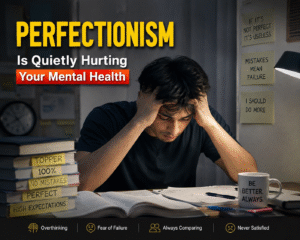
But beneath the polished exterior, the connection between perfectionism and mental health is far closer — and often far more painful — than it appears. What looks like discipline and high standards from the outside can, on the inside, feel like a constant, exhausting battle against never being “good enough.”
At Delhi Mind Clinic, we regularly meet individuals who are high-achieving, hardworking, and outwardly successful — yet privately struggling with anxiety, self-doubt, and burnout. At the root of many of these struggles lies an unaddressed perfectionism mental health pattern.
What Is Perfectionism, Really?
Perfectionism isn’t simply about wanting to do well. It’s a pattern of thinking where:
Your self-worth becomes tied to flawless performance
Mistakes feel like personal failures, not learning opportunities
“Good enough” never actually feels good enough
You set standards that are difficult — sometimes impossible — to meet
Rest or slowing down brings guilt instead of relief
Psychologists often describe perfectionism along a spectrum. Healthy striving pushes you to grow. Unhealthy or maladaptive perfectionism, on the other hand, keeps you trapped in a cycle of pressure, self-criticism, and fear of failure — and this is where perfectionism mental health concerns typically begin.
7 Signs of Perfectionism Mental Health Struggles
Perfectionism doesn’t exist in isolation — it interacts closely with our emotional wellbeing. Here are seven common ways perfectionism mental health struggles show up:
Perfectionism mental health struggles are more common than they seem. Discover 7 signs perfectionism is affecting your wellbeing and how to find balance.
1. Chronic Anxiety
When every task feels like it must be executed flawlessly, the mind stays in a constant state of alertness. Even small errors can trigger disproportionate worry, racing thoughts, or a sense of impending failure.
2. Burnout and Exhaustion
Perfectionists often push themselves far beyond healthy limits — skipping breaks, overworking, and rarely acknowledging their own effort. Over time, this can lead to emotional and physical burnout that feels difficult to recover from.
3. Low Self-Esteem
Ironically, perfectionism is rarely about confidence. It’s often driven by an underlying fear of not being enough. Achievements provide only brief relief before the pressure to perform returns.
4. Procrastination
When the fear of doing something imperfectly becomes overwhelming, many perfectionists delay starting altogether. This creates a frustrating cycle of avoidance followed by guilt.
5. Difficulty in Relationships
Perfectionism can extend beyond personal goals into how we view others — leading to being overly critical, difficulty delegating, or struggling to accept support and closeness.
6. Trouble Sleeping and Physical Tension
Racing thoughts about tomorrow’s tasks, replaying today’s “mistakes,” or an inability to switch off mentally can affect sleep quality, appetite, and overall physical wellbeing.
7. Feeling Like Achievements Are Never Enough
No matter how much is accomplished, the sense of satisfaction is fleeting. This is one of the clearest markers of a perfectionism mental health struggle — success stops feeling rewarding.
Why Perfectionism Mental Health Patterns Develop
Perfectionism rarely appears out of nowhere. It often develops through a combination of:
Upbringing and early conditioning — growing up in environments where love, approval, or attention felt conditional on achievement
Academic or professional pressure — especially in highly competitive settings common across Indian schools, colleges, and workplaces
Social comparison — amplified today through social media, where curated “perfect” lives are constantly on display
Personality traits — such as high conscientiousness or a strong need for control
Fear of judgment or rejection — using flawless performance as a way to avoid criticism
Understanding why perfectionism developed is often the first step toward gently loosening its grip and improving overall perfectionism mental health outcomes.
Expert Insight — Dr. Sugandha Gupta[ Consultant Psychiatrist/Psychologist, Delhi Mind Clinic]
“In my clinical practice, I often see perfectionism disguised as ambition. Patients come in for anxiety or low mood, and it’s only in later sessions that we uncover a deep-rooted belief that they must be flawless to be worthy of love or respect. The first step in therapy is often simply helping them notice this pattern — because most people don’t realise perfectionism is the problem until they see how much of their distress it’s actually driving.”
Signs Perfectionism May Be Affecting Your Mental Health
It may be worth pausing to reflect if you notice:
You feel anxious or restless even after completing tasks well
You find it hard to accept compliments or feel like you don’t deserve them
You avoid starting things unless you’re sure you can do them “perfectly”
You’re your own harshest critic — often harsher than you’d ever be with others
Rest feels like laziness rather than recovery
You measure your worth almost entirely through achievements
If several of these resonate with you, it doesn’t mean something is “wrong” with you — it simply means it may help to explore this pattern with support.
Improving Perfectionism Mental Health: From Perfectionism to Healthy Striving
The goal isn’t to stop caring about doing well — it’s to build a healthier relationship with effort, mistakes, and self-worth. A few gentle shifts that can support better perfectionism mental health:
1. Redefine success. Instead of asking “Was this perfect?”, try asking “Did I try my best with the resources and time I had?”
2. Separate self-worth from performance. Your value as a person isn’t determined by your output. Practicing this distinction — even in small ways — can ease a lot of internal pressure.
3. Allow room for mistakes. Mistakes are part of learning, not evidence of failure. Reframing errors as feedback rather than judgment can be a powerful shift.
4. Practice self-compassion. Notice how you speak to yourself. Would you say the same words to a close friend? If not, it may be time to soften your inner voice.
5. Set realistic, flexible goals. Rigid, all-or-nothing standards often set you up for disappointment. Realistic goals allow progress without constant self-punishment.
6. Seek professional support when needed. When perfectionism starts affecting your daily functioning, relationships, sleep, or peace of mind, speaking with a mental health professional can help you understand the underlying patterns and build sustainable coping strategies.
Expert Insight — Dr. Paramjeet Singh[ Consultant Psychiatrist/Psychologist, Delhi Mind Clinic]
“One thing I tell my patients often is that perfectionism thrives on an ‘all-or-nothing’ way of thinking — either it’s flawless, or it’s a failure. There’s no middle ground in that mindset, and that’s exhausting to live with. A big part of treatment is helping people build tolerance for ‘good enough,’ and slowly, that middle ground starts to feel less threatening and more like relief.”
Perfectionism Mental Health: When to Seek Help
Perfectionism becomes a concern when it starts to interfere with your quality of life — when the pressure to be flawless leaves little room for joy, connection, or rest. If you notice ongoing anxiety, low mood, burnout, or a persistent feeling of “never enough,” reaching out for professional guidance isn’t a sign of weakness — it’s a meaningful step toward long-term wellbeing.
At Delhi Mind Clinic, our team of mental health professionals works closely with individuals to understand the root causes of perfectionism and develop personalised, practical strategies for a healthier, more balanced relationship with achievement and self-worth.
Perfectionism often masquerades as ambition, discipline, or high standards — but when it starts driving anxiety, self-criticism, and burnout, it’s worth paying closer attention to. Good perfectionism mental health isn’t about doing everything flawlessly; it’s about doing things sustainably, with self-compassion, and in a way that allows you to feel genuinely well — not just accomplished.
If perfectionism feels like it’s taking a toll on your mental health, you don’t have to navigate it alone.