For general questions, please send us a message and we’ll get right back to you. You can also call us directly to speak with a member of our service team or insurance expert.
Mental illness rarely announces itself with a single dramatic moment. More often, it builds quietly — mood changes, withdrawal, disrupted sleep — until, for some families, it reaches a point where a loved one becomes acutely disturbed, aggressive, or unable to recognise that they need help at all. When that happens, families are often left asking the same painful question: what do we do now?
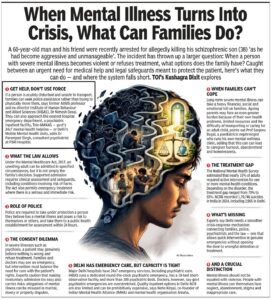
This question was at the heart of a recent feature in The Times of India (Times City, September 5, 2026), titled “When Mental Illness Turns Into Crisis, What Can Families Do?” The article was prompted by a deeply troubling case — a father and his friend allegedly killed his 38-year-old son, who was living with schizophrenia, after describing him as having become “aggressive and unmanageable.” It’s an extreme and tragic outcome, but it highlights something many families quietly struggle with: the gap between recognising a mental health emergency and knowing how to respond to it safely and lawfully.
Get Help, Don’t Use Force
Among the experts consulted for the piece was Dr. Paramjeet Singh, Consultant Psychiatrist, who offered a piece of guidance that deserves to be repeated often: when a person is acutely disturbed and unsafe to move, families should never attempt to physically restrain or transport them on their own.
Instead, Dr. Singh pointed families toward the support systems that already exist and are built for exactly this kind of moment:
The emergency department of the nearest hospital
A psychiatric inpatient facility
Tele-MANAS, the government’s round-the-clock mental health helpline
Delhi’s Mobile Mental Health Units, which can respond directly where the person is
This advice matters because in a crisis, panic often pushes families toward action that feels urgent but is actually unsafe — for the patient and for themselves. Knowing which door to knock on first can change the entire outcome of that day.
Why Families Feel Stuck: The Legal and Emotional Reality
The Times of India feature also unpacked why this issue is so complicated in the first place. Under the Mental Healthcare Act, 2017, an unwilling adult can be admitted for treatment only under specific, safeguarded circumstances — it isn’t simply a decision the family gets to make. This exists to protect patients from misuse, since allegations of mental illness have, unfortunately, been weaponised in disputes over marriage, dowry, or property in the past.
At the same time, severe conditions like psychosis can make it genuinely impossible for a patient to recognise that anything is wrong. Families and doctors may clearly see an emergency unfolding, while the patient sees no reason to seek care at all. Balancing a patient’s rights with a family’s need to act quickly is one of the hardest parts of mental healthcare — and one of the least talked about.
The article also cited sobering figures: an estimated treatment gap of 70–92% for various mental health conditions in India, and over 1.7 lakh reported suicides nationally in 2024, including thousands in Delhi alone. These numbers point to a system that is still catching up to the scale of the need — even as good emergency infrastructure, like round-the-clock psychiatric care at hospitals such as IHBAS, does exist.
What This Means for Families in Delhi
If there’s one message worth taking away from this feature, it’s this: a mental health crisis is a medical emergency, not a private failure to manage on your own. Families don’t need to have all the answers, and they certainly don’t need to face it alone or by force. What they need is to know where to turn — and to turn there early, before a situation escalates.
A few practical takeaways for families supporting a loved one with severe mental illness:
Recognise early warning signs of increasing agitation, disorientation, or risk — before a full crisis develops.
Keep helpline and hospital information handy in advance, not just when a crisis is already underway.
Don’t attempt physical intervention with someone who is acutely disturbed; seek professional or police assistance instead.
Understand that mental illness does not equal violence. As the article rightly notes, people living with mental illness are far more likely to face neglect, stigma, and inappropriate care than to pose a danger to others.
Look after the caregivers too. Long-term illness takes a real emotional and financial toll on families, particularly ageing parents.
Compassionate, Professional Care Starts with the Right Conversation
Being featured in a national publication for this kind of expert commentary reflects the broader work Dr. Paramjeet Singh and the team continue to do — helping families navigate not just crisis moments, but the everyday realities of living with and supporting someone through mental illness.
AtDelhi Mind Clinic, we believe families deserve clear guidance long before things reach a breaking point. Whether you’re noticing early changes in a loved one’s behaviour or facing a situation that already feels overwhelming, professional support can make the difference between a manageable moment and a full-blown crisis.
If you or someone you love needs guidance, don’t wait for things to escalate. Reach out to Delhi Mind Clinic to speak with an experienced mental health professional and find the right path forward — for your loved one, and for your whole family.
Does the thought of switching off the lights make your heart race? Do you find yourself scanning dark corners of a room, half-expecting something to be there? If so, you’re not alone. Fear of dark, medically known as nyctophobia, is one of the most common fears experienced by both children and adults.
While it’s normal to feel a little uneasy in the dark occasionally, for some people this fear becomes intense enough to disrupt sleep, daily routines, and overall quality of life. In this blog, we’ll explore what fear of dark really means, why it happens, and practical strategies to manage it.
What Is Fear of Dark?
Fear of dark isn’t simply about disliking darkness — it’s an intense, persistent anxiety triggered by the absence of light or the anticipation of what might be hiding in it. This fear can range from mild discomfort to a full-blown phobia that interferes with sleep, work, and social life.
It’s important to understand that darkness itself isn’t the real trigger. Rather, it’s the uncertainty that darkness creates — the inability to see clearly — that fuels the fear. Our minds tend to fill that uncertainty with imagined threats, whether that’s a burglar, a supernatural presence, or simply “the unknown.”
Is Fear of Dark Only Seen in Children?
Fear of dark is often associated with childhood, and indeed, it’s extremely common among children between the ages of 3 and 6. At this age, imagination is developing rapidly, and children often struggle to separate fantasy from reality — making shadows and unfamiliar sounds feel genuinely threatening.
However, fear of dark is not exclusive to children. Many adults continue to experience nyctophobia, sometimes as a lingering effect from childhood, and sometimes triggered later in life due to stress, trauma, or anxiety-related conditions. In adults, this fear often gets hidden or dismissed because of the stigma attached to admitting something so “childlike” — but it is a genuine and valid concern that deserves attention.
Common Symptoms of Fear of Dark
The symptoms of nyctophobia can be both emotional and physical. Some common signs include:
Rapid heartbeat or breathlessness when lights go off
Excessive sweating or trembling in dark spaces
Avoidance of dark rooms, hallways, or outdoor spaces at night
Difficulty falling asleep without a nightlight or some form of light
Intrusive thoughts about danger, intruders, or supernatural elements
A strong urge to check surroundings repeatedly before feeling safe
Sleep disturbances, including nightmares or frequent waking at night
If these symptoms are frequent and significantly impact your daily functioning, it may be time to explore this fear more deeply.
What Causes Fear of Dark?
There isn’t a single cause behind fear of dark — it usually develops due to a mix of psychological, environmental, and biological factors. Some of the most common contributors include:
1. Evolutionary Roots
Humans are visual creatures, and for our ancestors, darkness meant a higher risk of predators and danger. This survival instinct, though outdated in modern life, still lingers in our biology.
2. Childhood Experiences
Scary stories, movies, or a frightening personal experience in the dark during childhood can leave a lasting imprint, shaping how a person responds to darkness even as an adult.
3. Anxiety and Stress
People dealing with generalized anxiety or high stress levels are often more prone to heightened fears, including fear of dark, since their mind is already wired to anticipate threats.
4. Trauma
A distressing event that occurred in low-light or nighttime conditions can create a lasting association between darkness and danger.
5. Imagination and Overthinking
An active imagination, while a wonderful trait in many contexts, can sometimes work against a person by conjuring vivid, frightening scenarios in dim or dark settings.
How Fear of Dark Affects Daily Life
fear-of-dark
Left unaddressed, nyctophobia can quietly seep into multiple areas of life:
Sleep quality: Struggling to fall or stay asleep without lights can lead to chronic sleep deprivation.
Relationships: Partners or family members may not always understand the intensity of this fear, leading to friction or feelings of isolation.
Work and productivity: Poor sleep and constant anxiety can affect concentration, mood, and energy levels during the day.
Social life: Avoiding evening plans, night travel, or activities that involve low light can limit social participation.
Recognizing these ripple effects is the first step toward addressing the root fear rather than just managing its symptoms.
Effective Ways to Overcome Fear of Dark
The good news is that fear of dark is highly manageable with the right approach and consistent effort. Here are some strategies that can help:
1. Gradual Exposure
Slowly increasing your exposure to dim and dark environments — rather than avoiding them altogether — helps your brain relearn that darkness isn’t inherently dangerous. Start small, such as sitting in a dimly lit room for a few minutes, and gradually build up.
2. Practice Relaxation Techniques
Deep breathing, progressive muscle relaxation, and mindfulness meditation can help calm the nervous system when anxiety about darkness arises.
3. Reframe Negative Thoughts
Challenge irrational thoughts by asking yourself: “What evidence do I have that something bad will happen?” This cognitive shift can reduce the intensity of fear over time.
4. Create a Calming Nighttime Routine
A consistent, soothing bedtime routine — such as reading, listening to calming music, or journaling — signals to your brain that it’s time to relax rather than feel alert or fearful.
5. Use Dim Lighting Instead of Complete Darkness
Rather than forcing yourself into total darkness right away, use a soft nightlight or dim lamp as a transitional step while you build confidence.
6. Talk About It
Sharing your fear with a trusted friend, family member, or professional can reduce feelings of shame and isolation, making the fear feel more manageable.
7. Seek Professional Support
If fear of dark is significantly affecting your sleep, relationships, or daily functioning, speaking with a mental health professional can help. Therapy approaches such as Cognitive Behavioral Therapy (CBT) are widely used and highly effective in helping individuals understand and overcome irrational fears like nyctophobia.
Helping a Child Who Is Afraid of the Dark
If you’re a parent dealing with a child’s fear of dark, patience and reassurance go a long way:
Avoid dismissing or mocking their fear — validate their feelings first.
Use a nightlight to ease the transition into darkness gradually.
Check the room together to reassure them nothing unusual is there.
Encourage comforting routines like a favorite stuffed toy or bedtime story.
Avoid scary content (movies, stories) close to bedtime.
Most children naturally outgrow this fear as their brain matures and their ability to distinguish imagination from reality strengthens. However, if the fear is unusually intense or persistent, professional guidance can help.
When Should You Seek Help?
While mild fear of dark is common and often manageable on your own, consider reaching out to a mental health professional if:
The fear causes significant distress or panic
It interferes with sleep on a regular basis
It limits your daily activities or social life
Self-help strategies haven’t led to improvement
The fear has persisted for six months or longer
Seeking support isn’t a sign of weakness — it’s a proactive step toward reclaiming your peace of mind and improving your overall well-being.
Fear of dark is a deeply human experience rooted in our evolutionary instincts, personal experiences, and the way our mind processes uncertainty. Whether you’re a parent trying to comfort a frightened child or an adult quietly struggling with nyctophobia, know that this fear is common, valid, and — most importantly — manageable.
With patience, the right coping strategies, and support when needed, it’s entirely possible to feel safe and calm, even when the lights go out.
If you or a loved one is struggling with fear of dark or related anxiety, professional guidance can make a meaningful difference. Reach out to a mental health expert to take the first step toward lasting comfort and confidence.
Search for a famous person with autism and you’ll find far more than trivia — you’ll find proof that autism doesn’t limit what a person can achieve. Autism Spectrum Disorder (ASD) affects how a person communicates, processes information, and experiences the world, but it says nothing about a person’s potential, creativity, or capacity to succeed.
Every well-known famous person with autism featured in this list has, at some point, shared their journey publicly — helping break stigma, spread awareness, and remind us that neurodiversity is simply another way of thinking, not a limitation.
In this blog, we explore the inspiring stories of a famous person with autism from different fields — science, film, music, and activism — and what their achievements teach us about acceptance, strength, and human potential.
What Does It Mean to Be a Famous Person With Autism?
Being a famous person with autism means living publicly with a developmental condition that affects social communication, behavior, and sensory processing — while still reaching the very top of your field. Autism is called a “spectrum” because it looks different in every individual. Some people need significant daily support, while others live fully independent lives, pursue careers, and become household names.
Understanding this spectrum matters before we look at these famous names, because it shows just how diverse and multi-dimensional autism truly is.
5 Examples of a Famous Person With Autism
1. Temple Grandin — Scientist and Autism Advocate
Dr. Temple Grandin is perhaps the most recognized famous person with autism in the world. Diagnosed with autism as a child, she went on to become a professor of animal science and a global speaker on autism awareness. Her ability to “think in pictures” helped her revolutionize humane livestock handling systems used worldwide. Temple often says autism gave her a unique way of understanding the world — not a barrier to succeeding in it.
2. Satoshi Tajiri — Creator of Pokémon
The mind behind one of the most beloved franchises in gaming history, Satoshi Tajiri, has spoken about childhood traits associated with autism, including his intense, singular focus on collecting insects — a passion that later inspired the concept of “catching” and collecting creatures in Pokémon.
3. Daryl Hannah — Actress
Known for her roles in Splash and Blade Runner, Daryl Hannah is a famous person with autism who has spoken publicly about being diagnosed as a child. She has described how it once made red carpets and interviews overwhelming, yet it never stopped her from building a successful career in Hollywood.
4. Anthony Hopkins — Academy Award-Winning Actor
Sir Anthony Hopkins revealed later in life that he has Asperger’s syndrome, a term historically used to describe autism without significant language delay. Despite early struggles in school, Hopkins became one of the most celebrated actors of his generation, known for his intense focus and dedication to his craft.
5. Everyday Heroes You Won’t Find in the Headlines
For every well-known famous person with autism, there are countless individuals who quietly excel in their own lives — as engineers, artists, teachers, entrepreneurs, and parents. Fame is not a requirement for success. Every person on the spectrum has the potential to lead a fulfilling, meaningful life with the right understanding and support.
What a Famous Person With Autism Teaches Us
Autism is a spectrum, not a single story. Every individual experiences it differently.
Strengths often accompany challenges. Many people with autism display remarkable focus, memory, pattern recognition, and creativity.
Early support matters. Timely evaluation and the right guidance can help individuals build on their strengths from a young age.
Representation reduces stigma. When a famous person with autism speaks openly, it helps families and individuals feel less alone in their journey.
Supporting a Loved One Who May Be on the Spectrum
If you suspect that your child, or someone close to you, may be showing early signs of autism, it’s natural to feel uncertain about the next steps. Seeking a professional evaluation early can make a significant difference in how a person learns to navigate the world, build social connections, and use their natural strengths — the same strengths that helped every famous person with autism on this list thrive.
AtDelhi Mind Clinic, our team of experienced mental health professionals offers compassionate, evidence-based evaluation and support for children and adults on the autism spectrum. We believe every individual deserves an environment where their unique way of thinking is understood — not judged.
The story of every famous person with autism on this list proves one thing clearly: a diagnosis does not define a person’s ceiling. With acceptance, the right support system, and an environment that values neurodiversity, individuals with autism can — and do — achieve extraordinary things.
If you have questions about autism or want to understand more about evaluation and support options, reach out to Delhi Mind Clinic — because every mind, famous or not, deserves to be understood.
It’s payday, but instead of relief, there’s a knot in your stomach. Rent, EMIs, credit card bills, an “urgent” family expense — and somehow, a nagging feeling that you should be handling it all better. If this sounds familiar, you’re already experiencing the link between financial stress and mental health.
At Delhi Mind Clinic, we regularly meet individuals — students, young professionals, parents, and retirees alike — whose emotional struggles trace back, at least in part, to money-related worry. Understanding the connection between financial stress and mental health is often the first step toward feeling better.
Why Financial Stress and Mental Health Are So Closely Linked
Money Touches Every Part of Life
Finances aren’t just about numbers — they’re tied to security, identity, relationships, and self-worth. When money feels unstable, that instability naturally spills over into how we feel about ourselves and our future. This is exactly why financial stress and mental health so often move together.
The Body Reacts Like It’s Under Threat
Financial stress activates the same physiological stress response as other major threats — elevated cortisol, a racing heart, disrupted sleep, and a nervous system stuck in “alert mode.” Over time, this chronic activation is a key reason financial stress and mental health struggles tend to reinforce each other.
Rising Cost of Living
In cities like Delhi, rising rent, transportation, and daily expenses often outpace income growth, leaving many people feeling like they’re constantly running to stand still — a common trigger in the financial stress and mental health cycle.
Debt and Loan Pressure
Education loans, credit card debt, and EMIs create ongoing financial obligations that can weigh on the mind long after the initial purchase or decision is made.
Job Insecurity
Layoffs, contract-based work, and economic uncertainty mean many people don’t have the financial safety net that previous generations often had, making it harder to feel settled.
Social Comparison
Social media often creates a distorted sense of how others are doing financially, fueling feelings of inadequacy and shame even when someone is objectively managing well.
Family Financial Responsibilities
Supporting parents, siblings, or extended family while managing one’s own expenses is a common source of quiet, ongoing financial pressure in many Indian households.
7 Warning Signs That Financial Stress Is Affecting Your Mental Health
The connection between financial stress and mental health often shows up in ways people don’t immediately recognize. Watch for these seven signs:
Constant worry or racing thoughts about money, even during unrelated tasks
Sleep disturbances, including trouble falling asleep or waking up anxious
Irritability or mood swings, especially around bill due dates
Avoidance behaviors, like not opening bank statements or bills
Physical symptoms, such as headaches, muscle tension, or fatigue
Difficulty concentrating at work or in daily responsibilities
Social withdrawal or shame, avoiding outings or conversations about money
When several of these signs appear together, it’s a strong indication that financial stress and mental health are actively interacting — and that it may be time to address both.
financial stress and mental health
The Financial Stress and Mental Health Cycle
One of the most important things to understand about financial stress and mental health is how cyclical the relationship can be. Financial stress affects sleep and focus, which affects work or daily performance, which can affect income or stability, which then increases financial stress further. Recognizing this financial stress and mental health cycle early is key to interrupting it before it deepens.
“In my practice, financial stress rarely comes up on its own — it’s usually layered with self-worth issues and fear of judgment. Many people hesitate to talk about money problems even with close family, which only deepens the isolation. The first step is simply creating a safe space where they can say it out loud without shame.” — Dr. Sugandha Gupta, Delhi Mind Clinic
“What stands out to me is how often financial stress masks itself as something else — irritability, trouble sleeping, or unexplained fatigue. People don’t always connect the dots between their money worries and their physical or emotional symptoms until we explore it together. Early recognition really does change the course of recovery.” — Dr. Paramjeet Singh, Delhi Mind Clinic
Healthy Ways to Protect Your Mental Health During Financial Stress
Acknowledge the Stress Instead of Suppressing It
Many people feel embarrassed about financial struggles and push the feelings down. Simply naming what you’re feeling — “I’m stressed about money right now” — can reduce its grip on you.
Create a Simple, Realistic Budget
You don’t need a complicated spreadsheet. Start with the basics: income, fixed expenses, discretionary spending, and savings. Clarity, even imperfect clarity, often reduces anxiety more than avoidance ever will.
Separate Facts From Fears
Stress and anxiety tend to catastrophize. Try writing down the actual numbers versus the worst-case story your mind is telling you — this simple exercise can create helpful distance from spiraling thoughts.
Limit Comparison Triggers
Consider curating your social media feed or taking breaks from platforms that consistently trigger comparison and inadequacy around money and lifestyle.
Talk About It
Whether with a trusted friend, family member, or mental health professional, talking about financial stress can reduce feelings of isolation and shame. Far more people are quietly struggling than you might expect.
Practice Grounding Techniques
Simple breathing exercises, short walks, or mindfulness practices can help calm the nervous system when financial worry feels overwhelming in the moment.
Set Boundaries Around Family Financial Expectations
If family contributions are a major stressor, an honest, calm conversation about what’s realistically sustainable can prevent long-term resentment and burnout.
When Financial Stress and Mental Health Struggles Need Professional Support
It’s worth speaking with a mental health professional if financial stress is:
Interfering with your sleep, appetite, or daily functioning
Causing persistent feelings of hopelessness or worthlessness
Leading to panic-like symptoms (racing heart, shortness of breath, dread)
Making it hard to concentrate at work or maintain relationships
Accompanied by avoidance so severe that bills go unpaid or unopened
“A lot of people wait far too long before seeking help, thinking they should be able to ‘handle it themselves.’ But financial stress, like any other source of anxiety, responds well to timely support. There’s no need to wait until it becomes unmanageable.” — Dr. Sugandha Gupta, Delhi Mind Clinic
Financial stress is not a character flaw or a sign of failure — it’s a natural response to genuinely difficult circumstances, and its impact on mental health is real and valid.
How Delhi Mind Clinic Can Help With Financial Stress and Mental Health
At Delhi Mind Clinic, we understand that financial stress and mental health are closely intertwined, and rarely exist in isolation from career pressure, family dynamics, and broader anxiety patterns. Our approach focuses on understanding each individual’s unique situation and building practical, personalized coping strategies rather than one-size-fits-all advice.
As Dr. Paramjeet Singh puts it: “Our goal isn’t just to help someone manage financial anxiety in the short term — it’s to help them build a healthier, more resilient relationship with stress overall, so they’re better equipped to handle whatever life throws at them next.”
If financial stress is affecting your mental health, reaching out for support is a sign of strength, not weakness. You don’t have to navigate this alone.
Ready to talk to someone who understands? [Book a consultation with Delhi Mind Clinic] to take the first step toward a calmer relationship with money and your mental well-being.
Psychological trauma after sexual assault is far more complex, and far more lasting, than most people realize. A recent case out of Delhi — where a young girl endured a harrowing 47-kilometre ordeal aboard a moving bus — has once again forced the country to confront uncomfortable questions. Why do such crimes keep happening? Why does the fear never seem to leave? And why, despite decades of reform since the Nirbhaya case, does a woman still not feel fully safe travelling alone at night?
In a recent televised discussion, Dr. Sugandha Gupta, a leading psychologist at Delhi Mind Clinic, was invited to unpack the psychological trauma after sexual assault cases like this one — not just what happened, but why it happened, and what it does to the mind of a survivor, a family, and a society. Below are five key insights from her conversation.
psychological trauma after sexual assault
1. “Mental Illness” Is Not the Same as “Mindset” — And the Difference Matters
One of the most important clarifications Dr. Gupta made was around a common misconception: that people who commit such crimes must be “mentally ill,” and that psychological trauma after sexual assault can somehow be prevented simply by treating an underlying illness in offenders.
She was clear: this is not accurate.
What we are often looking at is not a mental illness, but a mindset — a set of learned beliefs and attitudes, absorbed from one’s surroundings over years. When boys grow up watching women being dominated, dismissed, or treated as objects rather than individuals, that observation quietly becomes internalised belief. Aggression gets rewarded with the label “masculine.” Boundary-crossing gets excused as “boys being boys.” Over time, this mindset hardens into a dangerous sense of entitlement — the belief that one has the right to take what they want, without consequence or guilt.
Alongside this, Dr. Gupta pointed to something else: a profound lack of empathy in individuals who commit such acts — an inability to register another person’s pain as real. This absence of empathy is what allows such crimes to be repeated without remorse, sometimes even years later, as seen in documented interviews of past offenders who showed no accountability even facing the harshest consequences.
2. Psychological Trauma After Sexual Assault Can Last a Lifetime
Perhaps the most sobering part of Dr. Gupta’s commentary was on the lasting nature of psychological trauma after sexual assault.
She noted that survivors — many of whom experience this trauma as teenagers — often carry it for the rest of their lives. It’s not something that fades neatly with time. Even women well into their middle age, she observed, continue to be affected by something that happened to them decades earlier, at 15 or 16 years old. That trauma doesn’t just shape how they see the world — it often shapes how they raise their own daughters, colouring their fears and their sense of safety passed on to the next generation.
This is a critical point for families and communities to internalise: healing from psychological trauma after sexual assault is not a linear or quick process, and survivors deserve patience, support, and access to spaces where they can process what they’ve experienced without judgment.
3. Victim Blaming Deepens Psychological Trauma After Sexual Assault
Dr. Gupta also addressed a pattern that surfaces after nearly every such case — the tendency of society to question the survivor rather than the perpetrator. Why was she out at night? Why did she board an empty bus?
These questions, however well-intentioned some may seem, add a second wound on top of psychological trauma after sexual assault. They compound the original experience with shame, self-doubt, and isolation — feelings that can be just as damaging as the incident itself, and that often prevent survivors from seeking help or speaking up at all.
Dr. Gupta was unambiguous: this pattern of victim-blaming stems from a deep-rooted patriarchal mindset in society — one that seeks to control and dominate, and that reduces women to objects rather than recognising them as individuals with full agency.
4. Systemic Delays Make the Trauma Worse
The conversation didn’t stop at diagnosis — it moved toward responsibility and accountability. Dr. Gupta emphasised a few key points that directly affect how psychological trauma after sexual assault is experienced and processed:
Accountability is collective. No single institution — police, government, or society — can address this alone.
Sensitisation is missing at every level — from how FIRs are registered, to how survivors are treated by law enforcement, to how cases are handled in courts.
Delayed justice deepens psychological harm. When consequences take seven or eight years to materialise, survivors are left carrying unresolved trauma for far longer, with little sense of closure or safety.
5. Healing Requires More Than Conversation — It Requires Support
Conversations like this one matter — but as Dr. Gupta pointed out, discussion alone cannot heal a survivor’s wounds. Addressing psychological trauma after sexual assault requires access to compassionate, professional psychological support: a space to process trauma, rebuild a sense of safety, and work through fear, grief, or anxiety at one’s own pace.
At Delhi Mind Clinic, our approach centers on providing exactly this — a safe, non-judgmental environment where individuals affected by trauma, whether recent or from years past, can find support tailored to their experience. Whether it’s a survivor, a parent, or anyone carrying the weight of fear after such news, professional guidance can make a meaningful difference in the healing journey.
If you or someone you know is struggling with psychological trauma after sexual assault, reaching out for support is not a sign of weakness — it’s often the first step toward reclaiming a sense of safety and control.
Learning how to deal with breakup depression starts with understanding that what you’re feeling is valid, common, and — most importantly — temporary with the right support and strategies. Breakups hurt. For some people, that hurt fades within a few weeks. For others, it settles in deeper, turning into what many describe as “breakup depression” — a heavy, persistent sadness that makes it hard to eat, sleep, focus, or feel like yourself again.
In this guide, we’ll walk through why breakups affect us so deeply, how to recognize breakup depression, and practical, science-backed ways to cope and heal — so you know exactly how to deal with breakup depression, one step at a time.
Why Do Breakups Hurt So Much?
Romantic relationships aren’t just emotional bonds — they’re wired into our brain’s reward and attachment systems. When a relationship ends, the brain processes it similarly to withdrawal or loss, which is why breakups can trigger:
Intense sadness or grief
Anxiety about the future
Loss of appetite or overeating
Trouble sleeping
Difficulty concentrating at work or studies
Loss of interest in things you once enjoyed
Feelings of worthlessness or self-blame
When these symptoms persist for weeks and start interfering with daily life, it may be more than ordinary heartbreak — it could be breakup depression.
Signs You May Be Dealing With Breakup Depression
It’s normal to feel sad after a breakup. But watch for these signs that suggest the sadness has become something more serious:
Persistent low mood that doesn’t lift after a few weeks
Withdrawing completely from friends, family, and social activities
Changes in sleep or appetite that don’t improve
Constant rumination about the relationship or ex-partner
Loss of motivation for work, hobbies, or self-care
Feelings of hopelessness about the future
Difficulty functioning in daily responsibilities
If several of these apply to you and have lasted more than two weeks, it’s worth speaking with a mental health professional about how to deal with breakup depression in a way that suits your situation.
how-to-deal-with-breakup-depression
How to Deal With Breakup Depression: 10 Practical Steps
1. Allow Yourself to Grieve
A breakup is a loss, and loss deserves grief. Suppressing your emotions often makes healing take longer. Give yourself permission to cry, feel angry, or feel numb — without judging yourself for it.
2. Limit Contact With Your Ex
As tempting as it is to check their social media or reread old messages, this often reopens the wound. Consider a “no contact” period, and mute or unfollow them on social platforms if needed. This isn’t about bitterness — it’s about giving your mind space to heal.
3. Reconnect With Your Support System
Isolation feeds depression. Reach out to friends and family, even if it’s just to talk about something unrelated to the breakup. Human connection reminds your brain that you’re not alone.
4. Rebuild a Routine
Depression thrives on chaos and inactivity. Try to maintain a simple daily structure:
Wake up and sleep at consistent times
Eat regular, balanced meals
Get outside for at least 20–30 minutes of daylight
Include some form of movement, even a short walk
5. Move Your Body
Exercise increases endorphins and reduces stress hormones. You don’t need an intense workout — a walk, light yoga, or dancing to your favorite playlist can help shift your emotional state.
6. Practice Mindfulness and Journaling
Writing down your thoughts helps process emotions instead of letting them loop endlessly in your mind. Mindfulness practices — like deep breathing or meditation — can also help calm anxious thoughts about the past or future.
7. Avoid Numbing Behaviors
It’s common to want to escape the pain through excessive drinking, overworking, or impulsive decisions. These numbing behaviors often make emotional recovery slower and more complicated. Try to notice the urge to numb out and choose a healthier outlet instead.
8. Rediscover Your Own Identity
Long relationships often blur individual identity. Use this time to reconnect with hobbies, goals, and interests that are yours alone — not shaped by the relationship.
9. Be Patient With Your Timeline
There is no fixed timeline for healing. Some days will feel better than others, and that’s normal. Progress in healing isn’t linear — expect ups and downs.
10. Seek Professional Support
If your low mood is intense, prolonged, or interfering with your ability to function, speaking with a psychologist or counselor can make a significant difference. Therapy provides tools tailored to you — helping you process the loss, challenge negative thought patterns, and rebuild emotional resilience.
When to Seek Professional Help
Consider reaching out to a mental health professional if you experience:
Symptoms lasting longer than a few weeks without improvement
Inability to carry out daily responsibilities (work, self-care, relationships)
Persistent feelings of hopelessness or worthlessness
Significant changes in sleep, appetite, or energy
Thoughts of self-harm or feeling like life isn’t worth living
Seeking help is not a sign of weakness — it’s a proactive step toward healing. If you’re unsure how to deal with breakup depression on your own, a trained therapist can help you navigate it in a safe, supportive, and non-judgmental environment.
Expert Insight
Dr. Sugandha Gupta notes: “Many people underestimate how physically and emotionally draining a breakup can be. What we often see in clinic is that patients delay seeking help because they assume the sadness will simply pass on its own. While that’s true for many, for others the low mood deepens into something that needs proper attention. There’s no shame in reaching out early — it usually leads to faster, easier recovery.”
Dr. Paramjeet Singh adds: “One pattern I frequently observe is rumination — replaying the relationship and breakup over and over in the mind. This keeps the emotional wound open longer than necessary. Structured support, whether through therapy or consistent self-care routines, helps individuals interrupt that cycle and gradually regain a sense of stability and control over their emotions.”
Final Thoughts: How to Deal With Breakup Depression, One Day at a Time
Breakup depression can feel all-consuming, but it doesn’t define your future. Knowing how to deal with breakup depression isn’t about a single fix — it’s about consistent, small steps: reaching out to a friend, going for a walk, journaling your thoughts. Each one is progress, even when it doesn’t feel like it.
Be gentle with yourself. You are allowed to grieve, to rebuild slowly, and to rediscover joy in your own time.
If you’re struggling to cope with breakup depression on your own, professional support can help. At Delhi Mind Clinic, our team of experienced mental health professionals offers a compassionate, confidential space to help you process your emotions and rebuild your sense of well-being. Reach out to us to take the first step toward healing.
Frequently Asked Questions
Q1. How long does breakup depression usually last? There’s no fixed timeline — it varies from person to person. For some, symptoms ease within a few weeks; for others, it can take a few months. If low mood persists beyond a few weeks and affects daily functioning, professional support is recommended.
Q2. Is it normal to feel depressed after a breakup? Yes. Breakups involve real emotional loss, and feeling sad, anxious, or low afterward is a normal human response. It becomes a concern when these feelings are intense, prolonged, or start interfering with daily life.
Q3. Can breakup depression turn into clinical depression? For some individuals, unresolved grief from a breakup can develop into clinical depression, especially if there’s a history of mental health challenges. This is why it’s important to monitor your symptoms and seek help if they don’t improve over time.
Q4. What’s the fastest way to get over a breakup? There’s no instant fix, but maintaining routine, limiting contact with your ex, leaning on your support system, staying physically active, and seeking therapy if needed can significantly speed up emotional recovery.