For general questions, please send us a message and we’ll get right back to you. You can also call us directly to speak with a member of our service team or insurance expert.
The history of autism is a story of curiosity, misunderstanding, and, finally, compassion. For more than a century, doctors, researchers, and families have worked to understand why some people experience the world differently. Today, we know autism as a lifelong neurodevelopmental difference. But that understanding took many decades to build.
At Delhi Mind Clinic, parents often ask us, “Is autism new?” or “Why do we hear about it so much more now?” The answer lies in the history of autism itself. In this guide, we walk through seven major milestones, bust a few myths, and share what our experts, Dr. Sugandha Gupta and Dr. Paramjeet Singh, want every family to know.
Quick Answer: Autism was first named in the early 1900s, described as a distinct condition in the 1940s, and officially recognised as a spectrum in 2013. Our understanding has changed enormously since then.
What Is Autism? A Brief Overview
Before exploring the history of autism, let us define it. Autism spectrum disorder (ASD) is a neurodevelopmental condition. It affects how a person communicates, interacts with others, and processes sensory information.
It is called a “spectrum” because every person is different. Some individuals need significant daily support. Others live independently and have remarkable strengths in areas like memory, pattern recognition, or creativity.
Autism did not suddenly appear in the 20th century. Historians believe that people with autistic traits have always existed. Old records describe individuals who were deeply focused on particular interests, spoke very little, or behaved in ways that communities found unusual.
However, without a medical term, these individuals were often misunderstood. Many were labelled with unrelated conditions. Others were simply described as “odd” or “different.” This lack of language is an important part of the early history of autism.
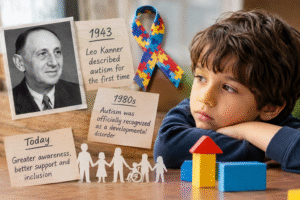
history of autism
Milestone 1: 1911 – The Word “Autism” Is Born
The word itself comes from the Greek word autos, meaning “self.” In 1911, Swiss psychiatrist Eugen Bleuler used the term “autism” while describing withdrawal from the outside world in adults with schizophrenia.
This early meaning was very different from how we use the word today. Still, it marks the first step in the history of autism as a named concept.
Milestone 2: 1943 – Leo Kanner’s Groundbreaking Study
In 1943, American child psychiatrist Leo Kanner published a landmark paper describing eleven children. These children showed strong difficulty connecting with others, a need for sameness, and unusual responses to their surroundings.
Kanner called the condition “early infantile autism.” Most experts agree that this paper is the true starting point of the modern history of autism as a clinical condition.
Milestone 3: 1944 – Hans Asperger’s Parallel Work
At almost the same time, Austrian paediatrician Hans Asperger described a group of children with strong verbal skills but marked social difficulties. His work was written in German and remained unknown to the English-speaking world for decades.
Later research, including historical studies published in 2018, raised serious questions about Asperger’s wartime role. Because of this, many clinicians now prefer the broader term “autism spectrum disorder” over “Asperger syndrome.”
Milestone 4: The 1950s–1960s – A Dark Chapter of Myths
An honest history of autism must include its painful mistakes. For several years, some experts wrongly believed that cold or distant parenting caused autism. This idea, often called the “refrigerator mother” theory, placed enormous blame and guilt on mothers.
This theory was completely incorrect. In 1964, psychologist Bernard Rimland challenged it in his book Infantile Autism, arguing that autism has biological roots. His work, along with growing parent advocacy, helped change the direction of research.
Dr. Paramjeet Singh shares: “Even today, I meet parents who quietly carry guilt, wondering if they did something wrong. The history of autism clearly shows that blaming parents was a scientific error. Autism is not caused by poor parenting. Families need support, not judgement.”
Milestone 5: 1980 – Autism Gets an Official Diagnosis
In 1980, autism was formally included in the American Psychiatric Association’s diagnostic manual (DSM-III) as a separate condition. Before this, many children were wrongly grouped under childhood schizophrenia.
This change was a turning point in the history of autism. It gave clinicians a common language, helped researchers study autism properly, and opened the door to services in schools and clinics.
Milestone 6: 1981 and the 1990s – The Spectrum Idea Grows
In 1981, British psychiatrist Lorna Wing introduced the idea that autistic traits exist across a wide range. She helped popularise the term “Asperger syndrome” in English and shaped the modern “spectrum” concept.
During the 1990s, diagnostic criteria widened, and awareness grew rapidly. More children, including girls and those with milder presentations, began to be identified. This is one reason why diagnosis numbers have increased over time.
Milestone 7: 2013 – One Spectrum, One Diagnosis
In 2013, the DSM-5 merged several separate labels into a single diagnosis: autism spectrum disorder. Doctors now describe each person’s support needs in areas such as social communication and repetitive behaviours.
Many parents worry that autism is “increasing.” Looking at the history of autism helps explain this. Several factors play a role:
Better awareness: Parents and teachers now recognise early signs.
Wider criteria: The spectrum approach includes more people.
Improved screening: Paediatric check-ups now include developmental questions.
Reduced stigma: Families are more willing to seek help.
Dr. Sugandha Gupta explains: “When we study the history of autism, we see that these children were always there. What has changed is our ability to notice, understand, and support them. Early identification gives a child the best chance to build communication and confidence.”
How Autism Care Has Changed Over Time
The history of autism also shows a major shift in how we support people. Decades ago, many individuals were placed in institutions. Today, care focuses on understanding the whole person.
Modern support commonly includes:
Early developmental assessment by a qualified specialist.
Speech and communication support tailored to the child.
Occupational and sensory-based activities to help with daily skills.
Behavioural and social skills guidance for children and families.
Inclusive education plans that respect the child’s learning style.
Parent counselling so families feel confident and supported.
Every plan should be personalised. There is no single approach that fits all.
The Neurodiversity Movement: A New Chapter
One of the most hopeful chapters in the history of autism began in the 1990s. Autistic self-advocates, including author and speaker Temple Grandin, began sharing their own voices. The neurodiversity movement encouraged society to see autism as a natural variation of the human brain, not simply something to be “fixed.”
Dr. Paramjeet Singh adds: “Today, our goal is not to make a child ‘normal.’ Our goal is to help each child communicate, learn, and enjoy life in their own way. Respecting strengths is just as important as addressing challenges.”
Common Myths the History of Autism Has Corrected
Myth: Bad parenting causes autism. Fact: It does not.
Myth: Autistic people have no feelings. Fact: Many feel deeply but express emotions differently.
Myth: Autism only affects boys. Fact: Girls are often diagnosed later because their signs can be subtle.
Myth: Autism can be “outgrown.” Fact: Autism is lifelong, but support can make a real difference.
When Should You Seek an Evaluation?
Knowing the history of autism is helpful, but acting early is even better. Consider speaking with a specialist if your child:
Does not respond to their name by 12 months
Has limited eye contact or shared smiles
Shows delayed speech or loses previously gained skills
Strongly resists changes in routine
Is very sensitive to sounds, textures, or lights
These signs do not always mean autism, but a professional assessment can bring clarity and peace of mind.
Final Thoughts: Learning From the History of Autism
The history of autism reminds us how far we have come, from confusion and blame to science, empathy, and inclusion. There is still more to learn, but one lesson is clear: understanding leads to better support.
If you have concerns about your child’s development or want guidance as a family, our team is here to help. Book a consultation with Dr. Sugandha Gupta or Dr. Paramjeet Singh at Delhi Mind Clinic and take the first step with confidence.
Frequently Asked Questions
Who first discovered autism? Eugen Bleuler first used the word in 1911, while Leo Kanner described autism as a distinct condition in children in 1943.
Is the history of autism the same as the history of Asperger syndrome? No. Asperger syndrome was described separately in 1944 and is now included within autism spectrum disorder.
Can autism be detected early? Yes. Many signs can be noticed in the first two years of life, and early assessment is encouraged.