For general questions, please send us a message and we’ll get right back to you. You can also call us directly to speak with a member of our service team or insurance expert.
Phone addiction is becoming one of the most common struggles in the digital age. You pick up your phone to check one notification, and twenty minutes later, you’re still scrolling — unable to remember what you were even looking for.
You’re not alone. Millions of people find themselves trapped in this same cycle every single day. What starts as a quick check-in turns into an unconscious habit that eats away at hours, focus, and peace of mind. If you’ve ever wondered whether your phone use has crossed a line, this post will help you understand why phone addiction happens and what signs to watch for.
What Is Phone Addiction?
Phone addiction refers to a pattern of compulsive phone use where a person finds it difficult to control how often or how long they use their device, even when it starts interfering with daily life. It isn’t an official clinical diagnosis in the same way as some other conditions, but it’s a widely recognized behavioral pattern that mental health professionals see more and more often. Phone addiction typically overlaps heavily with social media addiction, since apps are often the biggest driver of compulsive checking.
Why Phones Are So Hard to Put Down
Phone addiction isn’t simply about “weak willpower.” Apps are deliberately designed to keep you engaged for as long as possible. Every like, comment, and notification triggers a small reward response in the brain, similar to what happens with other habit-forming behaviors. Features like infinite scroll, autoplay videos, and unpredictable notifications are built to keep that reward cycle going — this is exactly how phone addiction develops over time, often without you noticing.
Over time, this constant stimulation can rewire your habits. Boredom, stress, or even a few seconds of silence can trigger an automatic urge to check your phone, often without you even realizing you’re doing it. This is one of the reasons phone addiction can be so hard to recognize in yourself, even when it’s obvious to people around you.
phone-addiction
Common Signs of Phone Addiction
Wondering if your relationship with your phone has become unhealthy? Here are some common signs of phone addiction to look out for:
1. You reach for your phone without thinking
Checking your phone becomes automatic, even when there’s no reason to. You might pick it up dozens of times a day out of habit rather than actual need.
2. You feel anxious or restless without it
If being away from your phone even briefly makes you feel uneasy, irritable, or like you’re missing out, that’s a sign your usage may have gone beyond casual habit.
3. You lose track of time while scrolling
Minutes turn into hours without you noticing. What felt like a quick check often ends up consuming a significant chunk of your day.
4. It affects your sleep
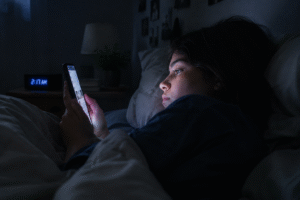
Scrolling late into the night, checking your phone right before bed, or waking up to check notifications can disrupt your sleep quality and leave you feeling tired the next day.
5. Your work or relationships are affected
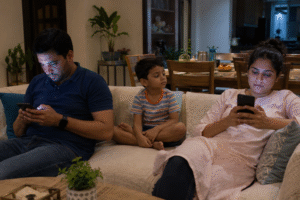
You find yourself distracted during conversations, missing deadlines, or feeling disconnected from people around you because part of your attention is always on your phone.
6. You’ve tried to cut back but couldn’t
You’ve set limits for yourself — no phone during meals, no scrolling after 10 PM — but keep breaking them despite your best intentions.
7. You use your phone to escape emotions
Reaching for your phone whenever you feel bored, stressed, lonely, or anxious, using it as a way to avoid dealing with uncomfortable feelings.
Bonus sign: You experience “phantom vibrations” — you think your phone buzzed or lit up, but when you check, there’s nothing there. This is another common sign of phone addiction and heightened phone dependency.
The Impact of Phone Addiction on Daily Life
Recognizing the impact of phone addiction matters because it can quietly affect several areas of life:
Mental well-being: Constant comparison on social media can affect self-esteem and mood, while the endless stream of information can heighten anxiety.
Sleep quality: Blue light exposure and mental stimulation before bed can interfere with restful sleep.
Focus and productivity: Frequent notifications fragment attention, making it harder to concentrate on tasks that matter.
Relationships: Being physically present but mentally elsewhere can create distance with family and friends.
Physical health: Long hours of screen time are often linked with reduced physical activity, eye strain, and poor posture.
Left unaddressed, phone addiction can gradually chip away at a person’s overall quality of life, making it harder to be fully present in the moments that matter most.
Who Is Most at Risk of Phone Addiction?
While anyone can develop phone addiction, certain groups tend to be more vulnerable. Teenagers and young adults, who have grown up with constant connectivity, often show higher rates of compulsive phone use. People experiencing high stress, loneliness, or low self-esteem may also turn to their phones more frequently as a coping mechanism, which can deepen patterns of phone addiction over time. Recognizing these risk factors can help individuals and families stay more alert to early warning signs.
Small Steps to Overcome Phone Addiction
The good news is that awareness is the first step toward change. Some simple strategies that can help reduce phone addiction include:
Turning off non-essential notifications
Setting specific “phone-free” times, such as during meals or the first hour after waking up
Using screen time tracking features to understand your actual usage patterns
Keeping your phone out of the bedroom at night
Replacing scrolling time with an offline activity you enjoy
Being mindful of why you’re reaching for your phone in a given moment
Small, consistent changes often make a bigger difference than trying to quit “cold turkey.”
When to Seek Support for Phone Addiction
For many people, self-awareness and small lifestyle adjustments are enough to build a healthier relationship with technology. But if phone addiction is significantly affecting your daily functioning, relationships, sleep, or emotional well-being despite your efforts to cut back, it may help to talk to a mental health professional. Behavioral patterns like this are very treatable, and support can make the process of change much easier and more sustainable.
Overcoming phone addiction rarely happens overnight — it builds slowly through small, repeated habits reinforced by design choices meant to keep us engaged. Recognizing the signs is the first step toward taking back control of your time, attention, and mental peace. If any of these signs of phone addiction sound familiar, know that change is possible, and you don’t have to navigate it alone.
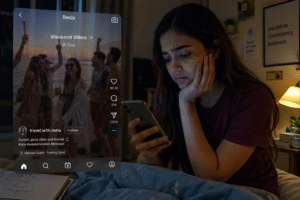
FOMO and comparison anxiety from Instagram Reels are two of the most common — and least talked about — sources of everyday stress today. You open the app for “just two minutes.” Forty-five minutes later, you put your phone down feeling restless, a little empty, and strangely dissatisfied with your own life. Your friend’s Goa trip, a colleague’s promotion post, a stranger’s perfectly lit apartment tour — none of it was about you, yet somehow it left you comparing your behind-the-scenes to everyone else’s highlight reel.
If this feels familiar, you’re not alone. This pattern is especially common among young professionals and students in cities like Delhi navigating fast-paced, hyper-connected lives.
In this article, we’ll unpack what’s actually happening in your mind when Reels trigger this anxiety, why it’s more common than you think, and practical, judgment-free ways to manage it.
What Exactly Is FOMO and Comparison Anxiety from Instagram Reels?
FOMO and comparison anxiety from Instagram Reels work together, but they’re slightly different experiences. FOMO is the uneasy feeling that other people are having more rewarding experiences than you — and that you’re missing out on them. Comparison anxiety goes a step further: it’s the discomfort or self-doubt that arises when you measure your own life, body, career, or relationships against carefully curated snapshots of someone else’s.
Instagram Reels are almost engineered to trigger both. The short, fast-paced, algorithm-driven format shows you an endless stream of:
Vacations, parties, and “perfect” weekends
Career wins, promotions, and financial milestones
Idealized bodies, skin, and fitness transformations
Picture-perfect relationships and family moments
What you rarely see is the effort, editing, financial stress, retakes, or personal struggles behind these clips. Your brain, however, doesn’t always make that distinction — it reacts to what it sees as if it were the full, unfiltered truth.
FOMO-and-comparison-anxiety-from-Instagram-Reels
Why Reels Specifically Feel Harder Than Other Social Media
Not all social media feels the same, and Reels are a big reason why FOMO and comparison anxiety from Instagram Reels can feel more intense than what you experience on other platforms:
1. Rapid-fire content delivery Unlike a slow-scrolling feed, Reels serve one high-stimulation clip after another. This constant novelty keeps your brain in a heightened, reactive state, leaving little time to process or contextualize what you’re seeing.
2. Algorithmic amplification The algorithm learns what keeps you watching — often content that triggers strong emotional reactions, including envy or inadequacy — and shows you more of it.
3. Passive, one-way consumption You’re watching, not necessarily interacting. This passive scrolling has been linked to lower mood compared to active engagement, like messaging friends directly.
4. Blurring of “real” and “curated” Reels often feel more spontaneous and authentic than posed photos, which paradoxically makes the comparison feel more real and personal.
Signs You Might Be Experiencing FOMO and Comparison Anxiety from Instagram Reels
This kind of anxiety doesn’t always look dramatic. It often shows up in quiet, everyday ways:
Feeling anxious, low, or irritable after scrolling, without an obvious reason
Repeatedly checking to see what others are doing when you’re alone or bored
Feeling like your life, body, or achievements are “not enough” after watching Reels
Difficulty being fully present at your own gatherings because you’re thinking about other events
Sleep disruption from late-night scrolling “just to see what’s new”
A dip in self-esteem that seems to track with how much time you spent online that day
If several of these sound familiar, it doesn’t mean something is “wrong” with you — it means your mind is responding, quite normally, to a very unnatural amount of curated comparison.
Why This Matters More Than We Often Admit
It’s easy to dismiss FOMO and comparison anxiety from Instagram Reels as “just social media” or something to laugh off. But research and clinical observation increasingly point to a real link between heavy, passive social media consumption and increased feelings of anxiety, low self-worth, and dissatisfaction with one’s own life — particularly among people already prone to comparing themselves to others.
Left unaddressed, chronic comparison anxiety can quietly erode confidence, strain relationships, and make it harder to feel content with genuine, meaningful progress in your own life.
“In my practice, I see this almost every week — clients who can’t quite explain why they feel low or restless, until we trace it back to an hour of scrolling Reels the night before. The mind isn’t built to process hundreds of curated ‘best moments’ from other people’s lives in a single sitting, and it responds the way it would to any repeated stressor — with anxiety, irritability, or a dip in self-worth.” — Dr. Sugandha Gupta
[Psychologist, Delhi Mind Clinic]
7 Practical Ways to Manage FOMO and Comparison Anxiety from Instagram Reels
You don’t need to delete your accounts or swear off Reels forever to manage FOMO and comparison anxiety from Instagram Reels. Small, sustainable shifts tend to work far better than extreme ones.
1. Notice the Pattern Before You Judge It
Before reaching for solutions, simply notice: What time of day do you scroll most? What mood are you in right before and after? Awareness alone reduces the automatic, unconscious nature of the habit.
2. Curate Your Feed Intentionally
Unfollow or mute accounts that consistently leave you feeling worse about yourself, even if you “should” like them. Follow accounts that inform, inspire practically, or make you genuinely laugh.
3. Set Boundaries Around Passive Scrolling
Try designating specific times for social media rather than scrolling reactively whenever you feel bored or anxious. Even simple steps like turning off auto-play or setting app time limits can interrupt the automatic scroll cycle.
4. Practice the “Behind the Clip” Reframe
When you catch yourself comparing, gently remind yourself: this is one curated 15-second moment, not a full life. Ask: “What effort, editing, or context might be missing here?”
5. Reconnect with Offline Sources of Self-Worth
Comparison anxiety thrives when our sense of value depends on external validation. Spend time on activities — hobbies, relationships, skills — where your worth isn’t measured in likes or views.
6. Talk About It
Comparison anxiety can feel embarrassing to admit, but it’s incredibly common. Talking to a friend, family member, or a mental health professional about these feelings often reduces their intensity almost immediately.
7. Practice a Nightly Digital Wind-Down
Avoid scrolling Reels in the last 30–60 minutes before bed. Late-night comparison scrolling is especially likely to affect sleep quality and next-day mood, so replacing it with reading, journaling, or simply talking to someone can make a noticeable difference over time.
“What’s changed in recent years is the speed of exposure. A generation ago, you might compare yourself to a handful of neighbours or classmates. Today, a teenager or young professional can be exposed to hundreds of ‘better’ lives before breakfast. It’s not a character flaw or a lack of gratitude — it’s a completely understandable response to an environment the human brain was never designed for. The good news is that with awareness and small, consistent changes, most people find real relief fairly quickly.” —Dr. Paramjeet Singh
When to Consider Professional Support for FOMO and Comparison Anxiety from Instagram Reels
Occasional FOMO is a normal part of modern life. However, if you notice that comparison anxiety is:
Persisting for weeks or months
Affecting your sleep, appetite, or concentration
Making you withdraw from real-life relationships or activities
Linked to ongoing low mood, excessive self-criticism, or anxiety in other areas of life
…it may be worth speaking with a mental health professional. A qualified psychologist or counsellor can help you understand the underlying patterns driving the anxiety and build coping strategies tailored to you — not just generic advice, but an approach that fits your specific life and mind.
Final Thoughts on FOMO and Comparison Anxiety from Instagram Reels
Instagram Reels aren’t going anywhere, and neither is the occasional pang of “everyone else seems to be doing better than me.” But that feeling doesn’t have to run your day — or your self-esteem. By understanding why FOMO and comparison anxiety from Instagram Reels happen, and making small, intentional changes to how you engage with social media, you can enjoy scrolling without letting it quietly chip away at how you feel about your own life.
If comparison anxiety or FOMO has been affecting your mood, sleep, or confidence for a while now, know that support is available, and reaching out is a sign of self-awareness, not weakness.
Frequently Asked Questions
Is FOMO and comparison anxiety from Instagram Reels a mental health condition? FOMO itself isn’t a clinical diagnosis, but persistent FOMO and comparison anxiety from Instagram Reels can contribute to or worsen anxiety and low mood, especially in people already vulnerable to these patterns.
Why do Reels feel worse than regular Instagram posts? Reels are fast, algorithm-driven, and consumed passively, which tends to intensify FOMO and comparison anxiety from Instagram Reels compared to slower, more deliberate feed browsing.
Can reducing screen time alone fix comparison anxiety? Reducing screen time helps, but lasting change usually comes from combining mindful usage habits with building self-worth from offline sources and, when needed, professional support.
When should I see a therapist for FOMO and comparison anxiety from Instagram Reels? If the anxiety persists for weeks, disrupts daily functioning, or is accompanied by low mood or withdrawal from real-life activities, it’s a good time to consult a mental health professional.
Walk into any Indian classroom, scroll through any teenager’s Instagram feed, or sit at any family dinner table, and you’ll likely find a conversation — spoken or unspoken — about how someone looks. “You’ve put on weight.” “Why are you so dark?” “Beta, eat less rice.” These comments, often meant casually, are shaping how an entire generation of Indian teenagers sees themselves.
Body image issues among Indian teens are no longer a rare concern whispered about in therapy rooms. They are becoming a widespread, everyday reality — and one that deserves far more attention than it currently gets. Understanding why body image issues among Indian teens are becoming so common is the first step toward helping the young people in our lives feel more at home in their own skin.
What Is Body Image, and Why Does It Matter So Much in the Teenage Years?
Body image refers to how a person perceives, thinks, and feels about their own body — not just how they actually look. During adolescence, the body is changing rapidly, identity is still forming, and peer approval matters intensely. This makes teenagers especially vulnerable to developing a distorted or negative view of themselves.
When body image issues take root early, they don’t just affect confidence. They can shape a teen’s relationship with food, exercise, social situations, and their own sense of self-worth for years to come. This is precisely why body image issues among Indian teens deserve early attention rather than being brushed aside as a passing phase.
Body image issues among Indian teens
Why Are Body Image Issues Rising Among Indian Teens?
Several overlapping factors are fuelling body image issues among Indian teens today:
1. Social Media and the Filtered Reality
Instagram, Snapchat, and short-video platforms expose teens to a constant stream of edited, filtered, and curated images. Many teens compare their unfiltered, everyday selves to these unrealistic standards, leading to persistent dissatisfaction with their own appearance.
2. Cultural Obsession With Fairness and “Ideal” Body Types
India’s long-standing preoccupation with fair skin, slimness for girls, and muscularity for boys sends a strong, often unspoken message: your worth is tied to your appearance. Advertisements, matrimonial preferences, and even well-meaning relatives reinforce these narrow ideals.
3. Family Comments and “Casual” Body Shaming
Comments about weight, height, skin tone, or eating habits made by parents, grandparents, or relatives — often without any harmful intent — can leave lasting emotional marks. Many Indian teens report that some of the most hurtful body-related remarks come from within their own homes.
4. Academic and Social Pressure
Board exams, competitive coaching classes, and packed schedules leave little room for physical activity, rest, or emotional processing. This pressure often gets tangled up with body image, especially when appearance becomes another area where teens feel they must “perform.”
5. Peer Comparison and Bullying
Nicknames based on weight or complexion, teasing in school WhatsApp groups, or exclusion based on appearance can quietly erode a teenager’s self-esteem over time.
Signs a Teen May Be Struggling With Body Image
Recognising body image issues among Indian teens early can make a real difference. Parents, teachers, and caregivers can watch for signs such as:
Frequently criticizing their own appearance or comparing themselves to others
Avoiding mirrors, photos, or social gatherings
Sudden changes in eating patterns or excessive focus on food and exercise
Wearing baggy clothes to “hide” their body, or the opposite — becoming preoccupied with certain outfits
Withdrawing from friends, sports, or activities they once enjoyed
Increased irritability, anxiety, or low mood, especially around appearance-related topics
Seeking constant reassurance about how they look
It’s important to note that occasional self-consciousness is a normal part of growing up. The concern arises when these thoughts and behaviours become persistent, distressing, or start affecting daily functioning.
The Emotional and Mental Health Impact
Left unaddressed, body image issues among Indian teens can contribute to:
Chronic low self-esteem and self-worth tied entirely to appearance
Social withdrawal and isolation
Anxiety and depressive symptoms
Unhealthy relationships with food and exercise
Difficulty forming secure, confident identities into adulthood
This is why body image struggles should never be dismissed as “just a phase” or vanity. For many teens, this is a genuine emotional burden that shapes how they experience the world.
How Parents Can Support a Teen Struggling With Body Image
Addressing body image issues among Indian teens often starts at home. Here’s how parents can help:
Watch your own language. Avoid commenting on your teen’s body, weight, or food choices — even in jest. Model body-neutral or body-positive language at home.
Create space for open conversation. Let your teen know they can talk about how they feel about their appearance without judgment or immediate advice-giving.
Focus on what the body can do, not just how it looks. Encourage strength, energy, and capability rather than appearance-based praise.
Limit appearance-focused comparisons within the family, including comparing siblings or cousins.
Be mindful of social media use and have honest conversations about filters, editing, and curated content — without shaming your teen for using these platforms.
Notice, don’t ignore. If you observe persistent distress, withdrawal, or changes in eating or mood, take it seriously rather than assuming it will pass.
How Teens Can Build a Healthier Relationship With Their Body
Teens themselves can also take small, meaningful steps to work through body image issues:
Curate your social media feed — unfollow accounts that consistently make you feel inadequate.
Practice noticing when you’re engaging in negative self-talk, and gently challenge it.
Spend time with people who make you feel accepted as you are.
Engage in movement or activities you genuinely enjoy, rather than ones focused purely on changing your appearance.
Remember that photos and reels rarely reflect real, everyday life.
When to Seek Professional Support
If body image concerns are affecting your teen’s mood, relationships, eating habits, school performance, or overall sense of self, it may be time to consult a mental health professional. Early support can make a significant difference — helping teens build resilience, self-compassion, and a healthier sense of identity before these patterns become deeply entrenched.
At Delhi Mind Clinic, our team works closely with adolescents and families across Delhi to address body image issues among Indian teens with sensitivity, evidence-based approaches, and a non-judgmental space where teens feel truly heard.
Expert Insights on Body Image Issues Among Indian Teens
“In my practice, I’ve noticed that Indian teens rarely talk about body image in isolation — it’s usually tangled up with academic pressure, family expectations, and how they’re perceived by peers. What helps most is when parents shift the conversation from ‘how do you look’ to ‘how do you feel,’ and when teens learn that their worth was never meant to be measured by a mirror.” — Dr. Sugandha Gupta
“One pattern I see often is that teens who struggle with body image stay silent for a long time before anyone notices. Families sometimes mistake withdrawal or irritability for ‘typical teenage moodiness.’ My advice to parents is simple: don’t wait for a crisis to start the conversation. Early, non-judgmental support changes outcomes significantly.” — Dr. Paramjeet Singh
Frequently Asked Questions
Q1: At what age do body image issues among Indian teens typically begin? Body image concerns often start emerging around early adolescence (ages 11–14), as physical changes, peer comparison, and social media exposure increase, though they can appear earlier or later depending on the individual.
Q2: Are boys also affected by body image issues, or is it mainly girls? While much of the conversation focuses on girls, boys are increasingly affected too — often around muscularity, height, and body shape — though they may be less likely to talk about it openly.
Q3: How is body image different from an eating disorder? Body image concerns relate to how a person perceives and feels about their appearance. Eating disorders are diagnosable mental health conditions involving disordered eating patterns. Not everyone with body image issues develops an eating disorder, but body image struggles are often an early risk factor — professional evaluation is important if eating patterns change significantly.
Q4: How can schools help address body image issues among Indian teens? Schools can play a big role through awareness sessions, training teachers to avoid appearance-based comments, encouraging media literacy, and creating safe spaces for students to discuss self-esteem and mental health.
Body image issues among Indian teens are shaped by a complex mix of culture, family, social media, and academic pressure. But with awareness, open conversation, and timely support, teens can be guided toward a healthier, more compassionate relationship with themselves. Addressing body image issues among Indian teens isn’t about a single conversation — it’s an ongoing, everyday practice of empathy at home and, when needed, professional guidance.
If you’re concerned about your teen’s emotional wellbeing or relationship with their body image, reaching out to a qualified mental health professional can be a meaningful first step. Tackling body image issues among Indian teens early — with empathy at home and expert support when needed — can help the next generation grow up feeling truly comfortable in their own skin.
Pick up your phone right now — how many times have you already checked it today? For most people, the honest answer is somewhere between 60 and 100 times. Phones have quietly become the first thing we touch in the morning and the last thing we see at night. For many, this has crossed from convenience into excessive phone use — a pattern that affects sleep, focus, relationships, and mental well-being.
At Delhi Mind Clinic, we increasingly see patients — students, working professionals, and parents alike — who describe feeling “controlled” by their phones rather than in control of them. The good news: this is a well-understood pattern, and it is absolutely possible to change it.
What Counts as “Excessive” Phone Use?
There’s no single screen-time number that applies to everyone. What matters more is the impact your phone use is having on your daily life. Excessive phone use is generally characterised by:
Reaching for your phone automatically, without a clear reason
Feeling anxious, restless, or “incomplete” when it’s not nearby
Losing track of time while scrolling, often for far longer than intended
Using the phone late into the night, cutting into sleep
Neglecting work, studies, chores, or face-to-face conversations because of phone use
Feeling a small jolt of relief or distraction every time a notification appears
If several of these sound familiar, you’re not alone — and it’s worth understanding why this happens.
excessive-phone-use
Why Phones Are So Hard to Put Down
This isn’t simply a matter of “willpower.” Phones — and the apps on them — are deliberately designed to hold attention.
1. The dopamine loop Every like, message, or notification triggers a small release of dopamine, the brain’s “reward” chemical. Because these rewards arrive unpredictably, the brain stays hooked, checking again and again in anticipation of the next one — the same mechanism that makes slot machines addictive.
2. Fear of missing out (FOMO) Social feeds create a constant, low-level worry that something important is happening elsewhere, making it hard to disengage.
3. Escape from difficult emotions For many people, scrolling becomes an automatic way to avoid boredom, stress, loneliness, or uncomfortable feelings — offering short-term relief but reinforcing the habit over time.
4. Habit and environment cues A buzzing notification, a lull in conversation, even a quiet room can become an automatic trigger to check the phone, often before we’ve consciously decided to.
The Real-World Impact
Excessive phone use rarely stays contained to “just the phone.” Over time, it can quietly affect several areas of life:
Sleep — Late-night scrolling delays sleep onset and reduces sleep quality, leaving you tired and irritable the next day.
Focus and productivity — Frequent checking fragments attention, making deep, sustained concentration harder to sustain.
Mood — Constant comparison with curated, highlight-reel lives on social media can lower self-esteem and increase feelings of anxiety or low mood.
Relationships — “Phubbing” (phone snubbing) — glancing at your phone while someone is talking to you — can quietly erode connection with family, friends, and partners.
Posture and physical health — Prolonged phone use is linked to neck strain, eye fatigue, and reduced physical activity.
Recognising these effects is not about guilt — it’s the first, most useful step toward change.
Practical Steps to Reduce Excessive Phone Use
Small, consistent changes tend to work far better than dramatic, short-lived resolutions. Here are strategies our team often recommends:
1. Create Phone-Free Zones and Times
Keep the phone out of the bedroom and away from the dining table. Even simple boundaries — like no phones for the first hour after waking, or the last hour before sleep — can significantly reduce automatic checking.
2. Turn Off Non-Essential Notifications
Most notifications aren’t urgent. Turning off alerts for social media and games removes the constant “pull” and lets you check apps on your own schedule instead of the app’s.
3. Use Screen-Time Tools Intentionally
Built-in screen-time trackers and app limits can make invisible habits visible. Simply seeing your daily average often motivates a natural reduction.
4. Replace, Don’t Just Remove
Cutting phone use without filling that time with something else often backfires. Keep an easy, satisfying alternative on hand — a short walk, a book, a hobby, or a quick chat with someone nearby.
5. Practice the “Pause Before You Pick Up” Habit
Before reaching for your phone, pause for three seconds and ask: Am I checking this for a reason, or out of habit? This small pause interrupts the automatic loop.
6. Be Mindful of Emotional Triggers
Notice if you reach for your phone specifically when bored, anxious, or lonely. Naming the feeling — “I’m scrolling because I feel anxious” — helps you address the actual emotion instead of masking it.
7. Set Tech-Free Time With Loved Ones
Designate meals, family time, or outings as phone-free. This strengthens real-world connection and gives the brain a genuine break from constant stimulation.
When to Seek Professional Support
For most people, awareness and small habit changes are enough to bring phone use back into balance. However, it may be worth speaking with a mental health professional if:
Your phone use feels genuinely out of your control, despite repeated attempts to cut back
It’s significantly affecting your sleep, work, studies, or relationships
You notice it’s linked to underlying anxiety, low mood, or difficulty coping with stress
Attempts to reduce use lead to noticeable irritability, restlessness, or distress
Excessive phone use is often a symptom of something deeper — stress, anxiety, loneliness, or difficulty regulating emotions — rather than the root problem itself. A mental health professional can help identify and address these underlying factors in a supportive, non-judgmental way.
Your phone is a tool — a powerful one — but it works best when it serves you, not the other way around. Rebuilding a healthier relationship with your phone doesn’t require giving it up entirely; it requires awareness, small structural changes, and patience with yourself along the way.
If you feel like excessive phone use is affecting your mental well-being, the team at Delhi Mind Clinic is here to help. Reach out to speak with a mental health professional in a confidential, supportive space.
Open your phone right now, and there’s a good chance you’ll find at least one app promising to “boost your mood,” “reduce your stress,” or “talk you through anxiety.” Over the past few years, AI chatbots and mental health apps have quietly become part of daily life for millions of people — especially younger users who find it easier to type out their feelings to a bot at 2 a.m. than to book an appointment.
At Delhi Mind Clinic, we get asked about this often: “Can an app really help my anxiety?” “Is talking to an AI chatbot the same as therapy?” “Should I trust these apps with my mental health?”
This blog post breaks down what AI chatbots and mental health apps actually do, where they genuinely help, where they fall short, and how to use them wisely — without replacing the human support that real healing often needs.
What Are AI Chatbots and Mental Health Apps, Exactly?
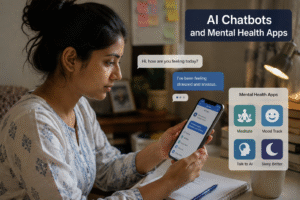
AI chatbots and mental health apps are digital tools designed to support emotional wellbeing. They generally fall into a few categories:
Conversational chatbots that simulate supportive conversation, using natural language processing to respond to how you’re feeling.
Mood and habit trackers that help you log emotions, sleep, and daily patterns over time.
Guided self-help tools offering structured exercises based on approaches like cognitive behavioural techniques, mindfulness, and journaling.
Meditation and relaxation apps that use guided audio, breathing exercises, and calming visuals to reduce stress in the moment.
Some of these tools are built by mental health professionals and grounded in evidence-based frameworks. Others are more casual wellness products with far less clinical rigour behind them — and knowing the difference matters.
Ai-chatbots-and-mental-health-apps
Why Are So Many People Turning to AI Chatbots for Mental Health Support?
The rise of AI chatbots and mental health apps isn’t happening in a vacuum. A few real factors are driving it:
1. Availability, Anytime
Mental health struggles don’t stick to office hours. A chatbot is available at midnight, during a panic moment, or on a quiet Sunday when no clinic is open.
2. Lower Barrier to Starting
For many people, the idea of walking into a clinic feels intimidating. Typing a message to an app feels safer as a first step — especially for those who aren’t ready to speak to a person yet.
3. Anonymity and Reduced Stigma
In a culture where mental health is still surrounded by stigma, an app can feel like a judgment-free space to admit “I’m not okay” for the first time.
4. Affordability
Many mental health apps are free or low-cost, which makes them accessible to people who may not yet be able to afford regular professional sessions.
5. Consistency
Apps don’t get tired, distracted, or busy. They can offer the same calm, structured check-in every single day, which builds a helpful routine for some users.
Where AI Chatbots and Mental Health Apps Genuinely Help
It’s easy to dismiss these tools as “just an app,” but used correctly, they do offer real value:
Building a daily self-awareness habit — logging moods and thoughts helps people notice patterns they’d otherwise miss.
Practising coping skills — breathing exercises, grounding techniques, and journaling prompts are simple but effective tools for everyday stress.
A bridge to professional help — for many people, using an app is the first step that eventually leads them to seek real therapy or counselling.
Support between sessions — for those already working with a therapist, apps can reinforce techniques discussed in session.
Reducing isolation in small moments — sometimes, just having something respond when you’re overwhelmed can feel steadying.
The Real Limitations of AI Chatbots and Mental Health Apps
This is where it’s important to be honest — because your mental health deserves more than good marketing copy.
They Cannot Diagnose You
An AI chatbot cannot understand the full context of your history, your relationships, your body, and your life the way a trained mental health professional can. Patterns that look “mild” in a chat window can sometimes be far more serious in person.
They Cannot Replace Human Connection
Healing often happens through relationship — being truly seen, heard, and understood by another person. No algorithm can fully replicate the safety of a real therapeutic relationship.
Risk in Crisis Situations
If someone is going through a serious mental health crisis, a chatbot is not equipped to provide the urgent, human intervention that’s needed. Relying on an app during a crisis can dangerously delay real help.
Data Privacy Concerns
Not every app is transparent about how your emotional data is stored, used, or shared. Given how sensitive mental health information is, this deserves real scrutiny before you share your innermost thoughts with any platform.
One-Size-Fits-All Responses
Even the most advanced chatbot responds based on patterns in data — not lived clinical judgment. Two people with “the same” symptoms can need completely different approaches, something only a professional assessment can determine.
How to Use AI Chatbots and Mental Health Apps Wisely
If you’re already using — or considering — one of these apps, here’s how to get the most out of it safely:
Treat it as a supplement, not a substitute. Use it alongside professional support, not instead of it.
Choose apps built with clinical input. Look for tools developed with psychologists, psychiatrists, or licensed mental health experts involved in their design.
Check the privacy policy. Understand exactly how your data is stored and whether it’s shared with third parties.
Notice if you’re relying on it to avoid real help. If you find yourself using an app to sidestep talking to a professional about something serious, that’s worth paying attention to.
Know when to escalate. If you’re experiencing persistent low mood, overwhelming anxiety, or thoughts of self-harm, reach out to a mental health professional or a trusted person immediately — don’t rely on an app alone.
What Our Doctors Say
We asked our senior clinicians at Delhi Mind Clinic to share their perspective on this growing trend.
Dr. Paramjeet Singh, Senior Neuropsychiatrist
“In my practice, I’ve seen a growing number of patients — especially young adults — who mention using an AI chatbot before they ever consider seeing a psychiatrist. I don’t see this as a bad thing in itself. For someone hesitant to seek help, an app can lower that first barrier. My concern is when it becomes a substitute rather than a starting point. Conditions like anxiety, depression, or bipolar disorder often present with overlapping symptoms that require a trained clinical eye to differentiate — something no chatbot is equipped to do. I always tell my patients: use these tools if they help you build awareness, but don’t let them delay a proper diagnosis.”
— Dr. Paramjeet Singh, Senior Consultant Neuropsychiatrist, Delhi Mind Clinic
Dr. Sugandha Gupta, Founder & Director, Delhi Mind Clinic
“AI chatbots can’t read body language, tone, or family history — the subtle cues we rely on in a real consultation. Still, they have a place, especially in India where stigma keeps many people from seeking help. If a mood-tracking app helps someone open up for the first time, that’s valuable. Our job as clinicians is to make sure that conversation continues safely, beyond the app.”
We believe technology has a real, growing role to play in mental wellness — especially in making the first step feel less overwhelming. AI chatbots and mental health apps can be a gentle entry point, a daily companion, or a helpful add-on to therapy.
But they are not, and should not be treated as, a replacement for professional care. Mental health is deeply personal, shaped by your history, your body, your relationships, and your circumstances — and that calls for a trained human who can truly listen, assess, and guide you.
If you’ve been using an app to manage stress, anxiety, or low mood and feel like you need more support, that’s not a failure — it’s simply the next right step. Our team at Delhi Mind Clinic is here to offer that human connection, with a safe, non-judgmental space to be heard.
Are AI chatbots and mental health apps safe to use? Many are safe for everyday stress management and self-awareness, but they aren’t equipped to handle serious mental health conditions or crisis situations. Always check an app’s credibility and privacy practices.
Can an AI chatbot replace a therapist? No. Chatbots can support daily coping and self-reflection, but they cannot replace the depth of understanding, diagnosis, and personalised guidance a trained mental health professional provides.
When should I stop relying on an app and see a professional instead? If your symptoms are persistent, intensifying, affecting your daily life, or involve any thoughts of self-harm, it’s time to speak with a mental health professional right away.
Are these apps useful for mild everyday stress? Yes — for general stress, mindfulness, and building healthy routines, many apps offer genuinely helpful, low-pressure support.
If you’ve been tossing and turning at night, staring at the ceiling fan at 2 AM, or waking up feeling exhausted no matter how early you went to bed — you’re far from alone. Sleep problems in India have become a silent epidemic, quietly affecting students, working professionals, homemakers, and senior citizens alike.
In a country that prides itself on hustle culture and “making it work,” sleep is often the first thing we sacrifice. But the cost of that sacrifice is higher than most people realize.
sleep-problems-india
How Common Are Sleep Problems in India?
Sleep problems in India are far more widespread than most people assume. Urban Indians, in particular, report high rates of poor sleep quality, difficulty falling asleep, and frequent nighttime awakenings. Metro cities like Delhi, Mumbai, and Bengaluru consistently rank among the most sleep-deprived in surveys, driven by long commutes, demanding work hours, and round-the-clock digital connectivity.
What makes this especially concerning is that many people don’t even recognize they have a sleep problem. They simply accept fatigue, irritability, and brain fog as “normal” parts of daily life — when in reality, these are often signs that the body isn’t getting the rest it needs.
Why Are So Many Indians Struggling to Sleep Well?
Sleep problems in India rarely have a single cause. Instead, they tend to stem from a combination of lifestyle, environmental, and psychological factors that are unique to how we live and work today.
1. Screen Time and Digital Overload
From late-night scrolling to binge-watching web series, screens have quietly taken over the hours that used to be reserved for winding down. The blue light from phones and laptops interferes with the body’s natural sleep signals, making it harder to fall asleep even when you’re tired. This is one of the most common contributors to sleep problems in India, especially among younger, urban populations. In fact, this pattern is closely tied to doomscrolling and digital burnout, a growing concern we’ve discussed in detail separately.
2. Work Stress and Long Hours
India’s fast-paced work culture, especially in IT, corporate, and startup environments, often blurs the line between work and personal time. Late-night emails, international client calls, and constant pressure to perform keep the mind active well past bedtime — a major driver of work-related sleep problems in India.
3. Noise and Urban Living Conditions
Traffic, construction, crowded housing, and general city noise make quality sleep difficult, especially in densely populated urban areas. Many people simply don’t have a quiet enough environment to sleep deeply.
4. Irregular Routines
Shift work, late dinners, inconsistent sleep-wake timings, and social obligations that stretch late into the night all disrupt the body’s internal clock, known as the circadian rhythm.
5. Anxiety and Overthinking
For many, the bedroom has become a place for worrying rather than resting. Financial stress, relationship concerns, career uncertainty, and general anxiety often surface most strongly at night, when there are no distractions left to mask them. This overlap between sleep and mental health is well documented — you can read more about how anxiety disorders affect the mind and body.
Dr. Sugandha Gupta, Senior Psychiatrist & Founder, Delhi Mind Clinic, notes that in her clinical experience, sleep and anxiety often feed into each other in a cycle: “A large number of patients who come to us with sleep complaints are, at the root, dealing with unaddressed anxiety. The mind doesn’t switch off simply because the lights are turned off — it needs to feel safe enough to rest, and that’s often where professional support makes the biggest difference.”
6. Lack of Awareness Around Sleep Health
Unlike diet and exercise, sleep is rarely discussed as a pillar of health in Indian households. Many people don’t realize that ongoing sleep problems in India often go undiagnosed simply because they’re seen as normal, rather than as a symptom of an underlying issue or “bad luck.”
7. Cultural and Social Expectations
Late-night family gatherings, festivals, and social obligations are deeply woven into Indian life, often pushing bedtimes later without people realizing the cumulative toll it takes. Over time, this contributes to some of the sleep problems in India that go unnoticed simply because they’re seen as part of everyday culture.
The Hidden Impact of Poor Sleep
Sleep problems in India are often dismissed as minor inconveniences, but the ripple effects can touch nearly every part of life. Research backs this up — a study published by NIMHANS researchers found that sleep-related disorders remain frequent yet consistently under-reported in the Indian population, with real consequences for long-term health:
Mental health — Poor sleep is closely linked to increased stress, low mood, and difficulty managing emotions.
Physical health — Chronic sleep disruption is associated with weakened immunity, weight gain, and long-term health risks.
Cognitive performance — Memory, focus, and decision-making all suffer when sleep is inadequate, affecting both students and working professionals.
Relationships — Irritability and low patience caused by sleep deprivation can strain personal and professional relationships.
Productivity — Ironically, sacrificing sleep to “get more done” often backfires, leading to lower efficiency and more mistakes the next day.
Signs Your Sleep Problem May Need Attention
While the occasional restless night is normal, it may be time to seek support if you notice:
Difficulty falling asleep most nights, even when tired
Waking up multiple times during the night
Waking up feeling unrefreshed despite sleeping for several hours
Persistent daytime fatigue or drowsiness
Increased irritability, anxiety, or low mood alongside poor sleep
Racing thoughts or overthinking as soon as you lie down
Relying on habits like excessive screen use just to “switch off” your mind
If these patterns sound familiar and have been going on for weeks rather than days, it’s worth having a conversation with a mental health professional rather than continuing to push through.
Building Better Sleep Habits: Where to Start
While every individual’s situation is different, a few foundational habits can help manage everyday sleep problems in India and make a meaningful difference for many people:
Keep a consistent sleep schedule. Going to bed and waking up at the same time each day — even on weekends — helps regulate your body’s internal clock.
Create a wind-down routine. Dimming lights, reducing screen use, and doing something calming an hour before bed signals to your brain that it’s time to slow down.
Be mindful of caffeine and heavy meals. Consuming these too close to bedtime can interfere with your ability to fall and stay asleep.
Make your bedroom sleep-friendly. A cool, dark, and quiet environment supports deeper, more restorative sleep.
Address anxious thoughts during the day, not just at night. Journaling or setting aside dedicated “worry time” earlier in the day can prevent your mind from racing once you’re in bed.
Move your body regularly. Physical activity during the day, even a short walk, can improve sleep quality significantly.
These strategies can help, but it’s important to remember that persistent sleep problems are often connected to deeper emotional or psychological patterns — and self-help strategies alone may not be enough to resolve them.
When to Seek Professional Support
Sleep problems in India are often treated as something to simply push through, but ongoing sleep difficulties deserve the same attention as any other health concern. If poor sleep has been affecting your mood, energy, relationships, or ability to function for more than a few weeks, it’s a sign worth taking seriously. This concern is echoed in a recent systematic review of sleep problems in India, which describes rising rates of insomnia and sleep-related conditions as “a wake-up call for promotion of sleep health” across the country.
Dr. Paramjeet Singh, Senior Consultant Neuropsychiatrist, Delhi Mind Clinic, adds: “Sleep is often the first thing people ignore and the last thing they think to get checked. But in our experience, chronic sleep difficulty is rarely an isolated issue — it’s usually connected to how someone is coping with stress, mood, or an underlying condition. Getting a proper clinical evaluation early can prevent months of unnecessary suffering.”
A mental health professional can help identify whether your sleep difficulties are linked to stress, anxiety, an underlying emotional pattern, or another root cause — and guide you toward a personalized approach to feeling rested again. You don’t have to figure it out alone, and you don’t have to wait until things get worse to ask for help.
Sleep problems in India are more common than we openly admit, but they are not something you simply have to live with. Quality sleep isn’t a luxury — it’s a foundation for mental clarity, emotional balance, and physical well-being. Recognizing the problem is the first step, and reaching out for support is often the most important one.
If sleepless nights have become your new normal, it may be time to talk to someone who can help you understand why — and guide you toward genuinely restful nights again.