For general questions, please send us a message and we’ll get right back to you. You can also call us directly to speak with a member of our service team or insurance expert.
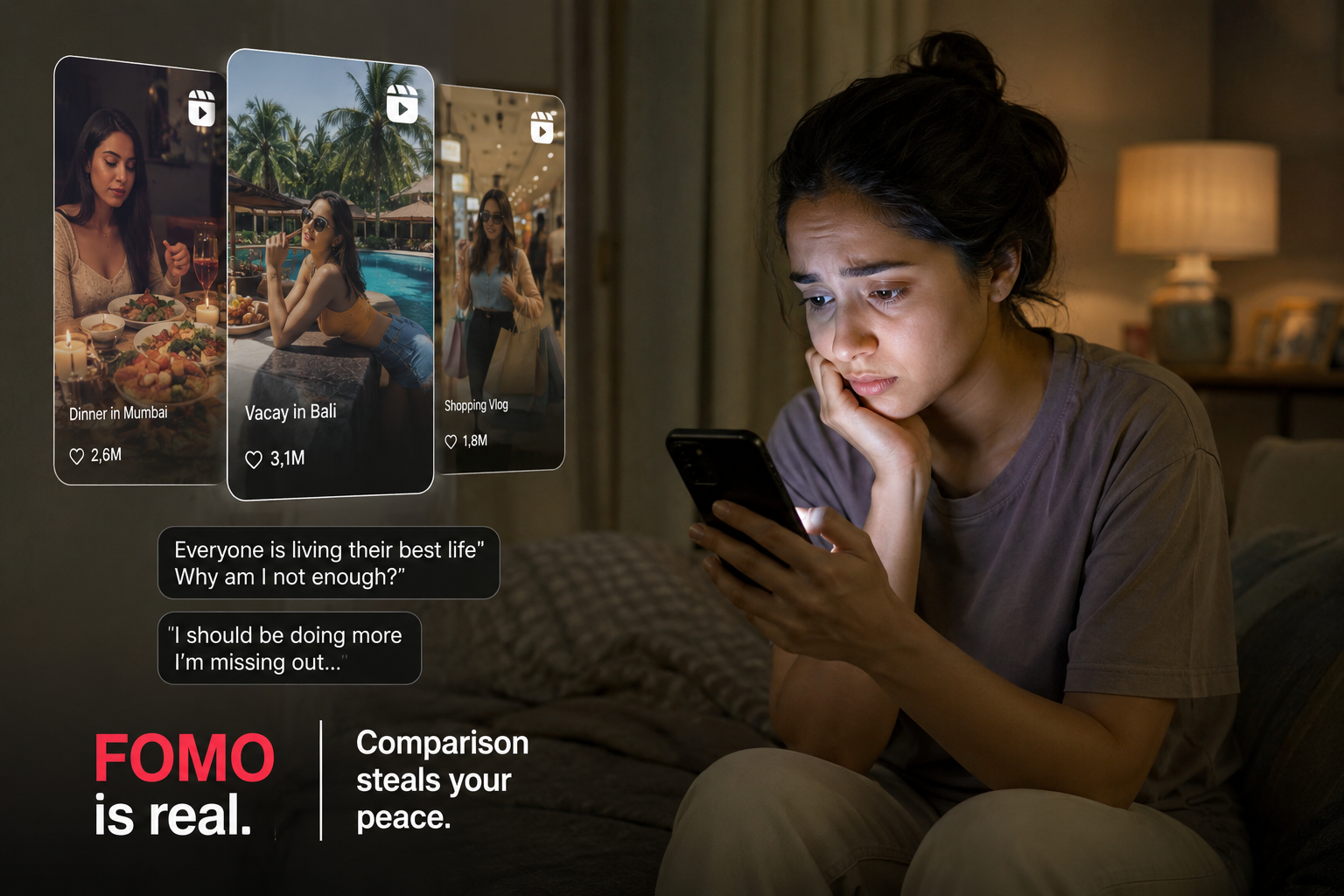
FOMO and comparison anxiety from Instagram Reels are two of the most common — and least talked about — sources of everyday stress today. You open the app for “just two minutes.” Forty-five minutes later, you put your phone down feeling restless, a little empty, and strangely dissatisfied with your own life. Your friend’s Goa trip, a colleague’s promotion post, a stranger’s perfectly lit apartment tour — none of it was about you, yet somehow it left you comparing your behind-the-scenes to everyone else’s highlight reel.
If this feels familiar, you’re not alone. This pattern is especially common among young professionals and students in cities like Delhi navigating fast-paced, hyper-connected lives.
In this article, we’ll unpack what’s actually happening in your mind when Reels trigger this anxiety, why it’s more common than you think, and practical, judgment-free ways to manage it.
What Exactly Is FOMO and Comparison Anxiety from Instagram Reels?
FOMO and comparison anxiety from Instagram Reels work together, but they’re slightly different experiences. FOMO is the uneasy feeling that other people are having more rewarding experiences than you — and that you’re missing out on them. Comparison anxiety goes a step further: it’s the discomfort or self-doubt that arises when you measure your own life, body, career, or relationships against carefully curated snapshots of someone else’s.
Instagram Reels are almost engineered to trigger both. The short, fast-paced, algorithm-driven format shows you an endless stream of:
Vacations, parties, and “perfect” weekends
Career wins, promotions, and financial milestones
Idealized bodies, skin, and fitness transformations
Picture-perfect relationships and family moments
What you rarely see is the effort, editing, financial stress, retakes, or personal struggles behind these clips. Your brain, however, doesn’t always make that distinction — it reacts to what it sees as if it were the full, unfiltered truth.
FOMO-and-comparison-anxiety-from-Instagram-Reels
Why Reels Specifically Feel Harder Than Other Social Media
Not all social media feels the same, and Reels are a big reason why FOMO and comparison anxiety from Instagram Reels can feel more intense than what you experience on other platforms:
1. Rapid-fire content delivery Unlike a slow-scrolling feed, Reels serve one high-stimulation clip after another. This constant novelty keeps your brain in a heightened, reactive state, leaving little time to process or contextualize what you’re seeing.
2. Algorithmic amplification The algorithm learns what keeps you watching — often content that triggers strong emotional reactions, including envy or inadequacy — and shows you more of it.
3. Passive, one-way consumption You’re watching, not necessarily interacting. This passive scrolling has been linked to lower mood compared to active engagement, like messaging friends directly.
4. Blurring of “real” and “curated” Reels often feel more spontaneous and authentic than posed photos, which paradoxically makes the comparison feel more real and personal.
Signs You Might Be Experiencing FOMO and Comparison Anxiety from Instagram Reels
This kind of anxiety doesn’t always look dramatic. It often shows up in quiet, everyday ways:
Feeling anxious, low, or irritable after scrolling, without an obvious reason
Repeatedly checking to see what others are doing when you’re alone or bored
Feeling like your life, body, or achievements are “not enough” after watching Reels
Difficulty being fully present at your own gatherings because you’re thinking about other events
Sleep disruption from late-night scrolling “just to see what’s new”
A dip in self-esteem that seems to track with how much time you spent online that day
If several of these sound familiar, it doesn’t mean something is “wrong” with you — it means your mind is responding, quite normally, to a very unnatural amount of curated comparison.
Why This Matters More Than We Often Admit
It’s easy to dismiss FOMO and comparison anxiety from Instagram Reels as “just social media” or something to laugh off. But research and clinical observation increasingly point to a real link between heavy, passive social media consumption and increased feelings of anxiety, low self-worth, and dissatisfaction with one’s own life — particularly among people already prone to comparing themselves to others.
Left unaddressed, chronic comparison anxiety can quietly erode confidence, strain relationships, and make it harder to feel content with genuine, meaningful progress in your own life.
“In my practice, I see this almost every week — clients who can’t quite explain why they feel low or restless, until we trace it back to an hour of scrolling Reels the night before. The mind isn’t built to process hundreds of curated ‘best moments’ from other people’s lives in a single sitting, and it responds the way it would to any repeated stressor — with anxiety, irritability, or a dip in self-worth.” — Dr. Sugandha Gupta
[Psychologist, Delhi Mind Clinic]
7 Practical Ways to Manage FOMO and Comparison Anxiety from Instagram Reels
You don’t need to delete your accounts or swear off Reels forever to manage FOMO and comparison anxiety from Instagram Reels. Small, sustainable shifts tend to work far better than extreme ones.
1. Notice the Pattern Before You Judge It
Before reaching for solutions, simply notice: What time of day do you scroll most? What mood are you in right before and after? Awareness alone reduces the automatic, unconscious nature of the habit.
2. Curate Your Feed Intentionally
Unfollow or mute accounts that consistently leave you feeling worse about yourself, even if you “should” like them. Follow accounts that inform, inspire practically, or make you genuinely laugh.
3. Set Boundaries Around Passive Scrolling
Try designating specific times for social media rather than scrolling reactively whenever you feel bored or anxious. Even simple steps like turning off auto-play or setting app time limits can interrupt the automatic scroll cycle.
4. Practice the “Behind the Clip” Reframe
When you catch yourself comparing, gently remind yourself: this is one curated 15-second moment, not a full life. Ask: “What effort, editing, or context might be missing here?”
5. Reconnect with Offline Sources of Self-Worth
Comparison anxiety thrives when our sense of value depends on external validation. Spend time on activities — hobbies, relationships, skills — where your worth isn’t measured in likes or views.
6. Talk About It
Comparison anxiety can feel embarrassing to admit, but it’s incredibly common. Talking to a friend, family member, or a mental health professional about these feelings often reduces their intensity almost immediately.
7. Practice a Nightly Digital Wind-Down
Avoid scrolling Reels in the last 30–60 minutes before bed. Late-night comparison scrolling is especially likely to affect sleep quality and next-day mood, so replacing it with reading, journaling, or simply talking to someone can make a noticeable difference over time.
“What’s changed in recent years is the speed of exposure. A generation ago, you might compare yourself to a handful of neighbours or classmates. Today, a teenager or young professional can be exposed to hundreds of ‘better’ lives before breakfast. It’s not a character flaw or a lack of gratitude — it’s a completely understandable response to an environment the human brain was never designed for. The good news is that with awareness and small, consistent changes, most people find real relief fairly quickly.” —Dr. Paramjeet Singh
When to Consider Professional Support for FOMO and Comparison Anxiety from Instagram Reels
Occasional FOMO is a normal part of modern life. However, if you notice that comparison anxiety is:
Persisting for weeks or months
Affecting your sleep, appetite, or concentration
Making you withdraw from real-life relationships or activities
Linked to ongoing low mood, excessive self-criticism, or anxiety in other areas of life
…it may be worth speaking with a mental health professional. A qualified psychologist or counsellor can help you understand the underlying patterns driving the anxiety and build coping strategies tailored to you — not just generic advice, but an approach that fits your specific life and mind.
Final Thoughts on FOMO and Comparison Anxiety from Instagram Reels
Instagram Reels aren’t going anywhere, and neither is the occasional pang of “everyone else seems to be doing better than me.” But that feeling doesn’t have to run your day — or your self-esteem. By understanding why FOMO and comparison anxiety from Instagram Reels happen, and making small, intentional changes to how you engage with social media, you can enjoy scrolling without letting it quietly chip away at how you feel about your own life.
If comparison anxiety or FOMO has been affecting your mood, sleep, or confidence for a while now, know that support is available, and reaching out is a sign of self-awareness, not weakness.
Frequently Asked Questions
Is FOMO and comparison anxiety from Instagram Reels a mental health condition? FOMO itself isn’t a clinical diagnosis, but persistent FOMO and comparison anxiety from Instagram Reels can contribute to or worsen anxiety and low mood, especially in people already vulnerable to these patterns.
Why do Reels feel worse than regular Instagram posts? Reels are fast, algorithm-driven, and consumed passively, which tends to intensify FOMO and comparison anxiety from Instagram Reels compared to slower, more deliberate feed browsing.
Can reducing screen time alone fix comparison anxiety? Reducing screen time helps, but lasting change usually comes from combining mindful usage habits with building self-worth from offline sources and, when needed, professional support.
When should I see a therapist for FOMO and comparison anxiety from Instagram Reels? If the anxiety persists for weeks, disrupts daily functioning, or is accompanied by low mood or withdrawal from real-life activities, it’s a good time to consult a mental health professional.